On an autumn riverbank, boat trackers strain on a rope to haul a laden cargo boat, the leader calling out with hand cupped to his mouth. Above, farmers harvest terraced fields as a woman and a man call across the slopes.
Music centred on the singing voice: the Book of Songs, yuefu, qin songs and ci tunes; regional folk songs such as work chants, mountain songs, ditties, hua'er, long songs and the Kam grand songs; and the art songs of the twentieth century, recording work, love and local life.
1926 · ImpactA Tsinghua University page records that Liu Bannong wrote How Can I Not Think of Her in 1920 and that Yuen Ren Chao set it to music in 1926.
The Treatise on Literature in the Book of Han quotes the Book of Documents, "poetry gives voice to intent", and separates poem from song: to recite its words is a poem, to chant its sounds is a song. The treatise also says: "In antiquity there was an office for gathering poems, by which kings observed customs, learned gains and losses, and corrected themselves." The Records of the Grand Historian says that of the three hundred and five poems in the Poems, Confucius "sang them all to strings, seeking to match the sounds of the Shao, the Wu, the Ya and the Song". In this account, all three hundred and five poems of the Classic of Poetry could be sung to strings.
Summoning the Soul in the Songs of Chu already speaks of "the songs of Wu and the singing of Cai". Its authorship is given two ways: Wang Yi's preface says "Summoning the Soul was made by Song Yu", while an article on the Chinese Social Sciences Network gives it to Qu Yuan. Of the Nine Songs in the Songs of Chu, Wang Yi's commentary says they are linked to the songs sung to the gods in Chu: between the Yuan and Xiang rivers “the custom was to believe in spirits and delight in sacrifices”, and at a sacrifice they “always made song, music, drumming and dance to please the gods”; Qu Yuan saw the songs and dances of these common sacrifices, found “their words crude”, and so composed the Nine Songs. Under Emperor Wu of Han, the Treatise on Rites and Music in the Book of Han records that "the Music Bureau was then set up, poems were gathered and chanted at night, and there were songs of Zhao, Dai, Qin and Chu". The Treatise on Literature says these were "all moved by grief and joy and arising from events, and by them one can observe customs and learn how thick or thin they are"; it lists twenty-eight groups of songs, three hundred and fourteen pieces, among them "fifteen pieces of songs from Wu, Chu and Runan; nine pieces of songs from Yan, Dai, Yanmen, Yunzhong and Longxi". The Music Bureau had its opponents: when Emperor Ai took the throne he cited Confucius, "banish the sounds of Zheng, for they are licentious", and decreed "abolish the office of the Music Bureau". Mulberry on the Path is included in the Collection of Yuefu Poems, and Cui Bao's Notes on Past and Present says it "came from the Qin family's daughter"; Going to War at Fifteen opens with "At fifteen he went to war; at eighty he first came home".
In the Song, Guo Maoqian compiled the Collection of Yuefu Poems and sorted them by kind. The book quotes the Treatise on Music in the Book of Jin: "The songs and miscellaneous tunes of Wu all came from south of the river", and "at first all were sung without accompaniment, and later set to pipes and strings". Under Midnight Song it quotes the Treatise on Music in the Book of Tang: "In Jin there was a girl named Ziye who made this melody." The western tunes "came from between Jing, Ying, Fan and Deng, and their rhythm and refrains also differ from the songs of Wu". Songs of the south entered the northern courts too: the Later Wei took the performers of the south, and among them "the songs of Wu south of the river and the western tunes of Jing and Chu were together called Qingshang music". Of the Chile Song the book says it was "originally in the Xianbei language, turned into the speech of Qi, so its lines are of unequal length"; under the Ballad of Mulan it quotes the Record of Past and Present Music, which says "Mulan's name is not known". Songs were gathered, altered and set to pipes and strings; they were not simply passed on as they were.
In the Tang people sang poems. The Collection of Yuefu Poems says that Wang Wei's Seeing Off Yuan the Second on a Mission to Anxi was "originally a poem seeing someone off to Anxi, and afterwards was set to song", under the title Weicheng, also called Yangguan, and it quotes Bai Juyi's line "I hear them sing the fourth line of Yangguan". Su Shi said: "The Three Refrains of Yangguan, as handed down, but singers today only repeat each line twice." The name Three Refrains of Yangguan thus stayed in the mouths of singers. In the Song, tunes survived through notation: the summary in the Complete Library of the Four Treasuries says Jiang Kui "was especially good at composing his own new melodies", and sighs that "the Song tune scores can no longer be seen and nobody can sing them"; what remains is the beat he marked beside the words, "the one thread left of the method of singing lyrics".
In the Ming, Feng Menglong compiled Hanging Branch Tunes and Mountain Songs. In his Preface to Mountain Songs he writes: "Since the Songs of Chu and the regulated verse of the Tang vied in splendour, the voice of the people's feelings has not been allowed a place in the poets' circle." He also says: "There are false poems and essays, but no false mountain songs", and cites "Sangjian and Puyang, which the Airs of the States rebuked and which Confucius recorded, because the feeling was true and could not be thrown away". He pleads for the people's songs by the old precedent of the Classic of Poetry.
The art song of the twentieth century was another road. A Tsinghua University page says that in 1920 Liu Bannong "wrote down" the poem How Can I Not Think of Her, and that in 1926 Yuen Ren Chao set it to music, so that it was widely sung. An article by the Shanghai Federation of Literary and Art Circles on The Paper records that He Luting studied harmony with Huang Zi, who had returned from study in America, and that He Luting's The Cowherd's Flute won a prize; the article calls Huang Zi "the earliest scholar to bring the Western system of music into China". In the same century folk songs came to be treated as cultural heritage: the Chinese Social Sciences Network records that the Wu songs were approved by the State Council in 2006 for the first national list of intangible cultural heritage; UNESCO's pages record that the Mongolian long song was proclaimed in 2005 and listed in 2008, and that the Grand Song of the Dong and Hua'er were listed in 2009.
It is joined to other canons. With Confucian Classics: the Poems are one of the five classics and also the words Confucius sang to strings. With Chu Poetry & Li Sao: Summoning the Soul speaks of "the songs of Wu and the singing of Cai", and so the names of southern songs are left in the Songs of Chu. With Song Lyric Rhythm: ci lyrics were sung to music, and Jiang Kui's own tunes with their marginal notation give today's reader a thread to how the Song sang. With Record of Music: the Record of Music says "the sounds of Zheng and Wei are the music of a disordered age", and the decree that abolished the Music Bureau again cites "banish the sounds of Zheng", so that songs were weighed between refined and common from the start.
The Poems were all "sung to strings", the Music Bureau "gathered poems and chanted them at night", the Collection of Yuefu Poems took in the songs of Wu and the western tunes, Feng Menglong defended mountain songs as "true in feeling and not to be thrown away", and from Yuen Ren Chao's setting to the listing of the Grand Song of the Dong and Hua'er, the poem sung by the voice has kept being gathered and rewritten, and kept finding someone to speak for it. This line shows that Chinese song does not live only in books: it was first the sound of the people, and then court, scholars and learned men took it up, generation after generation.
Chinese song is music centred on the singing voice. Its source is the Book of Songs, all 305 pieces of which were sung. After it came Han yuefu, the Wu songs and Western songs of the Southern Dynasties, the qin songs and ci tunes of the Tang and Song, and the folk songs passed down for generations in fields, mountains and on rivers: work chants, mountain songs, ditties, hua'er, long songs and the Kam grand songs. In the twentieth century poets and composers together wrote art songs. Song ties poetry, dialect and melody together and stays close to daily life.
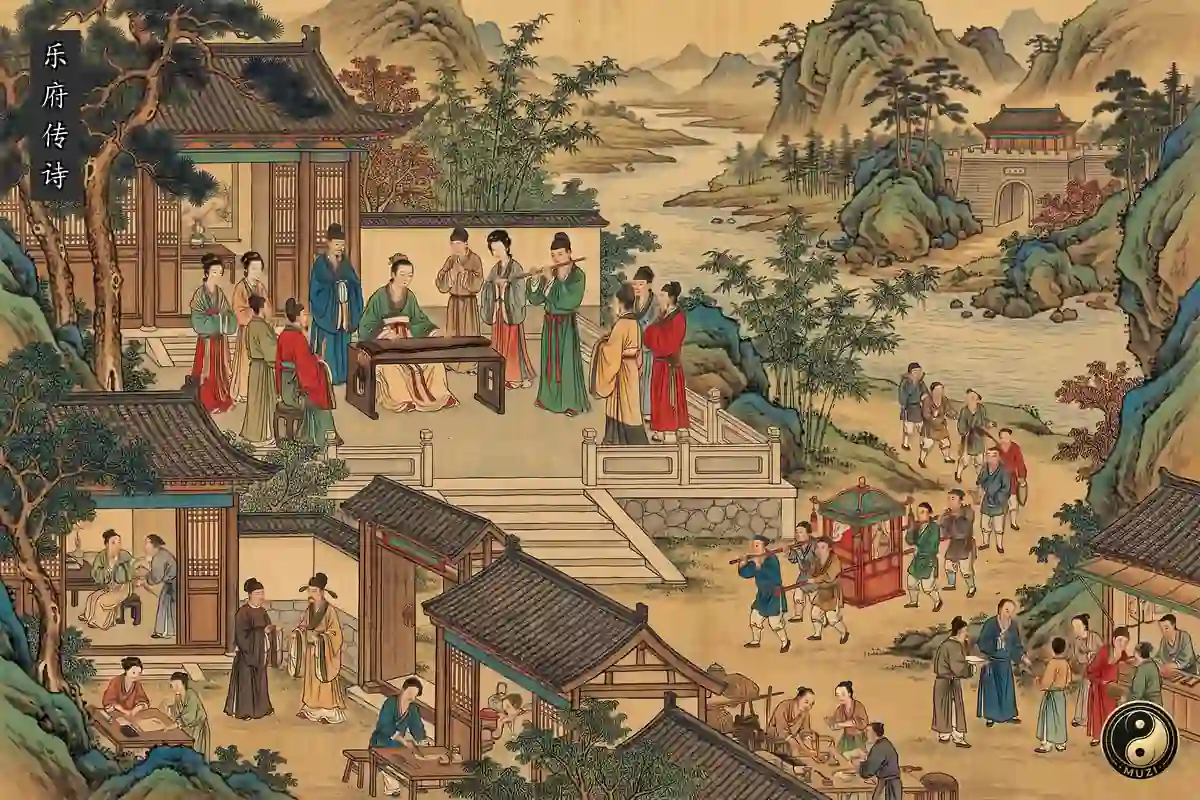
The qin player and surrounding singers on the central terrace form the core scene of teaching and performing music-poetry.
Sedan Procession
The sedan chair and welcoming group at right center extend the scene into travel and ceremony linked with yuefu culture.
Lower-Left Consultation
The seated figures talking in and around the lower-left room suggest recording and discussing collected songs.
Street-Corner Gathering
The small groups talking around the lower-right stalls show how songs circulate through everyday urban spaces.
In the Music Bureau office, officials teach from songbooks while folk singers perform and a scribe transcribes the lyrics onto bamboo slips, collecting poetry from the people for the imperial repertoire. An imperial auditory registry collecting folk songs to break noble cultural monopolies.
Song is like a wind blowing across the fields: the Airs of the States in the Book of Songs are a gust that rose early, yuefu and ci tunes are the sound of the wind that followed, and the folk songs of every region are the fields it passes over. Wherever the wind blows it picks up the smell of the soil and the local accent.
People may not remember where the wind rose, or who wrote a song, but they remember the tune and keep singing it, generation after generation.
An old boatman lived by the Yellow River. As a young man he had hauled boats upstream, singing work chants all the way. His grandson studied music in the city and came home one day with a tape recorder.
"Grandpa, sing me a chant and I'll record it."
The old man waved him off. "A chant isn't sung by one person. One leads and everyone answers; that's how the rope gets pulled together."
So the grandson invited several old men from the village. The boatman gave the first call, the others answered line by line, and the voices grew louder and louder. When they finished, one of them wiped his eyes and said he hadn't sung like that in years.
Back in the city, the grandson played the recording for his teacher. The teacher said, "Many of the Airs of the States in the Book of Songs were regional folk songs, sung just like this. Later someone wrote them down, and that is how they reached us."
Many Chinese songs have their roots among ordinary people. From the Airs of the States and Han yuefu to Ming-Qing folk-song collections and today's recordings, each generation has sung its work, love and longing, and others have collected and written the songs down. A song belongs both to those who sing it and to those who record it. (This is an illustrative story, not a historical account.)





 Sung Shijing and Chu VersePre-Qin song: the Shijing as sung music and the songs of Chu, still heard in the Hejian singing of the Odes
 Work Chants (Haozi)Call-and-response songs of boatmen, fishermen, dockers, carriers and rammers at work
 Yuefu SongsThe xianghe songs, qingshang music and horn-and-drum songs sung by the Music Bureau tradition from Han to early Tang
 Tang–Song Sung LyricsTang poems and Song ci sung to the tunes of banquet music
 Mountain Songs (Shan'ge)Han songs sung out loud in hills, fields and on the water: xintianyou, Hakka mountain songs, Wu songs and fishermen's songs
 Songs of Tibet and the Northwest PeoplesTibetan mountain songs, layi and drinking songs, the folk songs of Xinjiang's peoples, and the Uyghur muqam
 Songs of the Southern PeoplesHill songs, love songs and antiphonal singing of the Miao, Zhuang, Yi, Yao, She, Bai and other southern peoples
 Qin Songs and ChantingSongs sung to one's own qin, with the chanting of classical verse
 Mongolian and Northern Peoples' SongsMongolian long song and khoomei, with the songs of the Oroqen, Daur, Hezhen and other northern peoples
 Ditties and Popular Tunes (Xiaodiao)Town and village ditties and the Ming–Qing popular tunes, from Guazhi'er to Jasmine Flower
 Hua'erMountain songs sung in local Chinese dialects by many peoples of the northwest, and their song festivals
 Grand Song of the DongDong multi-part choral singing without leader or accompaniment, with the other multi-part folk songs
 Chinese Art SongFrom school songs to piano-accompanied settings of poetry
 Canon
 Literature
 Song of the Chile Plains
 Classic of Poetry
 Songs of Chu
 Seeing Off Yuan the Second on a Mission to Anxi
 Book of Documents
 Complete Library of the Four Treasuries
 Sent to War at Fifteen
 Summoning the Soul
 Mulberries by the Path · Soft and Swaying Boughs
 People
 Su Shi (Su Dongpo)
 Jiang Kui
 Feng Menglong
 Qu Yuan
 Song Yu
 Emperor Wu of Han (Liu Che)
 Wang Wei
 Bai Juyi
 Wei Shou
 Zhao Yuanren
 Stage
 Three Refrains at Yang Pass
 The Cowherd's Flute
 How Can I Help Thinking of Her
 Midnight Songs
 History
 Wang Zhaojun's Journey Beyond the Passes
 Noble Clans Flee South
 Sui Reunification
 Reign of Kaiyuan
 Qing Three Gorges Boat Trackers
 Zhuo Wenjun Elopement with Sima Xiangru
 Atlas
 Beijing
 Tianjin
 Inner Mongolia
 Jilin
 Shanghai
 Henan
 Chongqing
 Sichuan
 Tibet
 Gansu
 Qinghai
 Ningxia
 Xinjiang
 Hohhot
 Tongliao
 Ordos City
 Hulunbuir
 Xilingol League
 Yanbian
 Qiqihar
 Yichun
 Daxing'anling Prefecture
 Wuxi
 Changzhou
 Suzhou
 Lianyungang
 Yangzhou
 Huzhou
 Huangshan
 Chuzhou
 Ningde
 Zibo
 Rizhao
 Yichang
 Yueyang
 Meizhou
 Shanwei
 Zhongshan
 Nanning
 Liuzhou
 Sanya
 Danzhou
 Bazhong
 Ngawa
 Garzê
 Qiandongnan
 Honghe
 Nyingchi
 Shannan
 Nagqu
 Xi'an
 Yan'an
 Yulin
 Linxia
 Gannan
 Xining
 Hainan
 Yushu
 Haixi
 Hami
 Changji
 Bayingolin
 Ili
 Altay Prefecture
 Yangpu
 Pudong
 Qingpu
 Chongming
 Qianjiang
 Liangping
 Wushan
 Shizhu
 Xiushan
 Chang Li County
 He Jian City
 Zuo Quan County
 He Qu County
 Ke Er Qin Zuo Yi Zhong Banner
 Zhun Ge Er Banner
 Hang Jin Banner
 Mo Li Da Wa Da Wo Er Zu Zi Zhi Banner
 E Lun Chun Zi Zhi Banner
 E Wen Ke Zu Zi Zhi Banner
 Xin Ba Er Hu Zuo Banner
 Wu La Te Qian Banner
 Xi Lin Hao Te City
 Xi Wu Zhu Mu Qin Banner
 A La Shan Zuo Banner
 Zhang Hai County
 Fu Xin Meng Gu Zu Autonomous County
 Qian Guo Er Luo Si Meng Gu Zu Autonomous County
 Rao He County
 Hai Men District
 Gao You City
 Xing Hua City
 Xiang Shan County
 Jia Shan County
 Dai Shan County
 Wu He County
 Tong Cheng City
 Feng Yang County
 Chai Sang District
 Xing Guo County
 Po Yang County
 Zi Chuan District
 Peng Lai District
 Tan Cheng County
 Lao He Kou City
 Li Chuan City
 Li County
 Jia He County
 Chen Xi County
 Jing Zhou Miao Zu Dong Zu Autonomous County
 Ji Shou City
 Bao Jing County
 Lei Zhou City
 Ma Shan County
 San Jiang Dong Zu Autonomous County
 Na Po County
 Ping Guo City
 Fu Chuan Yao Zu Autonomous County
 Yi Zhou District
 Qiong Lai City
 Qing Chuan County
 Jiu Zhai Gou County
 Jiu Long County
 Lu Huo County
 Mian Ning County
 Li Ping County
 Rong Jiang County
 Cong Jiang County
 Lei Shan County
 Fu Ning County
 Mi Du County
 Jian Chuan County
 Ban Ge County
 Xun Yang City
 Zhang Jia Chuan Hui Zu Autonomous County
 Tian Zhu Zang Zu Autonomous County
 Gan Zhou District
 Su Nan Yu Gu Zu Autonomous County
 Min County
 Liang Dang County
 Kang Le County
 He Zheng County
 Da Tong Hui Zu Tu Zu Autonomous County
 Le Du District
 Min He Hui Zu Tu Zu Autonomous County
 Hu Zhu Tu Zu Autonomous County
 Xun Hua Sa La Zu Autonomous County
 Men Yuan Hui Zu Autonomous County
 Qi Lian County
 Shan Shan County
 Wen Quan County
 Yu Li County
 Ku Che City
 Sha Che County
 Mai Gai Ti County
 Ta Shen Ku Er Gan Ta Ji Ke Autonomous County
 Yi Ning City
 Cha Bu Cha Er Xi Bo Autonomous County
 He Bu Ke Sai Er Meng Gu Autonomous County
 Ledong Li Autonomous County
 Chuihong Broken Bridge