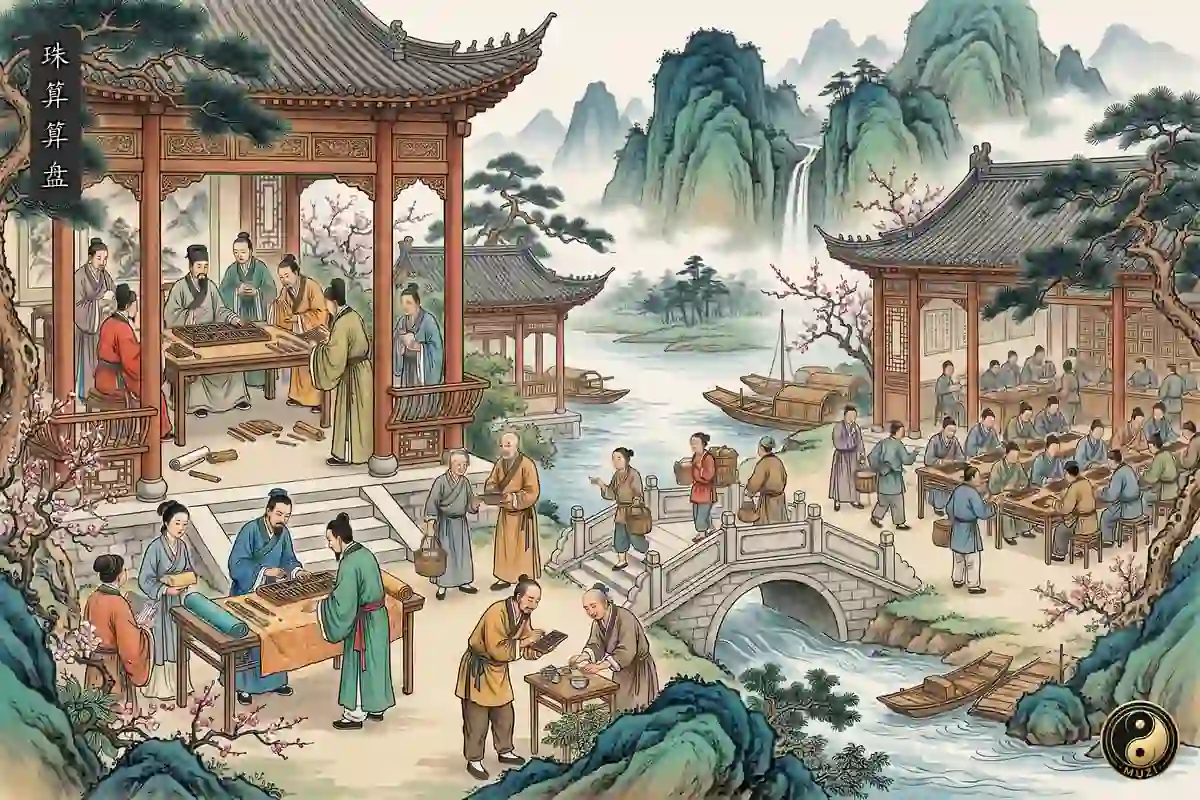
One has to ask first where the abacus comes from. Among the methods that Xu Yue lists in the Memoir on Some Traditions of Mathematical Art there is one marked "another is the bead calculation." An article by Niu Teng, Zhao Xiangyi and Tan Jing (reposted by the Chinese Social Sciences Net on 8 January 2024) reads the surviving evidence as showing the word "zhusuan" in this book, finished in 190, and says that Zhen Luan of the Northern Zhou annotated its line "bead calculation holds the four seasons and weaves the three powers": "Carve a board into three parts; the upper and lower parts hold free-moving beads, and the middle part fixes the place values. Each place has five beads; the upper one differs in colour from the lower four." The article admits that this device differs in form from the abacus of today and calls it the Han bead-calculation board.
Around the Song and Yuan the evidence grows, and grows scattered. The article says that abacus pictures begin to appear in Song paintings, and that in the Yuan records of bead calculation and the abacus multiply, but they appear in poems, paintings and plays, while mathematical books hardly mention them. Examples are Liu Yin's Abacus Poem, Wang Zhenpeng's painting Qiankun Yidan Tu, and the play Layman Pang Wrongly Lends Out the Next Life's Debt. In "Well Beads" in volume 29 of Tao Zongyi's Chuogenglu, he writes: "When servants are newly taken in, they are called 'grinding-bowl beads,' for they move without being pushed. After a while they are called 'abacus beads,' for they move when pushed. After longer still they are called 'Buddha's-crown beads,' for all day they stay still, and do not move even when pushed. Though this is a folk saying, it fits the facts." So by then the abacus bead was already a figure of speech. An article on China Daily's government channel says that the abacus in common use today developed between the Song and Yuan dynasties.
In the Ming the material becomes specific. The article lists the children's books Kuiben Duixiang Si-yan Zazi (1371) and Xinbian Duixiang Siyan (1436), which carry pictures of the abacus; the Lu Ban Jing of the later fifteenth century, which records the "abacus pattern" with "two beads above at one cun one fen, five below at three cun one fen"; Wu Jing's Complete Collection of Analogies on the Nine Chapters (1450), which carries rhymed rules for addition and subtraction on the abacus; and afterwards Xu Xinlu's revised Panzhu Suanfa (1573), Ke Shangqian's Shuxue Tonggui (1578), and Cheng Dawei's Suanfa Tongzong (1592). Mei Wending's Wuan Lisuan Shuji, for its part, reminds readers that Wu Xinmin's Jiuzhang Bilei "came before the Tongzong, and the Tongzong could not match it," and that Cheng had not seen Zhou Shuxue's book. The article says that among these "the reprints of Suanfa Tongzong and similar books spread most widely," though Cheng's book was written after the Panzhu Suanfa and Shuxue Tonggui.
It entered history as one tool displacing another. Niu Teng and colleagues write that Chinese mathematics rested for long on rod calculation, and that when bead calculation spread it gradually replaced it; that the written arithmetic and Napier's rods brought by missionaries in the late Ming and early Qing were used almost only by students of mathematics; that the Qing public still used the abacus; and that late Qing schools put it into the primary curriculum. The Siku abstract says of Fang Zhongtong's Shudu Yan that "its abacus section follows Cheng Dawei's Suanfa Tongzong"; the Draft History of Qing records that Li Rui "found the Suanfa Tongzong in his village school, grasped its meaning, and went on to study the Nine Chapters and the eight lines." The article adds that "read, write, use the abacus" became the basic skills of Japanese in the seventeenth century, and that books like the Suanfa Tongzong passed to Korea and Japan.
Its dealings with other canons run along several lines. Counting Rods & Decimals is what it displaced; Mei Wending writes "the Nine Studies are the Nine Chapters" and that "all that is left of Lishou's method is the titles of the Nine Chapters," and that of later authors "none went beyond its range"; he speaks of later mathematicians in general and does not mention the abacus, but the tie of the abacus to Nine Chapters shows in a title: Wu Jing's book with the rhymed rules for addition and subtraction on the abacus is called the Complete Collection of Analogies on the Nine Chapters; the Kuiben Duixiang Si-yan Zazi belongs with the primers described under Primary Education; the written arithmetic carried by missionaries belongs to Western Learning; and the building manual Lu Ban Jing, which records the abacus's size, is one corner of the craft tradition treated in the entry on Timber Building.
In 2013 UNESCO inscribed "Chinese Zhusuan" on the Representative List of the Intangible Cultural Heritage of Humanity. The description on the listing page says that the oral formulas are easy-to-learn rhymes representing specific calculation rules and summarizing the arithmetic operations, and that zhusuan has a wide influence in folk customs, language, literature, sculpture and architecture.
Two beads above, five below, and rhymed rules that are easy to remember: the Yuan used the abacus bead as a figure for newly taken-in servants; the Ming drew it in primers and wrote its measurements into a carpenter's book, and Cheng Dawei's Suanfa Tongzong was reprinted and carried to Korea and Japan; late Qing schools put the abacus into the primary timetable, and today it still stands on UNESCO's list. Where the abacus came from is still disputed, but its place among ordinary people and in schools can be shown in books.
Abacus Arithmetic is the class in the chapter on Sciences on reckoning with the abacus and its rhymed rules. The abacus, with two beads above the beam and five below, took its standard form around the Song-Yuan transition; Cheng Dawei's Systematic Treatise on Arithmetic in the Ming summed up the rhymed rules and methods, and abacus arithmetic spread across the country and east to Japan and Korea.
 Literature
 Draft History of Qing
 People
 Zhen Luan