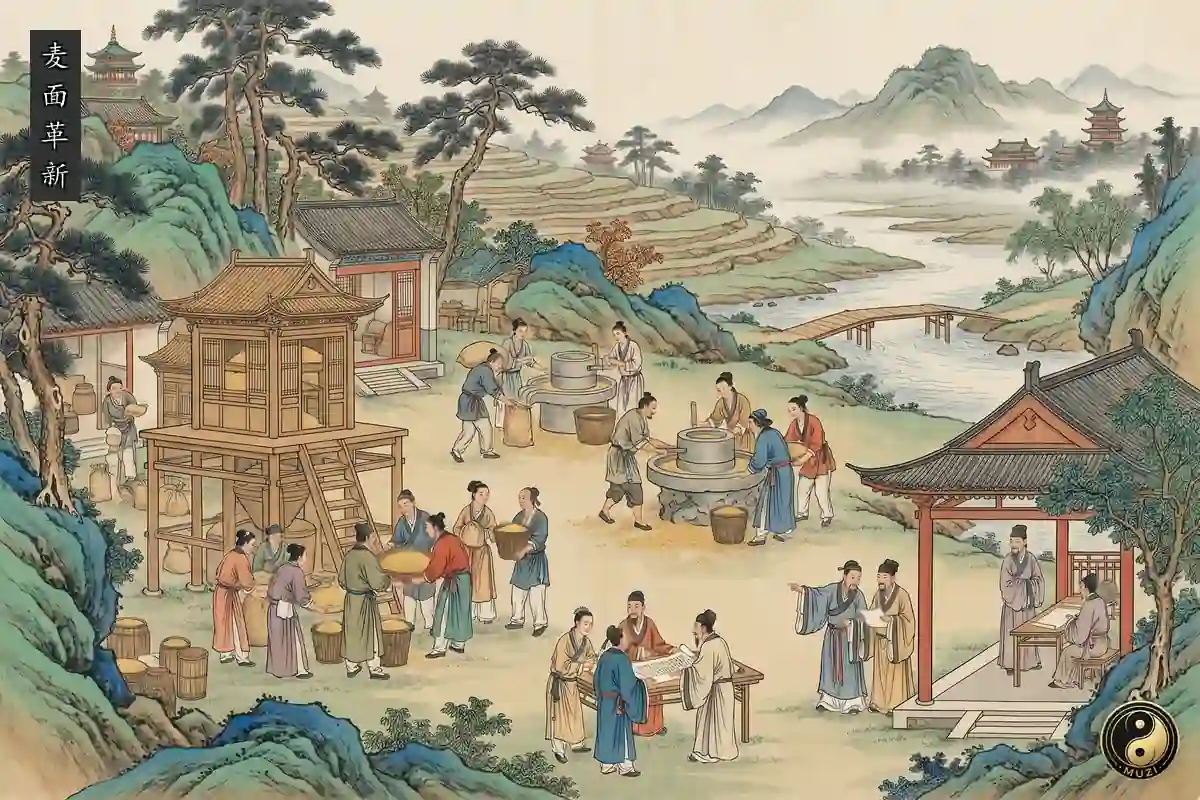
The spread of rotary stone mills during the Han dynasty enabled wheat to be ground into flour, providing a basis for making flour foods. An early account uses bing as a general term for flour foods, explaining the word through the joining of flour into dough. It lists names including zhengbing, tangbing, suibing, and suobing, saying that their names follow their forms without describing each shape. Older recipes quoted in a Northern Wei account describe preparing a fermentation starter with sour liquid and japonica rice. For one shi of flour, the recipe calls for two sheng of starter in the sixth month and four in winter, varying the amount with the season. The same account describes shaobing made with flour, lamb, scallion whites, fermented black bean liquid, and salt. Suibing combines flour with marrow fat and honey and is baked in a hubing oven. In Song-dynasty Bianjing, oil-cake shops sold zhengbing and sugar cakes, while hubing shops sold suibing. These names occur in accounts of urban shops, but a shared name does not establish that preparation remained the same across periods.
Descriptions of excavated dumplings and wontons require a distinction between shape and ingredients. In 1978, three dumpling-shaped foods were excavated from a late Spring and Autumn period aristocratic tomb at the ancient city of Xue in Shandong, held in a bronze fu vessel. “Dumpling-shaped” describes their appearance; the flour is not confirmed. In the fall of 1959, three dough dumplings, five centimeters long, were excavated from a Tang-dynasty tomb at Astana in Turpan, Xinjiang. That record likewise does not state the flour. A separate transmitted account reports several wheat-flour wontons excavated from Tang tombs at Astana. During the Song and Yuan dynasties, dumplings were often called jiao'er or jiaozi; Ming accounts also use shui dianxin and bianshi. Among dumplings, filled buns, wontons, and steamed buns, a food could have several names, and a name could refer to several foods. Early names therefore cannot be matched directly to present-day foods.
Identifying foods shaped into strips or sheets also requires descriptions of preparation. Accounts of tangbing and suobing leave their shapes unspecified, and an account of zhubing does not say whether it was made into strips. These names cannot directly establish that the foods were noodles. For shuiyin, dough was worked into lengths, soaked, and then thinned over the pot to resemble garlic chive leaves. For botuo, short pieces were soaked and worked into thin sheets. Both were cooked in boiling water. Another preparation involved cutting square pieces resembling game counters, steaming them, spreading them out to cool, and storing them for later boiling. This cannot be equated directly with dried or instant noodles. In Song-dynasty Lin'an, noodle shops were also called fencha shops. Listed names include shredded chicken noodles, three-delicacy noodles, yanjian noodles, and silver-thread cold noodles. A Qing-dynasty description of eel noodles combines steamed, deboned eel flesh with dough, kneads it with chicken broth, and rolls it into a sheet before cutting fine strips. A separate description recommends replenishing noodles after a serving has been eaten and identifies this practice as prevalent in Yangzhou; it cannot be extended to other places. These records do not state the flour for each of the shuiyin, botuo, square pieces, listed Lin'an noodles, or eel noodles, so whether they are wheat-flour foods remains to be confirmed.



 Hand-Pulled NoodlesNoodles made by stretching a dough by hand, often folding it and stretching it again many times, into strands thick or fine.
 Cut and Shaved NoodlesNoodles and dough pieces shaved or taken straight off a dough, without rolling or pulling.
 Rolled and Cut NoodlesNoodles made by rolling a dough into a thin sheet and cutting it into strips.
 Extruded NoodlesNoodles made by pressing a dough through the holes of a press so that strands come out of them.
 Hung Dried NoodlesDried wheat noodles made by sheeting and cutting a dough and hanging the strands to dry so that they keep.
 Instant NoodlesFactory-made dried noodle products eaten after soaking in hot water or a short boil.
 Steamed Sheet NoodlesFoods made by steaming a rice batter, or a wheat batter with the gluten washed out, into a thin skin and cutting it into strips, usually dressed and eaten cold.
 Starch NoodlesStrand-shaped foods made from bean or tuber starch, mostly dried before sale and soaked before eating.
 Coarse-Grain NoodlesNoodles and similar foods whose main material is a coarse grain such as buckwheat, oat or maize.
 JiaoziFilled dough parcels cooked by boiling, steaming or pan-frying.
 WontonsThin dough wrappers enclose a filling and are served in soup.
 MantouPlain buns made from wheat dough and cooked by steaming.
 BaoziBuns made by enclosing a filling in dough and steaming them.
 Flower RollsSteamed breads shaped by rolling dough, including silver-thread rolls.
 ShaobingFlatbread often topped with sesame seeds and cooked by baking.
 Griddle FlatbreadDough is rolled into flat rounds and cooked on a griddle.
 GuokuiA thick baked flatbread associated with northwestern China.
 Nang FlatbreadA flatbread from Xinjiang made by shaping and baking dough.
 Spring PancakesThin pancakes used as food wraps at the beginning of spring.
 HuoshaoA baked flatbread that can be split and filled with meat.
 QiangbingA large leavened flatbread of Shanghai and Suzhou, made in an oily and a hard kind.
 RoujiamoA mo flatbread split and filled with meat.
 Spring RollsThin wrappers are rolled around a filling and cooked by frying.
 Canon
 Flavor