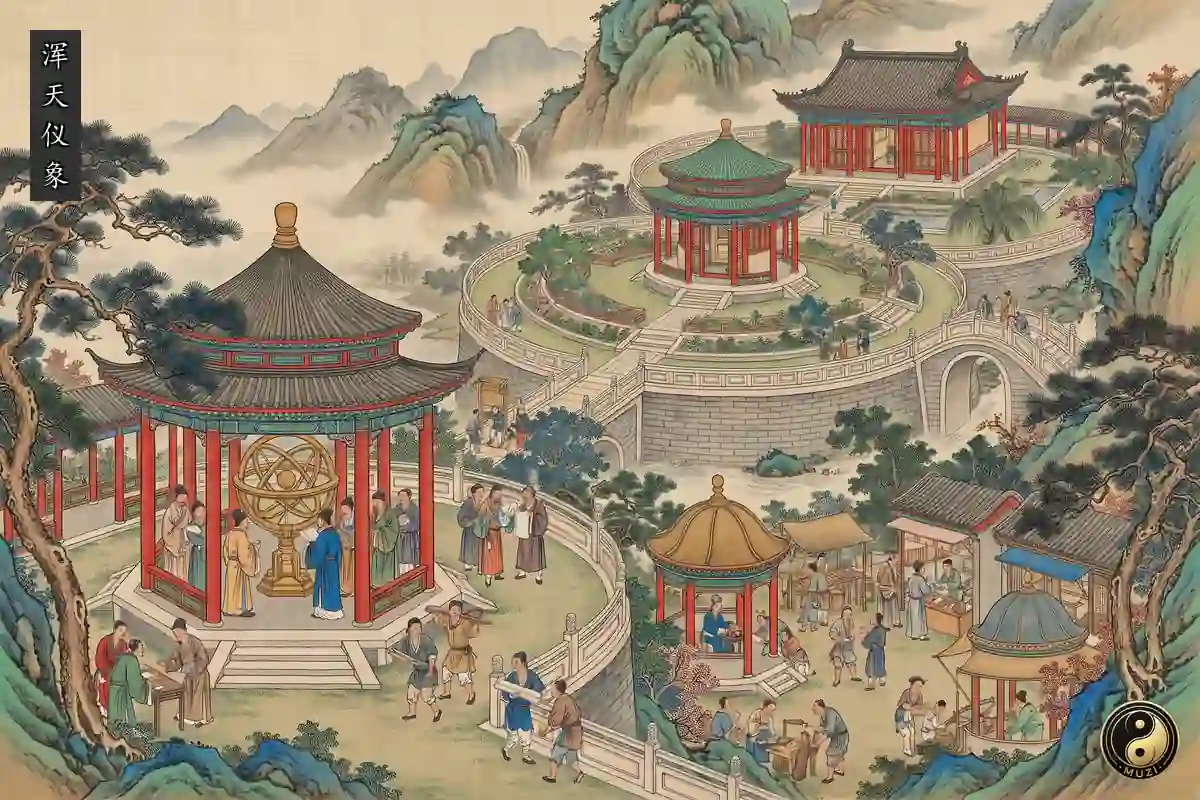
Armillary Spheres are a class of astronomical instruments that turned the order of the heavens into something that could be seen, measured and demonstrated. The armillary sphere fits together nested rings and axes; turned and aimed at a lodge, it gives a star's position and its degrees. The celestial globe marks the starry sky on a sphere, so that the heavens can move on the ground. These instruments are therefore not only bronze objects; they are material witnesses to the ties between the calendar, government offices, sacrifice, timekeeping and cosmology.
The tradition has three points. During the Western Han calendar reform, the Treatise on the Calendar in the Records of the Grand Historian records that "Luoxia Hong of Ba did the calculations and turned the calendar"; the Treatise on Pitch-pipes and the Calendar in the Book of Han records Emperor Wu's order "to make the seventh year the first year", that is, the first year of Taichu (104 BCE), and lists Luoxia Hong among those who made the Han Taichu calendar. Yang Xiong's Model Sayings, speaking of the sphere of the heavens, says: "Xia Hong constructed it, Xianyu Wangren measured it, and Vice Censor Geng gave it form," assigning its construction, measurement and form to three men. Zhang Heng of the Eastern Han served as Grand Astrologer; the Biography of Zhang Heng in the Book of the Later Han records that he "examined yin and yang", made an armillary sphere and wrote the Lingxian and the Suanwang lun, and the Treatise on Astronomy in the Book of Jin records that his instrument was "turned by clepsydra water in a closed chamber". In the Yuanyou era of the Northern Song, Su Song completed his water-driven astronomical clock tower; according to his biography in the History of Song, it had "the armillary sphere above, the celestial globe in the middle and the time-keepers below, all linked by one mechanism, the water driving the wheel without human effort". These three records show the tradition moving from calculation and measuring the stars to demonstrating them, and then joining that demonstration to public time.
Its effect on history lies first in how the state arranged its calendar and its order. The Treatise on the Calendar says that "when a king changes the ruling house and receives the mandate, he must take care over the beginning, change the first month of the year and change the colour of court dress", recalls how "the Southern Director Zhong was ordered to take charge of heaven and serve the spirits", and, in its story of how the ancient offices of heaven were set up and abandoned, writes of "disasters coming one after another" and "the reckoning of the calendar falling out of order"; the Book of Han lists Luoxia Hong among the makers of the calendar, and observation and calculation thus entered a calendar the court issued and the realm obeyed. The calendar governed sacrifice, farming and the hours of the court, and astronomical instruments therefore entered the government of the dynasty. Zhang Heng was at once Grand Astrologer, astronomer and author, which shows that measurement and calculation were carried by officials in an office. The Treatise on Astronomy in the Book of Jin placed the shape of the heavens, the instruments, the fixed stars and the twenty-eight lodges in one treatise, so that the instruments also became a way into the classified knowledge of the official histories. Cai Yong, as quoted in that treatise, held that among the theories of the heavens "only the sphere of the heavens comes close to the truth", and said that "the bronze instrument now used by the historians at the observation platform follows this method", which could "correct the ecliptic", "follow the sun and moon" and "trace the five planets"; the armillary sphere thus changed from a made object into a measure for checking the state's order of the heavens.
Its influence on culture goes beyond craft. The lodges were written into the calendar, into sacrifice and into poetry; the seasons entered the farmer's work and the arrangements of the household; and water clocks and time signals turned the cycles of the sky into hours that offices and cities kept in common. Su Song's clock tower set star measurement, display of the heavens and timekeeping side by side and changed the cultural image of "heaven": the sky could still be gazed up at, but it also became an order that craftsmen, officials, mathematicians and scholars could build, inspect and explain. Zhang Heng also left the Lingxian, so that instrument, calculation and cosmology shed light on one another; in Cai Yong's words, as quoted in the Book of Jin, the "sphere of the heavens" is both a theory of the heavens and the method the historians' bronze instrument followed. The three theories preserved in the Book of Jin, the canopy heaven, the infinite empty space and the sphere of the heavens, were not abstract labels, and the same sky thus held different traditions of explanation.
Armillary Spheres are linked with Shadow Measurement: the gnomon uses the sun's shadow to find direction, noon and the solar terms, the armillary sphere locates the lodges with its rings, and the two join measure on the ground with motion in the sky. They are linked with Water Clocks: the Book of Jin records that Zhang Heng's instrument was turned by clepsydra water, and Su Song combined water power, the heavens and timekeeping in one machine, so that flowing water became the driving force of public time. They are linked with Shoushi Calendar: observation affects social time only when it enters the calendar, and a calendar has grounds for correction only when it is checked against the sky again and again. And they are linked with Constellations & Totems: the star offices, the twenty-eight lodges and the images of the sacred animals give the heavens their names and stories, carrying the degrees on the rings into poetry, sacrifice and dynastic memory.
They are also linked with Yin-Yang & Five Elements, but the two must not be confused. The Book of the Later Han records that Zhang Heng examined yin and yang, and the Book of Jin preserves the three theories of the heavens; yin-yang and the Five Phases lean toward explaining the response between heaven and humankind, the seasons and portents, while the armillary sphere and the celestial globe provide forms for locating and demonstrating the heavens. The first asks what the heavens mean; the second asks where they are and how they move. Zhang Heng both made instruments and wrote the Lingxian, which shows that measurement, mathematics and cosmology could advance together in one official; this very closeness is why the line between the two has to be drawn.
From Luoxia Hong, who "did the calculations and turned the calendar" in the Taichu reform, to Zhang Heng, who made an armillary sphere and turned his instrument with clepsydra water, to Su Song's clock tower of the Yuanyou era with "the armillary sphere above, the celestial globe in the middle and the time-keepers below", Armillary Spheres brought the heavens down into the calendar, the offices of state, time-telling and everyday time. Their standing as a canon does not rest on any one instrument being right for ever, but on the fact that calendar makers and officials had to check the order of the heavens again and again between observation, record and explanation: Cai Yong's words, that the bronze instrument of the historians' platform could "correct the ecliptic", "follow the sun and moon" and "trace the five planets", name the measure that instrument after instrument was made to carry.
Armillary Spheres is the class in the chapter on Cosmos on the armillary sphere and the celestial globe: astronomical instruments that measured and showed the sky with linked rings and axes. Luoxia Hong of the Western Han made an armillary sphere to measure the positions of the lodges, Zhang Heng of the Eastern Han drove a celestial globe by water, and Su Song of the Northern Song built the water-driven tower that combined an armillary sphere, a celestial globe and a time-announcing device.
 Literature
 Book of the Later Han
 People
 Su Song
 Yang Xiong
 Zhang Heng
 Cai Yong
 Treasures