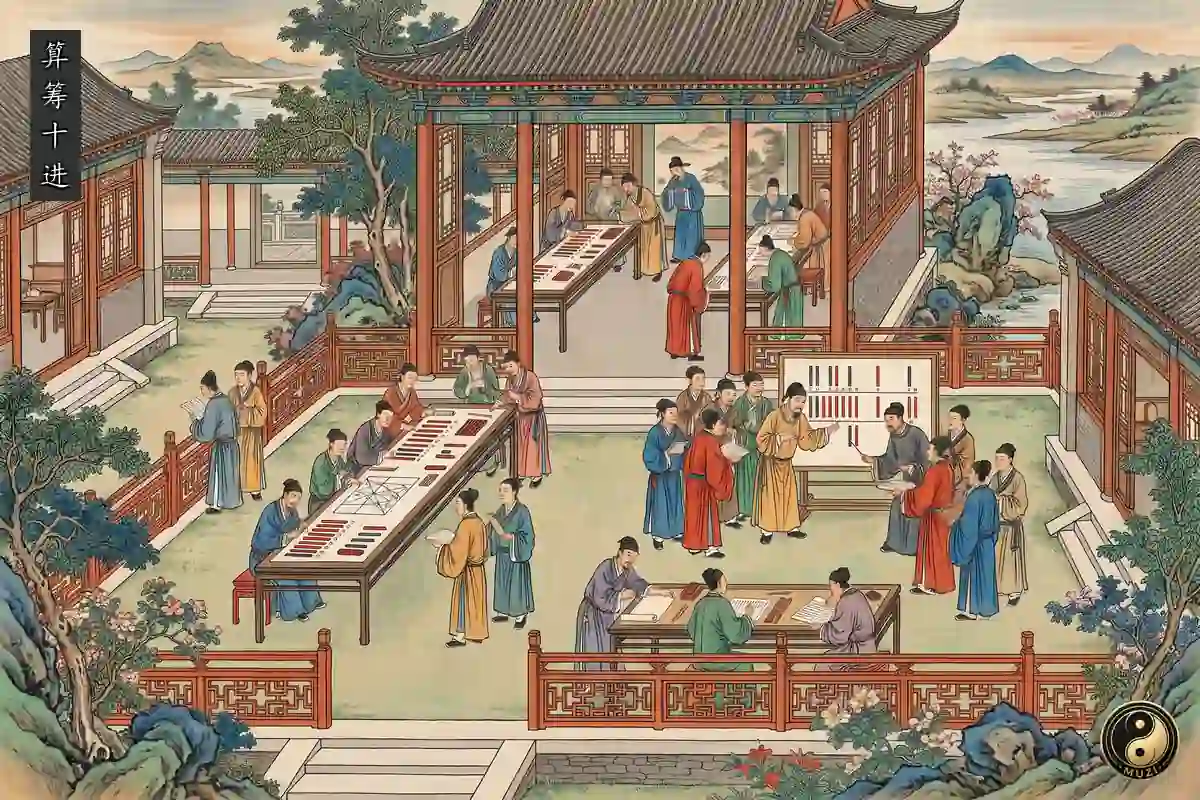
Counting rods are a calculating tool in which numbers are laid out and worked with small sticks. The Treatise on Pitch-Pipes and the Calendar in the Book of Han says: "Number means one, ten, a hundred, a thousand, ten thousand, and is how things are reckoned." It also gives the form: "Bamboo is used for reckoning, one fen across and six cun long, two hundred and seventy-one pieces making a six-sided bundle, one handful", and says that the matter "was the duty of the Grand Astrologer". A book titled Shushu jiyi, under "piled reckoning", differs a little: "The ordinary reckoning of today; made of bamboo, four cun long", so the books do not agree on the length. In 2023, Li Zhenfei, a doctoral student at Northwest University, said that the earliest bamboo counting rods were found in 1954 in a tomb in Changsha; early rods were mostly bamboo but also wood, metal and bone, came mostly from tombs between the late Warring States and the Eastern Han, and were generally 13 to 14 centimetres long.
Their use appears in the Master Sun's Mathematical Classic: "In the method of reckoning, first know the place: one is vertical, ten horizontal, a hundred stands, a thousand lies; thousand and ten face each other, ten thousand and a hundred correspond." The same digit, set in a different place, has a different value; this is place-value. Multiplication and division too depend on placing: "In the method of multiplying, set the places twice, one above the other." Zhu Yiwen of Sun Yat-sen University says that the most important achievement recorded in the Nine Chapters on the Mathematical Art is the counting-rod, quasi-decimal place-value notation. The working itself is in the text of the Nine Chapters: its positive-negative rule says: "Like names subtract, unlike names add; a positive with nothing to match enters as negative, a negative with nothing to match enters as positive", and the fangcheng (rectangular array) procedure lays out the rows and works them by "multiplying all across" and "subtracting straight". Sixty-one ivory rods unearthed at Shenheyuan in Xi'an were painted red and white or red and black; Liu Hui mentioned red rods as positive and black as negative, and Li Zhenfei takes this to show that the idea of positive and negative numbers existed in the late Warring States, but he also says that these rods were unlikely to have been used for mathematical calculation and were more likely counters for managing rewards and punishments.
Their place in institutions shows in later records. In the Tang the Directorate of Education had a school of mathematics, and the New Book of Tang's Treatise on Selection says "mathematics, thirty students" and "Sunzi and the Five Departments in one year, the Nine Chapters and the Sea Island in three years". The General Catalogue of the Four Treasuries, discussing the method of "establishing the celestial unknown", says that it appears in Qin Jiushao's Jiuzhang dayan shu and that Li Ye's Ceyuan haijing treats it uniquely fully, while after the Yuan mathematicians "clung to ready tables and did not examine them", and "by the Ming, no one knew the method". Counting rods were in use in China for about two thousand years and were replaced by the abacus in the sixteenth century; Fang Zhongtong's Shudu yan sets out abacus, pen, rod and ruler methods side by side, of which the abacus method "follows Cheng Dawei's Suanfa tongzong".
Excavated texts push the front of this line back and test older accounts. The Suan biao (Calculating Table) among the Warring States bamboo slips held by Tsinghua University is twenty-one slips forming a multiplication table that reaches ninety times ninety, eight thousand one hundred; it was formed around 305 BCE, and Zou Dahai and others of the Institute for the History of Natural Sciences, Chinese Academy of Sciences, call it the "big nine-nines". Hu Pingsheng says that the Zoumalou Wu-state slips from Changsha concern taxes and storage, that calculations on them had been thought to be by counting rods, "but when I tried laying out rods I made mistake upon mistake: it turns out those people already had a 'calculator'!" Guo Shuchun says that the table offers "corroboration" for the Spring and Autumn and Warring States periods as the first peak of traditional Chinese mathematics. A bamboo slip from a tomb in Jingzhou, Hubei, publicised in 2023, bears a multiplication rhyme, dated to the fourth century BCE.
Counting rods connect to several other canons. In the book treated in the entry on Nine Chapters, root extraction was done on the rods: Volume 4, Shao guang, gives methods for square and cube roots with counting rods. The abacus treated in the entry on Abacus Arithmetic is the tool that later took over from them. In the calendar treated in the entry on Shoushi Calendar, the Shoushi Cao (Calendar Draft) also uses the method of the celestial unknown, which the General Catalogue says "appears again and again". The arrival of Western learning treated in the entry on Western Learning allowed the celestial unknown, forgotten by the Ming, to be recognised again in the Qing by comparison with the method of borrowed roots.
A bamboo stick is not a number by itself; set in a place, it becomes one. The Book of Han records its size, Master Sun's Mathematical Classic sets the rule of "one vertical, ten horizontal", and the Nine Chapters extracts square and cube roots on the rods; Tang students of mathematics read Master Sun and the Nine Chapters, yet by the Ming no one could work the celestial unknown, and in the Qing it was recognised again by comparison with the borrowed roots. The Tsinghua Calculating Table is a reminder that the Warring States already had a multiplication table to look things up in; only in the sixteenth century did the abacus take over the place of the rods.
Counting Rods & Decimals is the class in the chapter on Sciences on calculating with counting rods in decimal place-value notation. The rods are slender bamboo sticks laid out on a table to record numbers and work sums; they replaced the earlier tally marks and laid the basis for more complex work such as root extraction and the tianyuan method, the method of the celestial element.
 Literature
 Book of Han
 People
 Li Ye
 Liu Hui
 Treasures