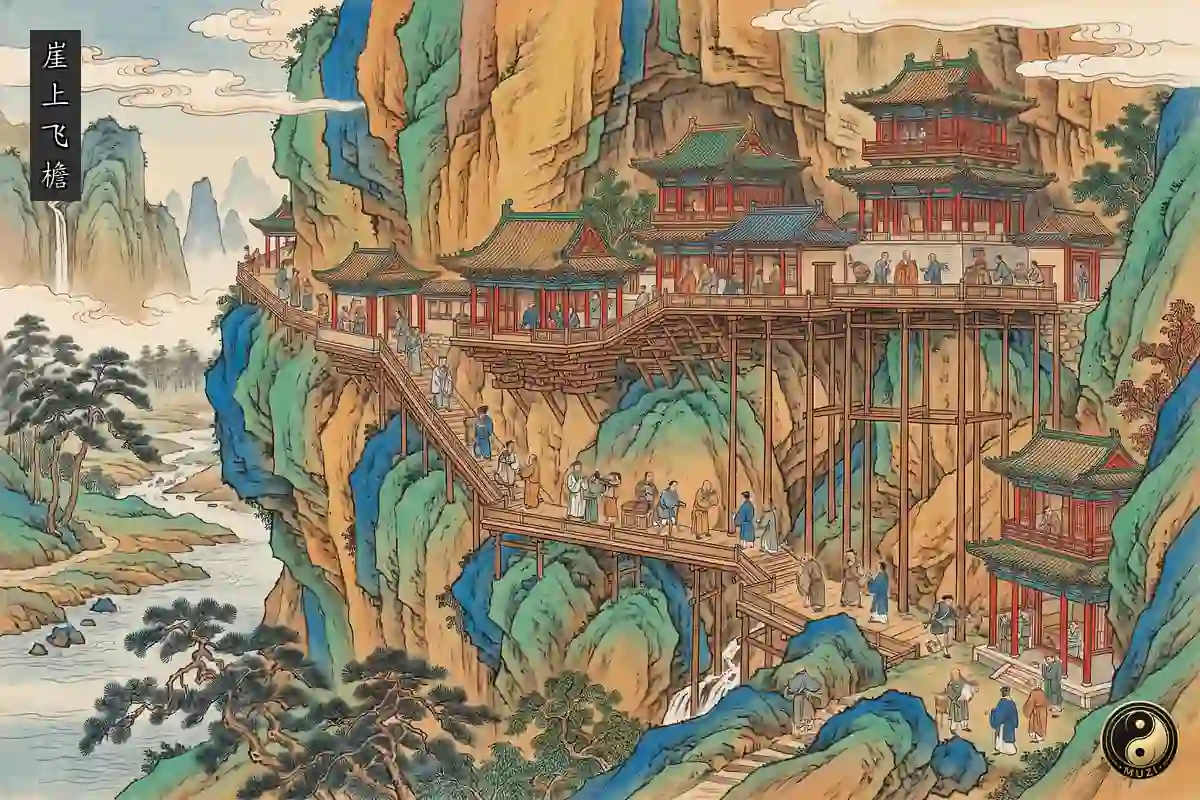

In his Travel Diary of Mount Heng (Youhengshan riji), Xu Xiake describes walking into a ravine between two cliffs. Both walls had been cut with stone sockets, "four or five feet across, a full zhang deep, set in rows above and below"; he guessed they were for "timber set in to make a covered plank road when the water rose", and "abandoned long ago, only two timbers still hang high up". A few bends further he saw "halfway up the western cliff, storeys hung high and winding pavilions leaning aslant", and this was the Hanging Temple. The diary gives no year for the visit.
How the temple stands on the cliff can be read from three statements side by side. The Paper's report quotes a line without saying where it comes from: "The Hanging Temple, half-way up the sky, hangs by three horse-tail hairs in mid-air." The introduction by Shanxi Tourism (relayed in a general report by The Paper, 22 August 2024) begins its account of the mechanics with "beams half-inserted as the base, with the rock giving them support". On 13 October 2026 the Hengshan Scenic Area Management Centre of Shanxi issued a notice (carried by Guangming Online on 14 October from CCTV News) saying that the temple "relies mainly on the beams inserted into the rock to bear its weight", and that its beams, bracing members and posts "bear load by being interlocked with mortise-and-tenon joints". In that line it is horse-tail that holds the temple up; in the introduction and the notice it is beams set into the rock.
Accounts of when it was built and by whom are not the same. The Shanxi Tourism introduction, as relayed by The Paper, says the temple was begun in the late Northern Wei, and that Kou Qianzhi (365-448) of the Northern Wei Celestial Masters left a last wish before his death for a temple in the air, meant to "reach up to the Heavenly guests and cut off the noise below"; his disciples then raised funds, chose the site and designed it, and "the Hanging Temple was completed in Taihe 15 of the Northern Wei (491)". In this introduction, then, 491 is the year of completion. The page of the Datong municipal government's foreign affairs office says only that "the Hanging Temple was begun in the late Northern Wei", with no year, and the Management Centre's notice says "begun in the Northern Wei period, more than 1,500 years ago". On the founder and the date, this entry sets the accounts side by side and decides nothing.
Two texts record another Northern Wei way of using a rock face. The Book of Wei (Weishu), "Treatise on Buddhism and Daoism", records the monk Tanyao asking the emperor to "cut the rock wall of the hills at Wuzhou Pass, west of the capital, open five caves, and carve a Buddha image in each"; Li Daoyuan's Commentary on the Water Classic (Shuijing zhu) describes the Lingyan temple beside the Wuzhou river: "cutting the rock and opening the hill, building according to the rock, the true images vast and mighty". That is going into the rock: the hill is cut open and the images and halls made inside. The Hanging Temple took the other road: the introduction speaks of "beams half-inserted", the notice of "beams inserted into the rock", and the halls hang outside the rock rather than being cut into it; that is this entry's summary of the two pages. Whether the two Northern Wei texts refer to the same place the pages do not say, and this entry does not decide; the texts are set side by side here as two ways of facing a cliff, and Li Daoyuan's "building according to the rock" is close in wording to what Xu Xiake later says, "building along the rock".
Another side of the temple in the record is that someone has always kept it up. The Datong page says that "every dynasty has repaired it". A CCTV app item carried by Huanqiu Online says that the Shanxi Earthquake Administration had recently laid "a new distributed optical-fibre sensing network at the key beams, columns and walkways" of the Hanging Temple on Mount Heng, on the principle of "no alteration to the original state of the cultural relic"; China Daily's English site reported the same work on 9 April 2026. The notice states that the temple is a nationally protected site, and calls it a rare timber building on a cliff that joins "Buddhism, Daoism and Confucianism in one". A wooden temple held up by beams now carries instruments on its beams and posts that measure vibration, and the care it receives has itself become part of its history.
Writing and legend have grown around it. Xu Xiake wrote: "The cliff is sheer, a grand sight under heaven, and the temple's touches match it in every excellence"; he also mentions that "in the northern ravine of Mount Wutai there is also a Hanging Temple, but set beside this it is less definite". This is one travel writer's verdict, and the diary speaks of the cliff first and then of the temple's touches. The Shanxi Tourism introduction says that on the rock below the temple the two characters "grand sight" are the handwriting of the Tang poet-immortal Li Bai. In 2024 The Paper, introducing the scenes of the domestic video game Black Myth: Wukong that are modelled on Shanxi's old buildings, listed the Hanging Temple among them. From travel diary and inscription legend to a game scene, what is written again and again is the sight of the temple hanging on the cliff.
Set against its neighbours, this entry divides the work with three other canons. Grotto Art is about cutting caves into rock, and the passages from the Book of Wei and the Commentary on the Water Classic above belong on that side; the Hanging Temple is its reverse, not cut in but hung out. Timber Building is about the joining of timber, and here the joints carry weight hanging beyond the cliff; the notice says beams, bracing members and posts bear load through interlocking mortise-and-tenon joints. In Earthen Building, the cave dwelling is about hollowing a dwelling out of an earthen cliff; the Shanxi Provincial Institute of Archaeology published the Xinyi site at Lüliang (rescue excavation in June 2020), with twelve cave-type houses "dug at the edge of the earthen ridge, using the broken scarp of the ridge"; both rely on a cliff, but one digs in and the other cantilevers out.
Without this method the lineage of Chinese building would lack a way that neither flattens the mountain nor avoids the cliff. Xu Xiake's verdict on this method is "building along the rock without being burdened by the rock, only this one"; that is one man's judgment and not a general rule. But the notice and the monitoring both show that such building is still being watched over and measured today.
The line quoted in the report has it held by three horse-tail hairs; the Management Centre's notice says it rests on beams set into the rock. In the ravine Xu Xiake saw first the row of stone sockets earlier people had cut in both walls, and only then the storeys. The Northern Wei texts record caves cut into the hills; it is the Shanxi Tourism introduction relayed by The Paper in 2024 and the notice of 2026 that date the temple to the Northern Wei and have it hang outside the cliff on beams. By the notice's reckoning it is more than 1,500 years old, and now its beams and posts carry instruments that measure vibration. The house stands outside the cliff and its roots lie inside it, and that is the reason for this entry.
Cliffside Architecture is the class in the chapter on Architecture on buildings set against cliff faces. It takes the Hanging Temple at Mount Heng as its example: begun around 491 (Taihe 15 of the Northern Wei), with halls carried on beams half-sunk into the rock and braced with posts standing against the cliff; the halls that survive were mostly rebuilt in the Ming and Qing, continuing the tradition of cantilevered timber building.
 Literature
 Commentary on the Water Classic
 Book of Wei
 People
 Xu Xiake
 Li Daoyuan
 Li Bai
 Tan Yao
 Kou Qianzhi
 Atlas
 Shanxi
 Datong