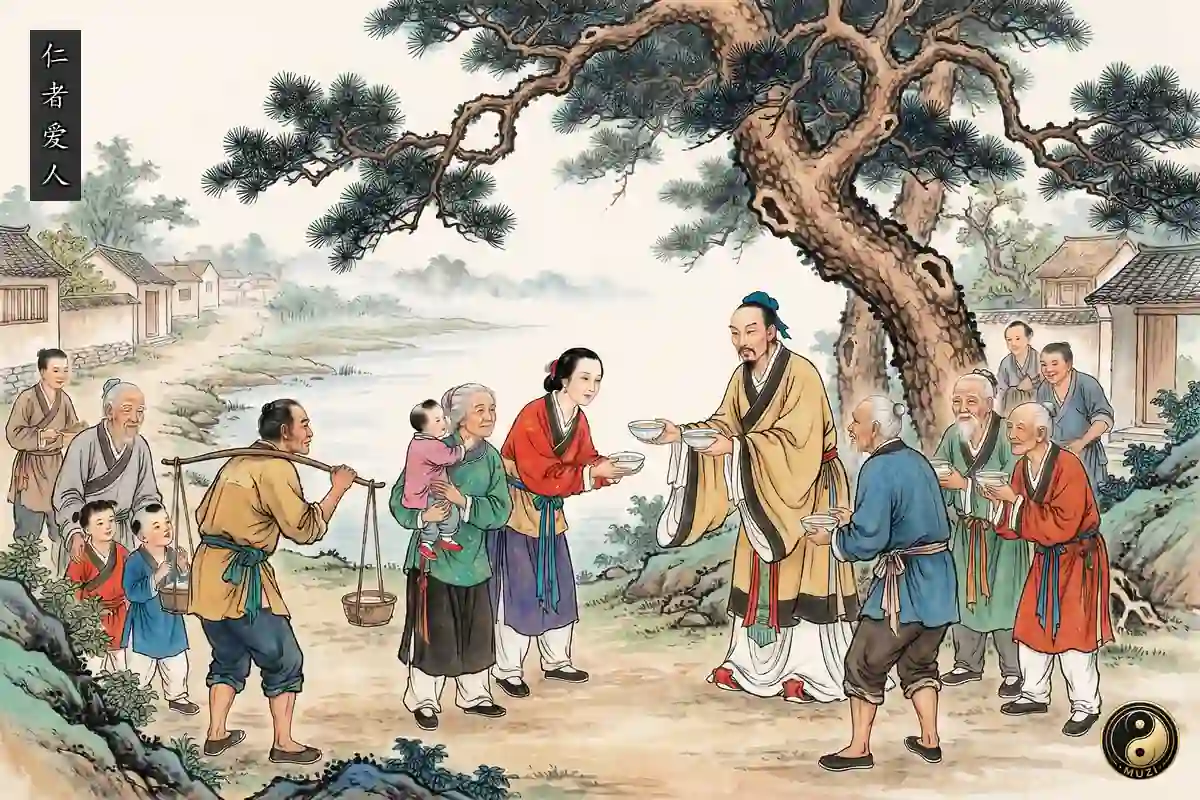
In the late Spring and Autumn period, Confucius's pupils asked him about ren, and he answered each one differently. When Yan Yuan asked, he said "to subdue the self and return to ritual is ren"; when Fan Chi asked, he answered "love others" (Analects, Yan Yuan); Youzi called filial piety and brotherly respect "the root of ren" (Analects, Xue Er). In the Warring States period Mencius said "the benevolent love others; those with propriety respect others" (Li Lou II) and "the feeling of compassion is ren" (Gaozi I), resting ren on a feeling every person has; he urged King Xuan of Qi to extend the heart that could not bear to see an ox led to slaughter to his people: "treat the aged of my family as aged, and extend it to the aged of others", and "extending kindness is enough to protect all within the four seas" (Liang Hui Wang I). The Stanford Encyclopedia of Philosophy sums up that for Mencius ren is cultivated from the love for parents that people have as infants.
Two later steps brought ren into the institutions of the state. After Emperor Wu of the Western Han came to the throne and called for men of worth, Dong Zhongshu answered: "The way of the Five Constants, ren, righteousness, ritual, wisdom and trustworthiness, is what a ruler ought to cultivate" (Book of Han, Biography of Dong Zhongshu). In the Southern Song, Zhu Xi brought together the Analects, the Mencius, the Great Learning and the Doctrine of the Mean with his commentary as the Collected Commentaries on the Four Books; according to the Encyclopaedia Britannica, the set was published in 1190. The Great Compendium of the Four Books quotes Zhu: "ren is the principle of love; spoken of alone it is one virtue; as the virtue of the heart, spoken of in full, it includes the four", and "taken together, the four are the virtue of the heart, and ren is chief among them".
Ren shaped history in three ways. First, it became a measure for rulers and their government. Mencius told King Hui of Liang: "Why must Your Majesty speak of profit? There is only ren and righteousness." He also said: "The benevolent have no enemies." A summary of a lecture by Song Lilin, deputy director of the Confucius Culture Institute at Qufu Normal University, compiled by the editors of the Rujiawang site, reports that Mencius tied rule by ritual closely to benevolent government, on the basis of the people-first idea that "the people matter most, the altars of the state come next, and the ruler counts least". Second, it entered the choice of officials and education. The Book of Han records that after Dong Zhongshu's answers, "Confucius was promoted and the hundred schools were held down. The offices for schools, and the recommendation by commanderies and provinces of the 'flourishing talents' and the 'filial and incorrupt', all began with Zhongshu": Confucian learning thus gained official teachers, and local recommendation gained its categories. Third, it became examination content. According to the New World Encyclopedia, the Yuan made the Four Books the official canon in 1313, and examinations on this basis began in 1315; the Encyclopaedia Britannica records that the Four Books were official examination subject matter from 1313 to 1905, and that from 1415 knowledge of Zhu Xi's commentary was indispensable to success. For nearly six hundred years after that, every scholar who entered office through the examinations had first to read Zhu Xi's explanation of ren.
In thought, ren was placed above life itself. Confucius said: "The resolute scholar and the man of ren do not seek life at the cost of ren; some give their lives to fulfil ren" (Analects, Wei Ling Gong). Later generations also reread and questioned it again and again. In the Qing, Dai Zhen wrote in his Commentary on the Meanings of Terms in the Mencius: "When a man dies by the law, there are still those who pity him; when he dies by principle, who will pity him?" His target was the practice of condemning people in the name of "principle". At the end of the Qing, Tan Sitong wrote A Study of Ren, whose first definition reads "ren takes connection as its first meaning", reading ren as the connection between one person and another. In 1918 Lu Xun, in A Madman's Diary, has the madman open a history book in which every page bears the words "ren, righteousness, the Way and virtue", yet between the lines he sees "the whole book filled with two words: 'eat people'". The same word that served as the standard for choosing officials under the Yuan, Ming and Qing was, in modern times, written into an indictment of the old history.
Ren and four other canons rest on one another. With Rituals: when Yan Yuan asked about ren the answer was "subdue the self and return to ritual", and Mencius set "the benevolent love others" beside "those with propriety respect others"; the same summary sums up the core of Confucius's thought as "the unity of ren and ritual", saying that by "explaining ritual through ren" Confucius gave new life to the culture of ritual and music. With Filial Piety: Youzi called filial and brotherly conduct "the root of ren", and Mencius's extension of kindness also begins with "treat the aged of my family as aged"; filial duty at home is the point from which ren is extended outward. With the Confucian Classics: Zhu Xi wrote his explanation of ren into his commentary on the Four Books, which therefore became the basic texts for teaching ren. With the Imperial Examinations: from the Yuan onward the examinations took the Four Books and Zhu's commentary as their standard, and his definition of ren entered the studies of every candidate.
Ren became a canon because it travelled from a teacher's answers to his pupils into the institutions of the state: Confucius used it to explain ritual, Mencius used it to measure rulers, the Han set up official teachers on Dong Zhongshu's proposals, and for nearly six hundred years the Yuan, Ming and Qing chose officials by Zhu Xi's commentary on it. It is also the common theme of ritual, filial duty, the Four Books and the examinations; without it, ritual would be left with ceremony alone, filial duty would stop at one household, and the Four Books and the examinations would lack the thread that runs through them. And because it stood in this place, Dai Zhen, Tan Sitong and Lu Xun returned to it again and again, to reread it and to question it.
Benevolence is the class in the chapter on Values on ren, the Confucian virtue of benevolence. Confucius explained ren as "loving others", Mencius said that the benevolent love others, extending the affection of kin to other people and to society, and in the Southern Song Zhu Xi placed ren at the head of the Five Constants, making it the core of Confucian ethics.