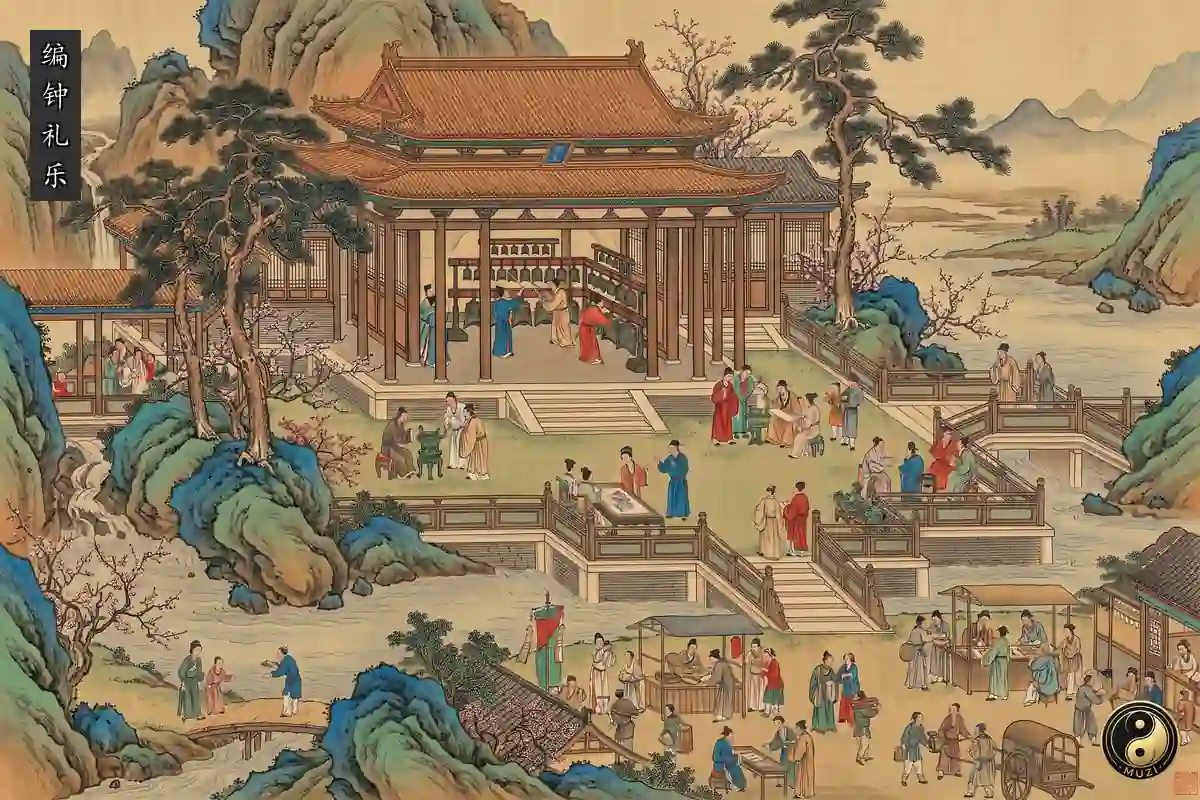
Bian-zhong li-yue (Chime Bells and Rites-Music: the bronze-acoustic statecraft and ritual-order materialization, the absolute-pitch-standardization and class-acoustic-barrier that locks the 12-tone scale into bronze-and-tuning-fork enshrined permanence) is, in the map of the Chinese classical rites-music tradition, the first-generation source-rule of the absolute-pitch-standardization and class-acoustic-barrier tradition that. under the historical pressure of state-ritual-institutionalization and rank-acousticization and bronze-alloy casting and one-bell-two-pitch physicalization and 12-tone-equal-temperament mathematicalization from Shang-dynasty to Qing-dynasty (16th century BCE to 19th century CE), defined as the bian-zhong (one-bell-two-pitch) as bronze-heavy-instrument and 12-lu as absolute-pitch-standard and the four-tier suspension-rig Wang-gong-xian / Zhu-hou-xuan-xian / Qing-da-fu-pan-xian / Shi-te-xian as class-acoustic-barrier and the Son-of-Heaven 8-yi / Zhu-hou 6-yi as dance-formation the most-fundamental civilizational answer that, in the Chinese classical rites-music system. the Bian-zhong li-yue is the absolute-pitch-standardization and class-acoustic-barrier that hard-rules state-ritual and rank-order and dance-formation as the 12-lu absolute-pitch and 4-tier suspension-rig class-acoustic-barrier and bronze-heavy-instrument permanence and one-bell-two-pitch physicalization, in the wake of state-ritual-institutionalization and rank-order and bronze-heavy-instrument and mathematicalized-12-lu convergence. To trace a single coherent lineage down to its source. you have to start from the Shang-early one-bell-one-pitch bronze-ling to the Shang-late 3-piece yong-niao at the Fu-hao-tomb Anyang Yin-xu to the Western-Zhou-mid yong-zhong institutionalization to the Zhou-li Chun-guan Da-si-yue the state-ritual music-bureau to the Zhou-li Chun-guan Xiao-xu the 4-tier suspension-rig class-acoustic-barrier to the Zhou-li Kao-gong-ji Fu-shi the bell-body geometric-cutting craft to the Zhou-li Chun-guan Dian-tong the 12-lu absolute-pitch-standardization to the Shi-jing Xiao-ya Gu-zhong the poetry-music-integration to the Spring-and-Autumn Warring-States bian-zhong cluster (Xi-chuan Xia-si Chu-wang bo-zhong and Hou-ma ceramic-mold and Liu-li-ge bian-zhong) to the early-Warring-States Marquis-Yi-of-Zeng bian-zhong (c. 433 BCE, 1978 excavated Hubei Sui-zhou Lei-gu-dun, 65 pieces, total weight c. 2500 kg, L-shaped bronze-wood suspension-frame, total range 5 octaves, one-bell-two-pitch) the canonical archaeological find to the Western-Han ancestral-temple bian-zhong continuation to the Tang Zhen-guan to Kai-yuan Da-tang Kai-yuan Ya-yue court-music renaissance to the Song Chong-ning to Jing-kang (1104-1127 CE) Da-sheng-fu Da-sheng-yue to the Ming Zhu Zai-yu (1536-1611 CE) Yue-lu Quan-shu (1581 CE) 12-tone equal-temperament mathematicalization to the Qing Qian-long (r. 1735-1796) gold-bian-zhong 16 pieces (1790 CE, each c. 800 taels of gold, hung on carved-lacquer painted suspension-frame). To trace Bian-zhong li-yue as the absolute-pitch-standardization and class-acoustic-barrier you have to do the most-complete back-trace author-by-author book-by-book. The earliest textual anchor is the Shang-early bronze-ling: with the Shang-early (c. 16th-14th century BCE) one-bell-one-pitch bronze-ling as the initial acoustic-form of one-bell-one-pitch , so that the bronze-ling in the Shang-early first acquires the fundamental position of the one-bell-one-pitch acoustic-form. The Shang-late yong-niao group-formation: the Yin-xu (c. 13th-11th century BCE) , with the 1976 excavated Hunan Anyang Yin-xu Fu-hao-tomb 3-piece yong-niao (c. 13c BCE) as the marker of the yong-niao two-pitch group , so that Yin-xu yong-niao in the Shang-late first acquires the fundamental position of the yong-niao two-pitch acoustic-form. The Western-Zhou-mid yong-zhong institutionalization: c. 10th-9th century BCE , with the single-piece two-pitch yong-zhong as the Western-Zhou bian-zhong core form , so that Western-Zhou yong-zhong first acquires the fundamental position of the bian-zhong core form. The Zhou state-ritual music-bureau institutionalization: the Zhou-li Chun-guan Da-si-yue section (assembled c. 4th-3rd century BCE from the Spring-and-Autumn to mid-Warring-States Zhou-guan leftover-rules) , with the marker sentence the Da-si-yue controls the Cheng-jun method, to govern the state-school-politics, and to gather the state's sons-and-brothers , so that Da-si-yue in the Zhou first acquires the fundamental position of the state-ritual music-bureau. The Zhou 4-tier suspension-rig class-acoustic-barrier: the Zhou-li Chun-guan Xiao-xu section , with the marker sentence rectify the music-suspension-positions, the Wang-gong-xian, the Zhu-hou-xuan-xian, the Qing-da-fu-pan-xian, the Shi-te-xian , so that Xiao-xu in the Zhou first acquires the fundamental position of the 4-tier suspension-rig class-acoustic-barrier. The Zhou bell-body geometric-cutting craft: the Zhou-li Kao-gong-ji Fu-shi section , with the marker sentence the Fu-shi makes the bell, the two-luan called the xian, the between-xian called the yu, the above-yu called the gu, the above-gu called the zheng, the above-zheng called the wu , so that Fu-shi in the pre-Qin first acquires the fundamental position of the bell-body geometric-cutting craft. The Zhou 12-lu absolute-pitch-standardization: the Zhou-li Chun-guan Dian-tong section , with the marker sentence control the six-lu six-tong harmony, to distinguish the Heaven-Earth-Four-Directions Yin-Yang sounds, to be the musical-instruments. For all musical-instruments, use the 12-lu as the numerical-degree , so that Dian-tong in the Zhou first acquires the fundamental position of the 12-lu absolute-pitch-standardization. The Zhou poetry-music-integration: the Shi-jing Xiao-ya Gu-zhong (Western-Zhou) , with the marker drum-bell qin-qin, drum-se drum-qin, sheng-qing same-sound, with ya with nan, with yue not-jian , so that Gu-zhong in the Western-Zhou first acquires the fundamental position of the poetry-music-integration. The Spring-and-Autumn Warring-States bian-zhong cluster regionalization: the mid-to-late Spring-and-Autumn (c. 7th-5th century BCE) , with Hunan Xi-chuan Xia-si Chu-wang bo-zhong (c. 550 BCE, 9-piece group) and Shanxi Hou-ma ceramic-mold (c. 500 BCE) and Hunan Hui-xian Liu-li-ge Spring-and-Autumn bian-zhong (c. 530-500 BCE) as the marker of the bian-zhong cluster regionalization , so that bian-zhong cluster in the mid-to-late Spring-and-Autumn first acquires the fundamental position of the bian-zhong cluster regionalization. The early-Warring-States bian-zhong grand-systematization: the Marquis-Yi-of-Zeng (d. 433 BCE) , with the 1978 excavated Hubei Sui-zhou Lei-gu-dun Marquis-Yi-of-Zeng bian-zhong (c. 433 BCE, 65 pieces, total weight c. 2500 kg, hung on the L-shaped bronze-wood suspension-frame, total range across 5 octaves, one-bell-two-pitch: the zheng-gu note and the ce-gu note) , as the marker of the bian-zhong grand-systematization , so that Marquis-Yi-of-Zeng and bian-zhong in the early-Warring-States first acquires the fundamental position of the bian-zhong grand-systematization. The Western-Han ancestral-temple bian-zhong continuation: the Western-Han (c. 2nd century BCE to 2nd century CE) , with Shandong Lin-zi Western-Han bian-zhong and Xi-an Han-dynasty ancestral-temple bian-zhong as the marker of the Han ancestral-temple continuation , so that Han bian-zhong in the Western-Han first acquires the fundamental position of the ancestral-temple continuation. The Tang court-music renaissance: Tang Zhen-guan to Kai-yuan (627-741 CE) , with Da-tang Kai-yuan Ya-yue (c. 724 CE, revised by Zu Xiao-sun and Zhang Wen-shou and Xie-lv-lang, containing the 12-lu bian-zhong) as the marker of the court-music renaissance , so that Da-tang Kai-yuan Ya-yue in the Tang first acquires the fundamental position of the court-music renaissance. The Song Da-sheng-fu bian-zhong: Song Hui-zong Chong-ning to Jing-kang (1104-1127 CE) , with the Da-sheng-fu (1104 CE established) produced Da-sheng-yue 12-lu bian-zhong as the marker , so that Da-sheng-fu and Da-sheng-yue in the late-Northern-Song first acquires the fundamental position of the bian-zhong Da-sheng grand-systematization. The Ming 12-tone equal-temperament mathematicalization: the Ming Zhu Zai-yu (1536-1611 CE) , with the Yue-lu Quan-shu (completed Wan-li ninth year, 1581 CE) 12-tone equal-temperament (the mathematical mechanism of dividing the octave into 12 equal-ratio parts via 2^1/12) , as the marker of the 12-tone equal-temperament mathematicalization , so that Zhu Zai-yu and Yue-lu Quan-shu in the Wan-li first acquires the fundamental position of the 12-tone equal-temperament mathematicalization. The Qing bian-zhong craft grand-systematization: the Qing Qian-long (r. 1711-1799) , with the Qian-long fifty-fifth year (1790 CE) completed gold bian-zhong 16 pieces (each c. 800 taels of gold, hung on carved-lacquer painted suspension-frame) , as the marker of the craft grand-systematization , so that Qian-long and gold bian-zhong in the Qian-long first acquires the fundamental position of the craft grand-systematization. 、,《》、、、,、、、,:、、,。,,。