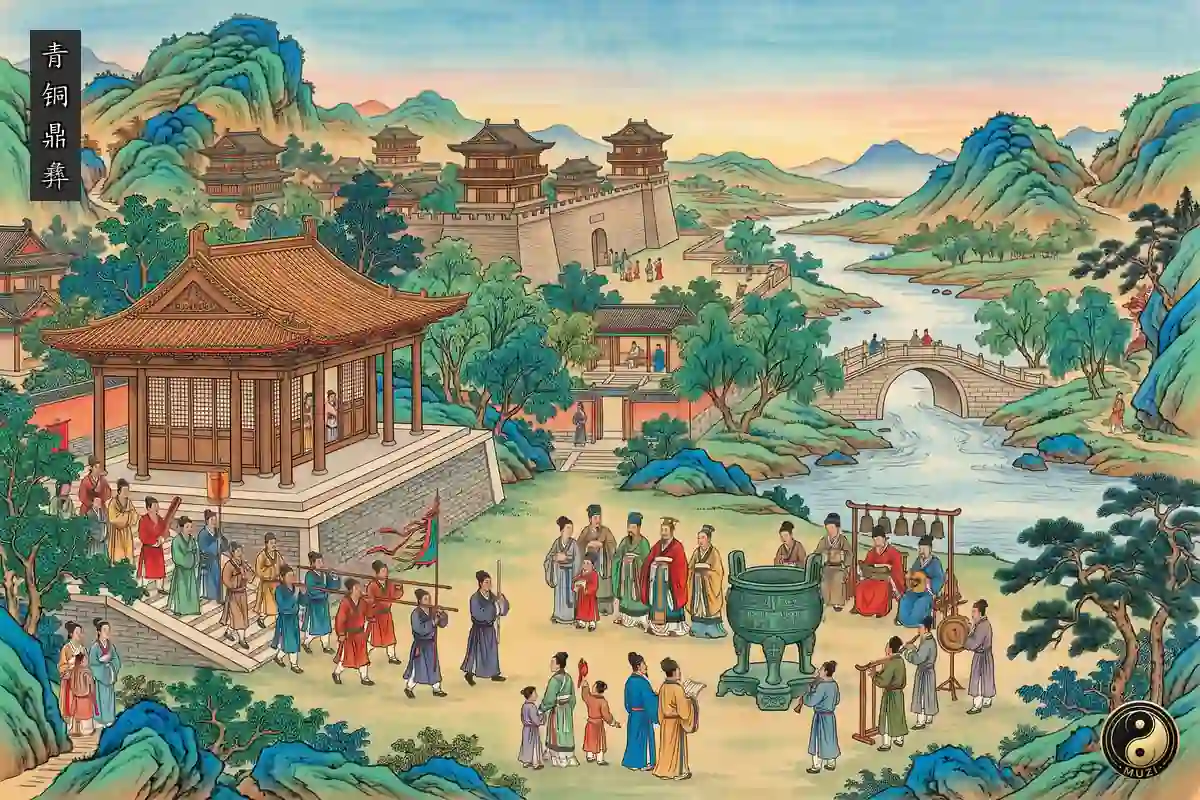


What is distinctive about the ritual bronzes begins with how they were made. In an article carried by China Social Sciences Network, Liu Yu says that casting ritual bronzes in ceramic molds differs from the tradition of West Asia, Central Asia and Europe, where weapons, tools and ornaments were hammered and statues were made by lost-wax casting, and that the Erlitou culture was the key stage in which this technique took shape: in its third phase the bronzes include the jue, the ge halberd and the qi axe, and in its fourth the ding, he, jia and gu; wine vessels stand out among the ritual vessels, with the jue, jia and he as representatives. The article also notes that the ceramic molds found at Erlitou carry mortise-and-tenon joints, made so that the mold sections would fit together. The Houmuwu ding of the late Shang, according to another article on the same site, was unearthed in 1939 at Xiaotun in Yinxu, Anyang, Henan, and is held by the National Museum of China; whether the character si in the inscription is a reversed form of hou is still argued two ways. Introducing Yinxu, UNESCO says that the tomb of Fu Hao is the only tomb of a member of the Shang royal family to have remained intact, and that its burial goods include decorated bronze ritual vessels.
The ding became a credential of rule, and the clearest scene in the texts is the asking about the tripods. The Zuozhuan, in the third year of Duke Xuan, records that the ruler of Chu massed his troops on the Zhou border and “asked about the tripods, their size and weight”; Wang Sunman, envoy of King Ding of Zhou, answered: “It lies in virtue, not in the tripods. In the days when Xia had virtue, distant lands drew the creatures of their regions and the nine regional heads sent in bronze, and the tripods were cast with those creatures on them.” He went on: “Jie had a dark virtue, and the tripods passed to Shang, holding for six hundred years. King Zhou of Shang was cruel and violent, and the tripods passed to Zhou.” In these words the tripods move with virtue. Of the later fate of the Nine Tripods, the Shiji, in its treatise on the Feng and Shan sacrifices, leaves two accounts: “Qin destroyed Zhou, and the Nine Tripods of Zhou went into Qin,” and another claim, that when the earth altar of Song at Taiqiu was lost, the tripods sank into the Si River below Pengcheng.
The ding was also a carrier of ritual, which links it to Rituals. In the second year of Duke Cheng, the Zuozhuan has Zhongni (Confucius) speak of rewards: “Only vessels and titles must not be lent to others,” and draw out a chain: “A title gives rise to trust, trust guards the vessel, the vessel stores the rites, and the rites carry out what is right.” In the thirteenth year of Duke Cheng, Liuzi says: “The great affairs of the state lie in sacrifice and war.” When Jin cast its penal code onto a tripod, Zhongni objected: “The people are in the tripod; how can they honor the noble?” The worry was that the order of high and low would be washed out. Sacrifice and war stand side by side in the recipe table of the Zhouli, Kaogong ji: “Divide the metal into six parts and let tin be one: this is the proportion for bells and tripods,” and “divide the metal into four parts and let tin be one: this is the proportion for ge and ji halberds.” Vessels for sacrifice and arms were made from the same copper and tin, differing only in the weight of tin, so the arms discussed under Weapons & Formations share their stock with the ritual vessels.
Inscriptions made the ding a carrier of writing. The Liji, in the chapter Jitong, says: “A ding has an inscription; the inscription is a naming of oneself, by which one praises the merits of one's forebears and makes them plain to later ages.” It copies out the tripod inscription of Kong Kui of Wei and warns: “To praise forebears who had no merit is deceit.” Words set on a vessel are bound by what is right and wrong. In an article from the Wenhui Daily, carried by China News Service and written by researchers of the Shanghai Museum, the inner-wall inscriptions of the Maogong ding, Da Yu ding and Da Ke ding are counted by Du Naisong at 497, 291 and 290 characters; the three tripods fall in the early, middle and late stages of the Western Zhou; the Maogong inscription records King Xuan of Zhou commissioning Lord Mao, and the Da Yu inscription agrees with the Shangshu chapter Jiu gao. The article quotes Li Xueqin: “The inscription of the Li gui of King Wu's time records the battle of Muye,” and “the He zun tells of the building of Chengzhou,” and adds that the surviving texts of Shang and Zhou are few, so such writings take on the task of outlining the society of the time. Together with the written history discussed under Records of the Grand Historian, they are two lines of record of one past.
After the Qin and Han, reading inscriptions became a discipline. The Hanshu, in its treatise on the suburban sacrifices, records that a tripod was found at Meiyang and sent to court, where the officials “mostly held that it should be offered in the ancestral temple”; Zhang Chang, governor of the capital region, who “was fond of ancient script,” argued from the inscription, citing the words cast in it, “The king commanded Shichen: 'Take charge of this Xunyi; I give you a banner with bells, embroidered ceremonial dress, and a carved ge halberd,'” and concluding that “this tripod was probably what Zhou gave to honor a minister, and his descendants cast his earlier merit into it and kept it in the temple of the house,” and that “it also bears a maker's mark, so it should not be offered in the ancestral temple.” The emperor ruled: “The governor's argument is right.” Xu Shen, in the preface to the Shuowen jiezi, says: “In the commanderies and kingdoms, tripods and vessels were often found in the hills and streams, and their inscriptions were the ancient script of earlier ages, all resembling one another.” The writing on tripods and vessels became a path into ancient script, the point where bronze meets Chinese Characters.
In the eyes of the ancients, metal and stone stood beside bamboo and silk as two carriers. The Mozi, in the chapter Guiyi, writes: “The sage kings of old, wishing to pass on their way to later ages, wrote it on bamboo and silk and cut it into metal and stone, to hand down to their descendants.” The bamboo and silk discussed under Slips & Scrolls, together with metal and stone, are what Mozi names as the tools for passing on a way. Without the ritual bronzes, “the vessel stores the rites” would have nothing to point to, and the Western Zhou's appointments, campaigns and city building would be left to a few surviving books.
Wang Sunman answered the ruler of Chu with virtue and not with the weight of the tripods; Zhongni said the vessel is what stores the rites; the Jitong said an inscription hands a forebear's merit to later ages; and Zhang Chang used the writing on a tripod to turn down a proposal to offer it in the ancestral temple. The ritual bronze was therefore a credential of rule, a physical form of the rites, and a record set on a vessel, and part of what we know of the appointments, campaigns and city building of the Western Zhou was kept by it.
Ritual Bronzes is the class in the chapter on Crafts on bronze ware, centered on the ding, gui, zun and jue vessels. They were cast in piece molds with inscriptions cast on them, carrying the rites in the vessel and past events in the text, and they give the lineage ritual order a material form. This class covers bronze food vessels, wine vessels and water vessels, and also bronze mirrors, lamps and censers, and measures and weights. Gold and silver vessels and ornaments belong to Gold, Silver & Enamel, and bronze figures and the bronzes of Sanxingdui belong to Sanxingdui Bronzes.
 Literature
 Zuo Tradition
 People
 Fu Hao
 Confucius (Kongzi)
 Treasures
 Houmuwu Ding
 Da Ke Ding
 Da Yu Ding
 Mao Gong Ding
 History
 Battle of Muye