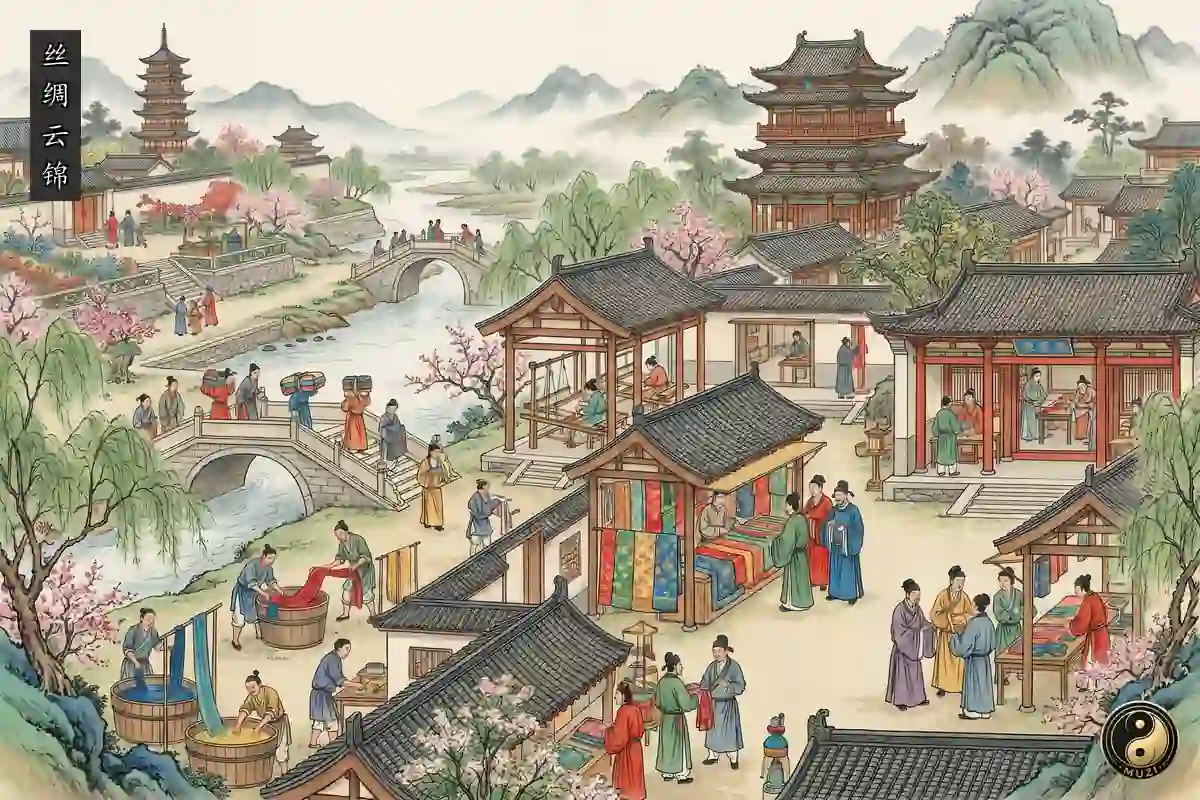


The weight of silk in Chinese civilization can be seen from two ends, the objects dug up and the records written later. The leno fabric from the Qingtai site at Xingyang in Henan (5,300 to 5,500 years ago) is the earliest silk fabric found so far, and the silk scraps and ribbon from Qianshanyang in Huzhou, Zhejiang (4,200 years ago) are the earliest and most complete silk found in the Yangtze valley. Qianshanyang shows that between 4,400 and 4,200 years ago the Yangtze valley already had the skills of raising silkworms, reeling silk and weaving it. One site lies in the Yellow River valley and the other in the Yangtze valley, so both great valleys have early silk objects.
Silk entered institutions through ritual. The Records of Ritual (Liji), in its chapter “Meaning of Sacrifices” (Jiyi), says: “In antiquity the Son of Heaven and the feudal lords must have a public mulberry grove and silkworm house, built near a stream.” The ruler's wife reeled the silk herself and had it dyed, “to make embroidered patterns. When the garment was finished, the ruler wore it to sacrifice to the former kings and lords.” In the table of offices in the Heavenly Offices part of the Rites of Zhou (Zhouli) are listed the keeper of silk, the dyer, the sewer and the inner clothing officer, posts devoted to silk and clothes. Silk thus became the material of ceremonial dress and joined the observances discussed under Rituals. The opening of the chapter on clothing in Exploitations of the Works of Nature (Tiangong kaiwu) says: “People and things adorn one another; noble and humble have their marks; Heaven itself made it so,” meaning that the patterns of clothes were used to tell ranks apart.
Silk was also everyday life for ordinary people. The Book of Songs (Shijing), in “Seventh Month” (Qiyue), says: “In the silkworm month they trim the mulberry, taking up axes and hatchets,” and “the girls take their deep baskets, go along the small paths, and seek the tender mulberry leaves,” and also “in the eighth month they spin, in black and in yellow; my red is very bright, to make a robe for the lord's son,” from picking mulberry to dyeing. The Book of Documents (Shangshu), in “Tribute of Yu” (Yugong), records of Yanzhou that “the mulberry lands were already used for silkworms,” and among its tribute “the tribute is lacquer and silk, and the baskets hold woven patterns.” Mencius, urging King Hui of Liang to rule with benevolence, set the condition: “A homestead of five mu planted with mulberry, and those of fifty can wear silk; keep chickens, piglets, dogs and pigs and do not miss their season, and those of seventy can eat meat,” and said that “when the seventy wear silk and eat meat and the common people are neither hungry nor cold, it has never happened that such a ruler does not become a true king.” Mulberry is named together with chickens and piglets, in the same picture of the farm household as Animal Foods.
Silk also tied distant places together. The ancient Silk Road linked East and West and became an important channel of trade and cultural exchange, which is the route discussed under Silk Road. There were new finds at the Sanxingdui site: by trace analysis archaeologists found silk in the sacrificial pits, in the forms of plain silk, patterned silk and woven fabric, and the ash layer of Pit 4 showed a strong signal of silk fibroin. Zhou Yang, deputy director of the China National Silk Museum, said: “In the process of the unification of Chinese civilization, silk was a very marked factor of convergence,” and that myths and legends, historical records and archaeological finds alike “show that Ba-Shu and the Central Plains held much the same system of knowledge and values.” Sanxingdui, in ancient Shu, lies far from the Central Plains, yet silk left traces on both sides.
Yunjin is the more intricate branch of this craft. Liu Yu of the Eastern Jin defeated the Later Qin and brought the craftsmen of Chang'an to the capital of the time, Nanjing, most of them brocade weavers; in 417 an office devoted to managing brocade production was set up in Nanjing, and Nanjing yunjin began there. Two craftspeople work the upper and lower parts of one large loom, weaving with silk, gold thread and peacock-feather thread, in more than a hundred steps, and the weavers sing mnemonic songs to remember the techniques. The method was once used for dragon robes and is now used to replicate ancient silk fabrics for researchers and museums. Dream of the Red Chamber often mentions yunjin clothing. As for the machine that weaves patterns, the section on the draw-loom in Exploitations of the Works of Nature says that the pattern-lifting worker “sits or stands on the wooden frame of the flower tower.”
In Chinese sericulture and silk craftsmanship, the silkworm's life cycle was seen as human life, death and rebirth, near the beginning of the lunar year silkworm families invite artists to perform the story of the silkworm deity, and in the fourth lunar month there is a Silkworm Flower festival. Silk therefore also ties to the Lunisolar Calendar.
Silk comes from one silkworm's thread, yet it went into ceremonial dress, the food and clothing of farm households, the exchanges between north and south, and the intricate loom. The objects of Qingtai and Qianshanyang, the mulberry-picking of the Book of Songs, the public silkworm house of the ritual books, the silk fibroin in the ash of Sanxingdui and the brocade office set up in Nanjing all remain in the records and in the earth. By this one thread the Chinese told noble from humble in their clothes, tied farm work to the seasons, and joined places far apart.
Silk & Brocade is the class in the chapter on Crafts on silk weaving and dress. It covers the silk tradition from raising silkworms and reeling silk to fine fabrics: the silk fragments of Qianshanyang, the graphs for silkworm, mulberry, silk and cloth in Shang writing, the brocade office at Jiankang in the Eastern Jin, and the imperial yunjin brocade that grew from it. It also covers the fabrics made from silk: brocade and braid, velvet and pile carpet, plain and brocaded gauze, kesi tapestry and embroidery; and what was worn, such as the gauze robe, brocade robe and wool robe, and the crowns of emperors and empresses.
 Literature
 Classic of Poetry
 Dream of the Red Chamber
 Rites of Zhou
 People
 Mencius (Mengzi)
 Liu Yu
 Treasures
 Plain Gauze Unlined Robe
 History
 Opening of the Silk Road