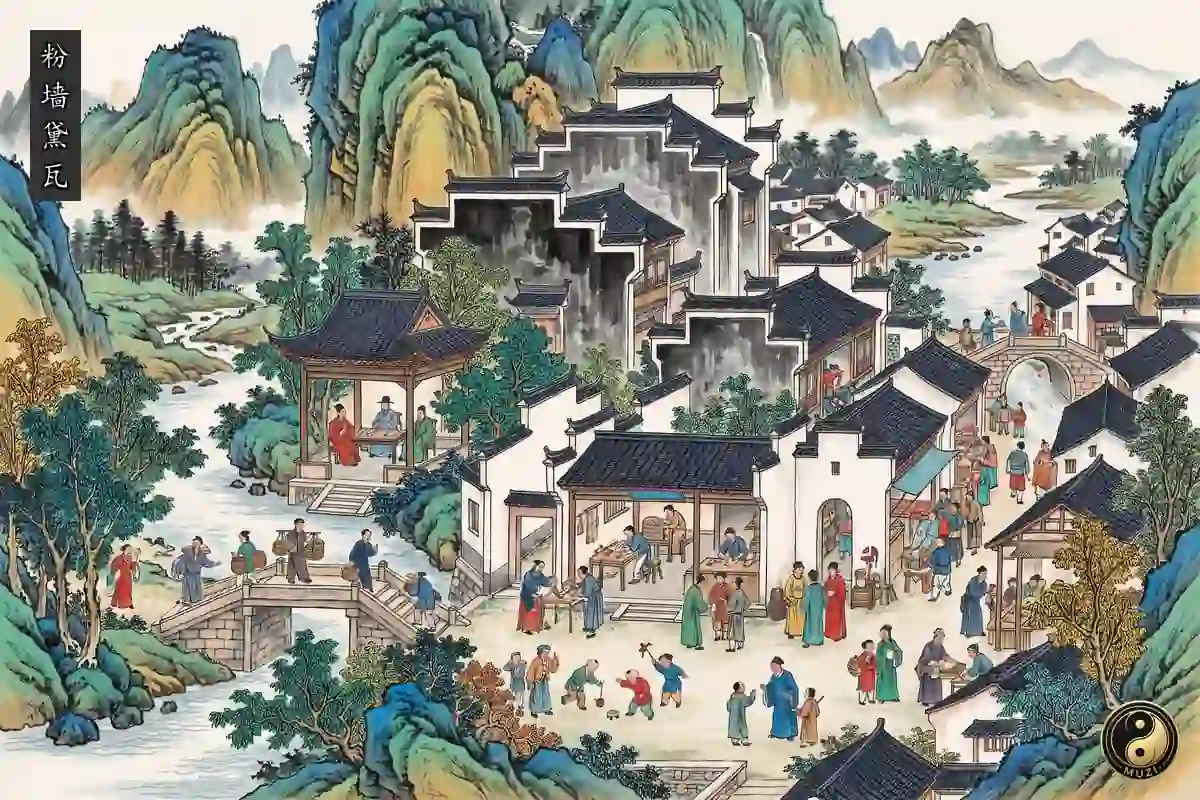

On the People's Daily client, an article marked 21 June 2026, "Huizhou charm in dark tiles, towering horse-head walls" (bylined Xu Bin and Chen Jiteng, compiled from interviews by the paper's reporter Xu Jing), defines it so: the horse-head wall is the part of a gable wall that rises above the roof; it began for fire protection and was at first also called a "fire-sealing wall". The article says that Huizhou is mountainous, land for dwellings was scarce, residents lived in clans and built with brick and timber, and fire was a great danger; "in the Hongzhi years of the Ming, the Huizhou prefect He Xin proposed a plan of 'managing the walls'", with every five households as a unit jointly paying to build fire-sealing walls above the roofs, and "within a month thousands of fire-sealing walls were built", after which each household built its own and added the horse-head shape. This is that article's account; it does not say where the story about He Xin comes from, and it gives no year.
The wall heads have a hierarchy of forms. The article says horse-head walls come in one to five tiers, three and four being the most common, and five the highest, the "five peaks facing heaven"; by how the wall head is made they fall into five types: the plain type uses only small dark tiles, the seal-and-measure type has a carved square brick as its head, the beast-seated type carries an animal-shaped finial "often built on higher-ranking buildings, such as ancestral halls and prefectural or county offices", the magpie-tail type is mostly used for homes and gardens, and the court-tablet type has a head made like an official's tablet, "to show the owner's wish for office and to serve the country". A wall that began for fire protection becomes here a wall that also shows standing and wishes.
Merchants carried these walls everywhere. Xie Zhaozhe writes in Five Miscellanies (Wu zazu): "Of the wealthy who stand foremost, in Jiangnan it is Xin'an, and north of the river Shanxi. The great merchants of Xin'an live by fish and salt, and some have savings of a million", while those with two or three hundred thousand count only as middling. The People's Daily article says that in the mid-Ming Huizhou merchants prospered in Jiangnan, along the Yangtze and on both banks of the Grand Canal, and the horse-head wall went with them; in the Kangxi years of the Qing, Huizhou merchants built the Ziyang Academy at Hankou as a Huizhou-style building with "high and steep walls". The article also quotes the saying "thirteen at home, seventeen in the world", and says the horse-head wall at home is the spirit of a traveller leaving, "the horse rearing to go", and also the welcome on returning, "ten thousand horses in ranks".
UNESCO's statement on Xidi and Hongcun (inscribed in 2000) is more specific: the two villages in Yi County have commerce as their main income and a family and clan social organization, and their layout, landscape, architectural form, decoration and building techniques keep the original features of Anhui villages of the 14th to the 20th centuries; they were built by successful officials or merchants returning home from office and trade, and gradually became models of conventional Chinese village construction. Xidi is built along three streams that meet at the Huiyuan Bridge; Hongcun lies at the foot of a hill, and its stream forms two pools, one of them the Moon Pond in the middle of the village. The page also says the gables carry delicate carving and the colours are plain and elegant. Criterion (v) says that the traditional non-urban settlements of China, largely lost over the past century, are exceptionally well preserved in these two villages.
Why does the horse-head wall count as canon? First, it left a public matter, fire protection, to neighbours. The authors of the article hold that the five households building fire-sealing walls together embodies the governing ideals of "courtesy as the root" and "friendly neighbours"; this is the authors' judgement, and the article gives no source for it. Second, it records where the money went: UNESCO's statement says the villages were built by officials and merchants returning home after office and trade. Third, its look can be carried away: the new Suzhou Museum, opened in 2006, does not use a literal horse-head wall on its roof but abstracts it with lines and a black-and-white scheme, which the article presents as an example of the horse-head wall's elements joining the modern city, adding that the animated film Luo Xiaohei Chronicles (Luo Xiaohei zhanji) also borrows its image.
Behind Walls & Gray Tiles stand five forces. The wall travelled with the merchant companies that Merchant Guild Commerce treats, of which Huizhou merchants were one; Five Miscellanies says the great merchants of Xin'an lived "by fish and salt", and the salt revenue that Salt & Transit Monopolies treats is one of the trades they followed; the article says Huizhou merchants prospered "on both banks of the Grand Canal", and the waterway that Grand Canal treats was the road by which the wall left Huizhou; the family and clan organization in UNESCO's statement is the same kind of body as the clan that Lineage Trust Funds treats; and the article adds that Ming and Qing Huizhou merchants in Suzhou, "through building gardens and houses", wove Huizhou-style buildings into Suzhou's urban fabric, which links to Jiangnan Gardens.
The head of a horse-head wall holds three things: the agreement, told in that People's Daily client article, by which five households formed a group to guard against fire together; the homes that officials and merchants built on returning to their villages; and the forms, from one to five tiers, in five styles. The fire wall went with the Huizhou merchants as far as Hankou, was later abstracted into lines on the roof of the new Suzhou Museum, and the Huizhou villages of Xidi and Hongcun were inscribed on the World Heritage List. For the story of He Xin's "wall order" the article gives no source; the wall heads themselves are there for anyone to see.
White Walls and Horse-head Gables is the class in the chapter on Architecture on Huizhou-style buildings, marked by white walls, dark tiles and stepped horse-head walls. The horse-head wall rises above the roof, serving against wind and fire, and its lines read like a sketch in ink.
 People
 Chang Jian
 Atlas
 Yi County