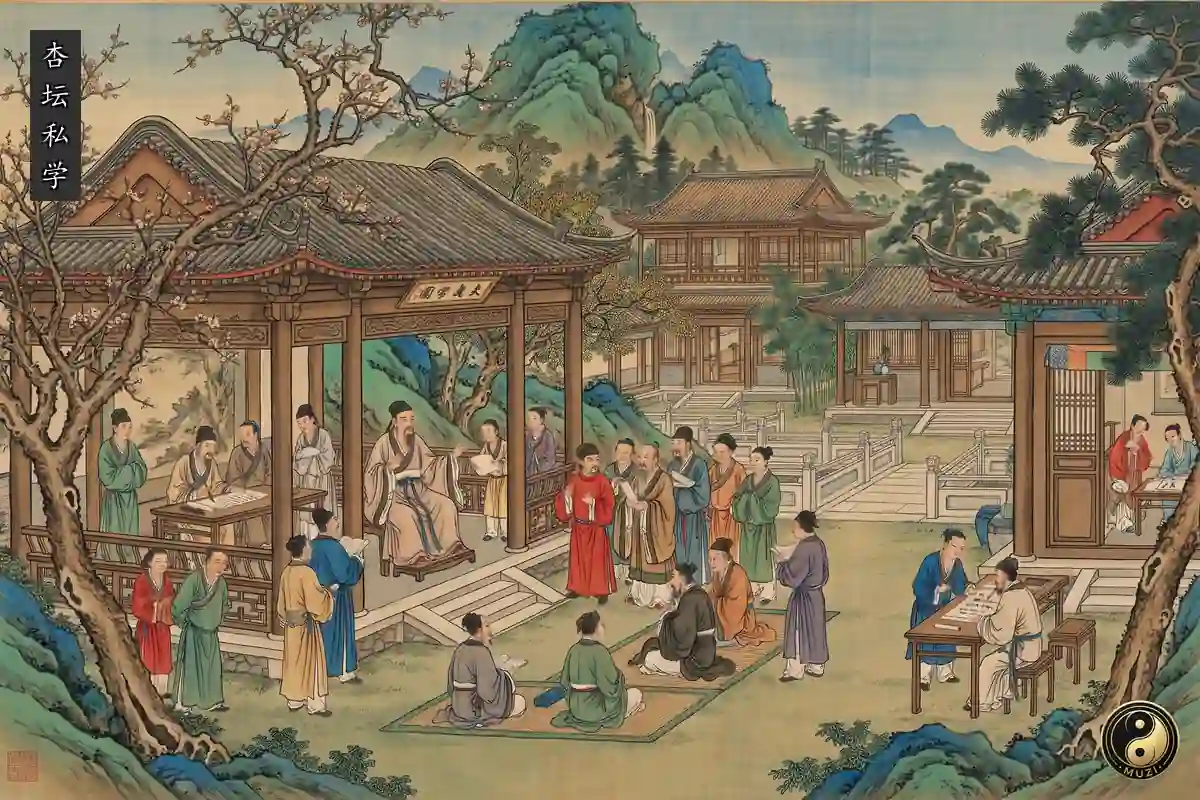
On private teaching, people think first of Confucius's "teaching without classes." The four characters appear in the Analects, in the chapter Wei Ling Gong, and this entry takes its name from them, for the practice of private teaching itself: first Confucius taking pupils, then the Warring States masters founding schools of their own. The four characters are Confucius's, and the entry does not say the masters all followed them; what they mean has long been disputed, as set out below. As for the Apricot Altar, the two characters xingtan appear in the Zhuangzi, in the chapter The Fisherman, where Confucius sits to rest on the altar while his disciples read and he sings and plays the zither; it is a story inside the Zhuangzi, not a historical record of a place of teaching, and it is mentioned here only in passing.
What can be seen of Confucius from his own words and from the Records of the Grand Historian is roughly this. Analects, Wei Zheng: "At fifteen I set my mind on learning; at thirty I stood firm." The Records of the Grand Historian, in the Hereditary House of Confucius, writes that he went to Zhou to ask about the rites and "when Confucius returned from Zhou to Lu, his disciples gradually advanced," and only afterwards says "in the twentieth year of Duke Zhao of Lu, Confucius was about thirty"; it also sums up: "Confucius taught with the songs, documents, rites and music; his disciples numbered three thousand, and seventy-two were thoroughly versed in the six arts." In the Analects, Shu Er, he says "from one who brings a bundle of dried meat or more, I have never withheld instruction," and also "I do not open the way for one who is not eager, nor help out one who is not struggling to speak"; the Wei Ling Gong has only four characters: "teaching without classes." As for the claim that Confucius began taking pupils at about thirty, the Records of the Grand Historian does not say so; its order is first that disciples gradually grew in number, then his thirtieth year.
What "teaching without classes" means has long been disputed. Hong Cheng of East China Normal University surveys it in that university's journal: Huang Kan, Zhu Xi, Ma Rong and Xing Bing each explain it differently, some reading it as "where there is teaching there are no classes," others as "no classes among those taught"; Hong Cheng's own view is that it is a value demand on the teacher and not a statement of fact about the learner, and that it "belongs neither to elite education nor can it be explained as education for commoners." On whether Confucius was the founder of private teaching, He Zonghai says in an article on Aisixiang that records the view that "Confucius is the founder of Chinese private teaching and its theory, and the one who brought it together," and also another view: that before Confucius opened a school there were already people passing on knowledge as private teachers, and that Confucius himself "had no fixed teacher." Li Linzhi, for his part, says that Confucius's opening of private teaching broke the official monopoly on schools, but that such private schools remained highly consistent with the official schools in purpose and content.
In the Warring States, private teaching became the base of each school of thought. The Han Feizi, in Xian Xue, says: "The famous schools of the age are the Ru and the Mo." After Confucius died "the Ru split into eight," after Mozi died "the Mo divided into three," and each "claimed to be the true Confucius or Mozi." When Mencius traveled, Peng Geng asked him: "To travel with scores of carriages behind and hundreds of followers, taking meals from one lord after another, is that not excessive?" At Jixia in Qi, the Records of the Grand Historian, in the Biography of Mencius and Xun Qing, says they were "all named senior grandees, with mansions opened on the thoroughfares and tall gates and great houses," and Xun Qing "three times served as libation-offerer," and Li Si was once his disciple. He Zonghai calls Jixia "official-run, privately headed," and Jixia Academy has its own entry.
How much force private teaching had, the Qin prohibitions show. Li Si says in the Basic Annals of the First Emperor of Qin in the Records of the Grand Historian: "In earlier times the lords contended, and lavishly invited wandering scholars." With the realm settled, what he wished to forbid was just the situation of "private schools that together condemn the laws and teachings": "hearing an order go out, each judges it by his own learning, inwardly condemning it, and outside gossiping in the lanes." So "those not within the offices of the Erudites, anyone under heaven who dares keep the Songs, Documents and sayings of the hundred schools, shall bring them to the governor and commandant to be burned together," and whoever wished to learn the laws would "take the officials as teachers." The proposer himself was a disciple of Xun Qing. He Zonghai says that the early Han "lifted the prohibitions on education and allowed private schools to be opened," and that "Dong Zhongshu, Wang Chong, Zheng Xuan and others came out of this age."
Private teaching is also tied to several other canons. The official school described in Schooling Roots is the arrangement it broke through; Six Arts Curriculum describes two kinds of "six arts," and which kind Confucius used when he "taught with the songs, documents, rites and music" is sorted out in that entry. The debates described in Masters' Prose were the other face of private teaching: He Zonghai cites the view that "creation in thought and running a private school are conditions for each other and advance each other." In Confucian Classics, the Analects, He Zonghai says, is held by some to have arisen in private teaching.
Today teachers also have a day of their own: the Communist Party Members website records that on 21 January 1985 the ninth meeting of the Standing Committee of the Sixth National People's Congress decided that 10 September each year would be Teachers' Day.
Without private teaching, learning could only have stayed in the hands of the government, which is just what the Qin wanted: whoever wished to learn the laws would "take the officials as teachers." After Confucius and Mozi, learning had a road that did not depend on office to carry it on.
The Analects records Confucius saying "from one who brings a bundle of dried meat or more, I have never withheld instruction," and the Records of the Grand Historian says his disciples numbered "three thousand"; the Han Feizi saw that after Confucius and Mozi the Ru split into eight and the Mo into three; Li Si, because of "private schools that together condemn the laws and teachings," wanted people to "take the officials as teachers," and He Zonghai says the early Han lifted the ban again. Once private teaching exists, the government cannot get round it: it passes on learning and also produces people who set up their own doctrines. The Apricot Altar story comes from the Zhuangzi and may not be history; that learning does not wholly lie in the government's hands is what these records point to together.
Teaching for All is the class in the chapter on Education on private teaching. It covers Confucius taking students in the late Spring and Autumn period, and then the masters of the Warring States taking many disciples and founding their own schools of thought; "teaching without classes" is Confucius's own phrase, and this entry does not say the masters all followed it. Private learning flourished into the Hundred Schools of Thought.
 Literature
 People
 Zhu Xi
 Confucius (Kongzi)
 Mozi
 Mencius (Mengzi)
 Li Si
 Dong Zhongshu
 Wang Chong
 History
 Hundred Schools Contention