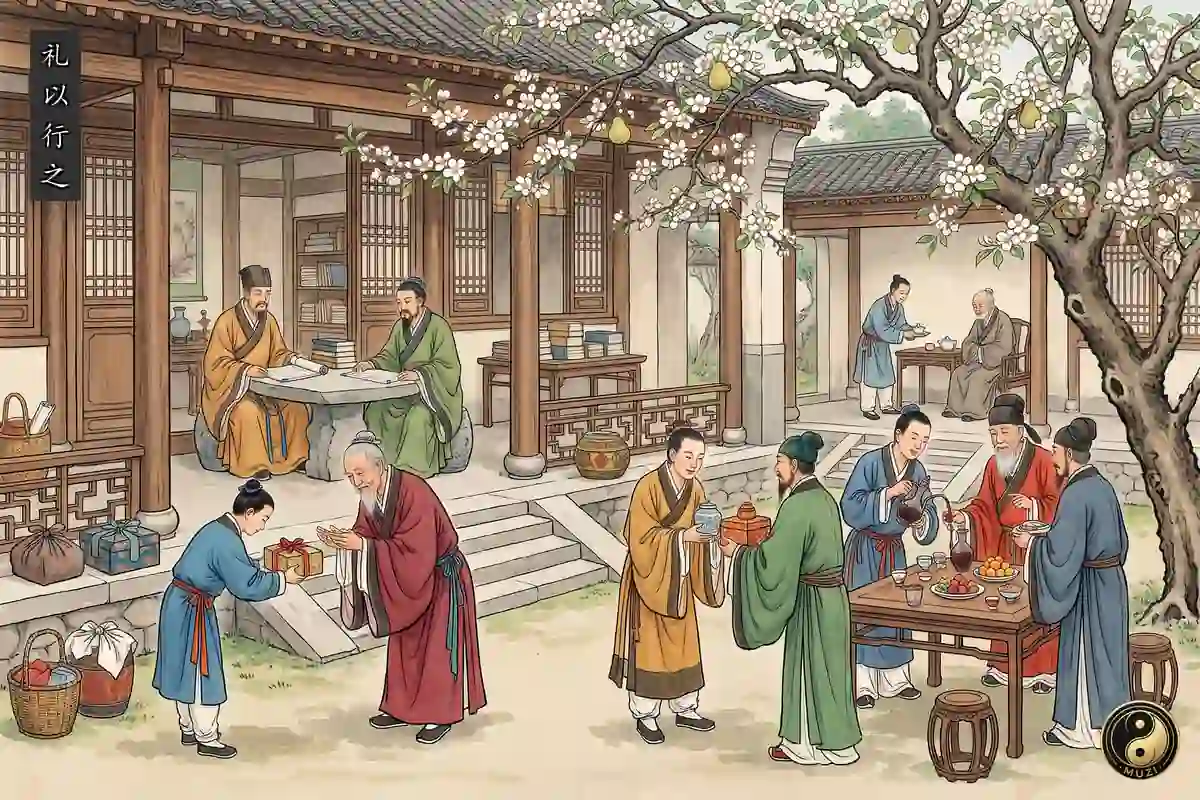
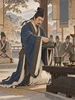
Why ritual is needed, Xunzi explains directly: "People are born with desires; when desires are not met, they cannot help seeking; when seeking has no measure or limit, they cannot help contending; contention brings disorder, and disorder brings exhaustion. The former kings hated this disorder, and so they set up ritual and rightness to divide things among them." (Xunzi, Discourse on Ritual) Confucius saw ritual as the way virtue is put into practice. He said: "The gentleman takes rightness as his substance, carries it out through ritual, brings it forth with modesty and completes it with good faith." (the Analects, Weilinggong) He also compared two ways of governing: "Lead them with government and keep them in line with punishments, and the people will evade them and have no shame; lead them with virtue and keep them in line with ritual, and they will have shame and set themselves right." (Analects, Weizheng) Here ritual and punishment are set against each other, and what ritual asks for is that people feel shame themselves.
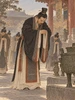
Tradition traces ritual to the Duke of Zhou. The Mingtang Wei chapter of the Book of Rites says that when King Wu died and King Cheng was young and weak, the Duke of Zhou took the Son of Heaven's place, and "in the sixth year he received the lords in the Bright Hall, framed the rites and made the music, issued the measures, and all under Heaven submitted". This is a traditional account; according to the bibliographic treatise of the Book of Sui, the Mingtang Wei itself is one of the three chapters that Ma Rong fixed and added to make forty-nine in the Eastern Han. The ritual books were also scattered and lost: the bibliographic treatise of the Book of Han says that after Zhou declined the lords "hated what harmed them and destroyed the records; from Confucius's time they were incomplete, and under Qin they were badly ruined"; when Han arose, "Gaotang Sheng of Lu transmitted the rites for officers in seventeen chapters". In the Western Han Dai De and Dai Sheng put the ritual records in order. The treatise of the Book of Sui records that Dai De "cut out what was cumbersome" and made eighty-five chapters, "called the Elder Dai's Record"; Dai Sheng cut that again to forty-six chapters, "called the Younger Dai's Record"; Ma Rong then fixed three more chapters, the Monthly Ordinances, the Mingtang Wei and the Record of Music, making forty-nine, and Zheng Xuan wrote a commentary on them. This book is the Book of Rites, which together with the Etiquette and Ceremonial became the classics of later ritual learning.
The force of ritual showed first at the court of the early Han. At the time the ministers "drank and quarrelled over merit, some shouting wildly when drunk, drawing swords and striking the pillars, and the founding emperor was troubled by it". Shusun Tong said that "ritual is the measured form made according to the times and to human feeling", and asked to summon the scholars of Lu, with his own disciples, "to devise a court ceremony together". In the seventh year of Han (200 BCE) the Changle Palace was finished, the lords and ministers paid court under the new ceremony, and the emperor said: "Only today do I know how exalted it is to be emperor." (Records of the Grand Historian, Biographies of Liu Jing and Shusun Tong) From then on ritual became a code that each dynasty set out to compile. According to the treatise on rites and music of the New Book of Tang, under Emperor Xuanzong the scholar Zhang Yue proposed reconciling the differences between the Zhenguan and Xianqing ritual codes; later Xiao Song petitioned for Wang Zhongqiu to compile it, in a hundred and fifty juan, "and this is the Kaiyuan Rites of the Great Tang"; the treatise goes on: "From this the texts of the five rites of Tang were complete for the first time, and later ages used them; though at times they made small additions and cuts, they could not go beyond them." Yet the same treatise opens with: "From the Three Dynasties back, government came from one source, and rites and music reached all under Heaven; from the Three Dynasties down, government came from two, and rites and music became empty names." The historians record the completeness of the ritual code and at the same time admit that ritual and actual government had become two separate things.
Ritual was also questioned again and again. Chapter 38 of the Laozi says: "When rightness is lost, then comes ritual. Ritual is the thinning of loyalty and good faith, and the beginning of disorder." In the Daoist view, ritual is what is needed only after loyalty and good faith have worn thin. In November 1919 Wu Yu published "Cannibalism and the Ritual Teaching" in New Youth, volume 6, number 6, ending: "Those who eat people are those who preach the ritual teaching! Those who preach the ritual teaching are those who eat people!" Here the ritual teaching became the accused. A norm that is at once revered as a code and denounced as an "empty name" and as "eating people" shows how tightly it is bound up with everyday order.
Filial piety, rightness, music and the classics all take shape through ritual. With Righteousness: "rightness as substance, carried out through ritual"; rightness needs ritual to be put into practice. With Filial Piety: when Meng Yizi asked about filial piety, Confucius answered "while they live, serve them by ritual; when they die, bury them by ritual and sacrifice to them by ritual" (Analects, Weizheng), so each step of filial piety rests on ritual. With Confucian Classics: the Great Learning and the Doctrine of the Mean were originally chapters of the Book of Rites, which Zhu Xi made part of the Four Books, and the Four Books became the basis of the civil service examinations from 1315. With Record of Music: according to the treatise of the Book of Sui, Ma Rong fixed the Record of Music as one of the forty-nine chapters of the Book of Rites, so that ritual and music sit in one classic. With Ritual Music and Dance: the tradition that the Duke of Zhou "framed the rites and made the music" treats ritual and music as one undertaking from the start.
Ritual turned invisible virtue into visible order: Xunzi said it was made to stop contention, Shusun Tong used it to put the ministers in a new palace each in his place, and the Kaiyuan Rites set down the five rites of Tang in a hundred and fifty juan, which later ages only added to or trimmed. Filial piety, rightness, music and the Four Books all depend on it to take concrete form. And because it governs so concretely, Laozi called it "the beginning of disorder", the historians lamented that it had become an "empty name", Wu Yu said it "eats people", and criticism has always been aimed at it.
Rituals is the class in the chapter on Values on how inner virtue is carried into outward norms and ceremony. The phrase comes from the Analects, "take rightness as the substance and carry it out through ritual", meaning that rightness is the root and ritual the way to practise it. The class concerns how the rites took shape, and how through everyday conduct they brought the order of elders above juniors into ordinary life.
 Literature
 The Analects
 The Great Learning
 People
 Zhu Xi
 Duke of Zhou (Ji Dan)
 Confucius (Kongzi)
 Xunzi
 Zhang Shuo
 Dai Sheng