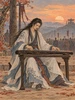
A seven-string guqin lies across a low table, a scholar in a plain long gown sits at it with a hand raised over the strings, a blank hand-copied score is unrolled on a small stand under the window behind him, and in the lower foreground a green bamboo sprig hangs at the right.
The study of the guqin as the literati solo instrument: scores and notation, schools, instrument making and surviving instruments, writings on the qin and its history, and qin societies. Qin songs stay with Songs and Folk Tunes, and the zheng, pipa and other instruments stay with Chinese Instrumental Music.
433 BCE · OriginThe tomb of Marquis Yi of Zeng yielded ten-string and five-string qin; an inscription on bells from the same tomb is dated to 433 BCE.1425 · EvolutionThe Shenqi Mipu, compiled under Zhu Quan’s direction, was published.1977 · ImpactGuan Pinghu’s performance of Flowing Water was included on the Voyager record.2003 · ImpactGuqin art was proclaimed a Masterpiece of the Oral and Intangible Heritage of Humanity.2006 · ImpactGuqin art entered China’s national intangible cultural heritage list.2008 · ImpactGuqin art entered the Representative List of the Intangible Cultural Heritage of Humanity. China’s national intangible cultural heritage extension items named seven qin schools: Yushan, Guangling, Jinling, Mei’an, Zhejiang, Zhucheng, and Lingnan.
The guqin has seven strings and thirteen studs on its surface. Early qin also took other forms: instruments excavated from the tomb of Marquis Yi of Zeng include ten-string and five-string qin, while an inscription on the bells from the same tomb is dated to 433 BCE. Archaeological evidence indicates that the qin's form had settled by the Han dynasty at the latest. Guan Ju in the Classic of Poetry speaks of befriending someone with qin and se, placing the instruments in a setting of affectionate companionship. The guqin was also an art cultivated by scholars and was not intended for public performance.
Scores preserve traces of the repertoire. Jieshi Diao: You Lan, transmitted by Qiu Ming of the Sui dynasty, survives in a seventh-century manuscript written in prose tablature; a copy returned from Japan in the late Qing. The Shenqi Mipu, compiled under Zhu Quan's direction, was published in 1425. The manuscript of You Lan and the printed Shenqi Mipu give the transmission of qin music identifiable texts and dates. Pieces such as Flowing Water and Three Variations on Plum Blossoms also give this tradition a repertoire of named works.
Historical accounts of the qin describe encounters between players and listeners. In the Book of Later Han, Cai Yong hears paulownia wood burning and recognizes its suitability for an instrument. The qin made from it retains a scorched tail, giving it the name “Scorched-Tail Qin.” The story of Bo Ya and Zhong Ziqi presents listening as understanding what the player has in mind. In the Benwei chapter of Master Lü's Spring and Autumn Annals, Zhong Ziqi recognizes Mount Tai and flowing water in Bo Ya's playing; after Ziqi dies, Bo Ya breaks his qin, cuts its strings, and never plays again. In the Book of Jin, Ji Kang asks for a qin before his execution and declares that the Guangling Melody will end with him. These accounts preserve different stories about instrument wood, an understanding listener, and the transmission of a piece.
Guqin art entered China's national intangible cultural heritage list in 2006. The extension items announced in 2008 name seven schools under guqin art: Yushan, Guangling, Jinling, Mei'an, Zhejiang, Zhucheng, and Lingnan.
Recordings have also carried the guqin's sound farther afield. In 1977, Guan Pinghu's performance of Flowing Water was included on the Voyager record. Guqin art was proclaimed a Masterpiece of the Oral and Intangible Heritage of Humanity in 2003 and entered the Representative List of the Intangible Cultural Heritage of Humanity in 2008. Excavated instruments, surviving scores, stories of playing and listening, and recordings preserve different parts of the tradition: instruments show its physical forms, scores leave written traces of its repertoire, stories record how people understood playing and listening, and recordings preserve the sound of individual performers.
The Guqin Tradition covers the instrument's form, its instrumental repertoire and scores, its schools, and historical accounts of playing and listening. Its focus is guqin performance and transmission. Songs accompanied by the guqin belong to Songs and Folk Tunes; the zheng, pipa, and other instruments belong to Chinese Instrumental Music.
Qin music is like flowing water: a listener hears in its sound the scene held in the player's mind. The story of Bo Ya and Zhong Ziqi gives an understanding listener a concrete form—one person recognizes in the music what the other has in mind.
Story: Bo Ya played the qin, and Zhong Ziqi listened. When Bo Ya had Mount Tai in mind, Zhong Ziqi described the music as towering like the mountain. When Bo Ya thought of flowing water, Zhong Ziqi described the music as surging like water. After Zhong Ziqi died, Bo Ya broke his qin, cut its strings, and never played again, believing that no one remained worth playing for.
Interpretation: This story appears in the Benwei chapter of Master Lü's Spring and Autumn Annals. It presents understanding the music as understanding the player's intention. Its idea of an understanding listener takes shape through particular acts of listening: the mountain and water are both what the player imagines and what the listener recognizes in the sound. Flowing Water also survives as a qin piece, and Guan Pinghu's performance was included on the Voyager record in 1977. The image of flowing water in the old story and the later recorded piece bearing that name can be encountered through text and recording respectively.




 The Art of the GuqinThe seven-string zither with thirteen studs, foremost instrument of China's literati solo tradition
 Qin Notation and ScoresHow the qin was written down, from a Tang prose-tablature manuscript to the Ming Shenqi Mipu
 Qin Schools and LineagesFrom players such as Ji Kang handing the art down, to today's Yushan and Guangling schools
 Qin Treatises and HistoryWhat each age wrote about the qin, and the history of the instrument
 Canon
 Literature
 Book of the Later Han
 People
 Bo Ya
 Cai Yong
 Ji Kang
 Stage
 Guangling San
 Flowing Water
 Three Variations on the Plum Blossom
 Solitary Orchid in Jieshi Mode
 History
 Guqin Proclaimed a UNESCO Masterpiece
 Atlas
 Han Yang District