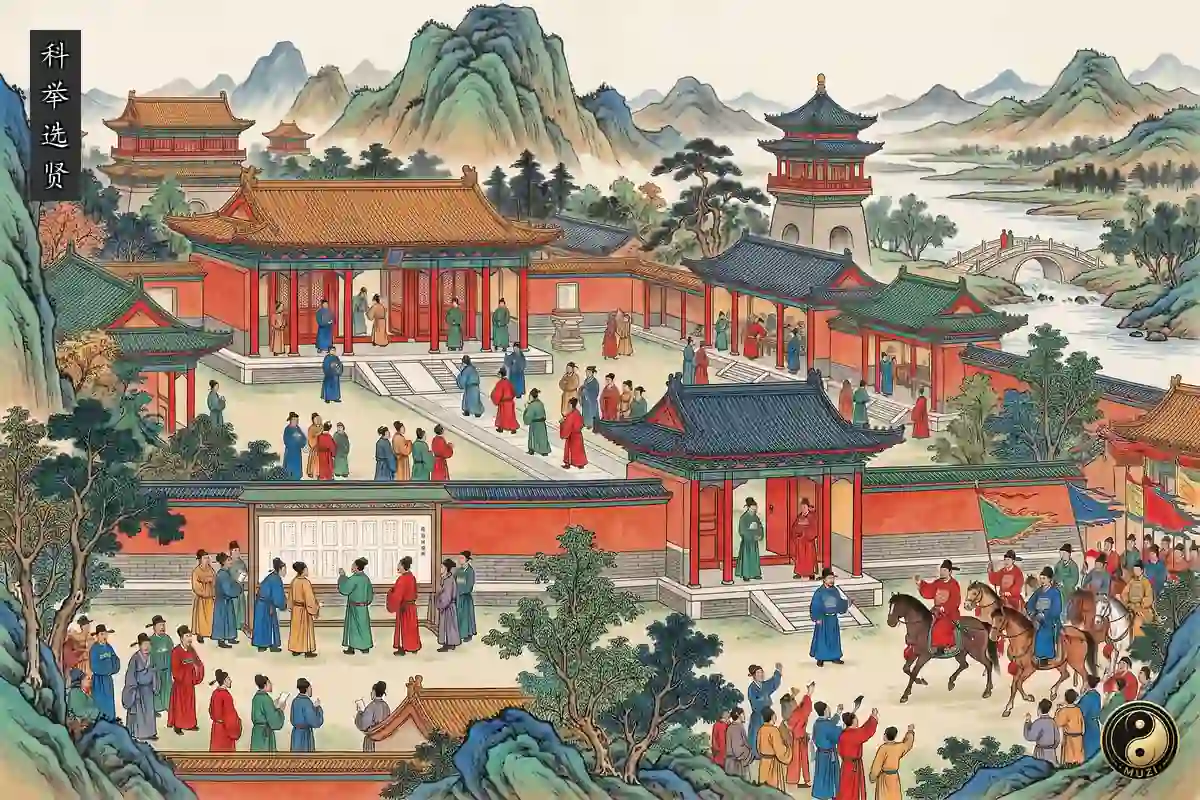
The question the examination answers is on what grounds the state picks its officials. The "Treatise on Selection" in the New Book of Tang opens by saying "the Tang system of selecting men for the subjects was in the main based on the Sui," and it names three roads: "those from the schools and academies were called students; those from the prefectures and counties were called tribute men," besides the decree examinations that the emperor called himself. In the twenty-fourth year of Kaiyuan the conduct of the examinations passed to a vice minister of the Ministry of Rites, and "selection of scholars by the Ministry of Rites began from this." When the jinshi subject began was already disputed among the Tang: in the second year of Baoying, Yang Wan, Vice Minister of Rites, memorialized that "the jinshi subject arose in the Daye years of the Sui, when it still tested only policy essays." A report by Sun Qingling in Chinese Social Sciences Today of 22 March 2021 quotes Zhang Xiqing of Peking University, who sums up the examination system as "budding in the Northern and Southern Dynasties, founded in the Sui, established in the Tang, and completed in the Song." Neither source gives the year the subject was set up, and this essay does not supply one.
In the Northern Song the examination moved into the palace hall. The "Treatise on Selection" in the History of Song records that Taizu summoned the failed candidates into the hall and set a separate test himself, so that "the palace examination became a standing rule," and it quotes his words: "In the past, subject titles were mostly taken by powerful families; now I preside over the test in person and have swept away that abuse." The Basic Annals of Taizu put the re-examination of jinshi candidates "at the Jiangwu Hall" in the third month of the sixth year of Kaibao. Fu Bi later argued against it, saying "it was only under Empress Wu of the Tang that palace examinations began, and what is to be gained from that?", so even then the origin of the palace examination was told two ways.
The results can be seen in several places. The History of Song's general preface says "Shenzong first abolished the miscellaneous subjects and divided the selection between classical meaning and poetry-and-rhapsody." The abstract of the paper by Zu Hui and Fei Xikuan of Zhejiang University says that Taizong "kept expanding the number admitted through the examinations, drawing large numbers of scholars into the bureaucracy through the examinations, and laying the foundation for civil government," and that in the fourth year of Xining the court "formally abolished the miscellaneous subjects, the Mingjing subject, and poetry, rhapsody, quotation tests and written answers, and testing by classical meaning became the mainstream." Wang Anshi's position at the time was that "in antiquity selection was all rooted in schools, so build schools and return to antiquity." In Renzong's reign there were thirteen examinations and 4,570 jinshi; of the thirty-nine who placed in the top three, "those who afterwards did not reach the ranks of ministers were only five."
The adverse record also stays in the histories. Yang Wan criticized the jinshi route because candidates "submit their own papers and put themselves forward, which is not the way the former kings sat waiting for worthy men." Under Emperor Wenzong, Zheng Tan repeatedly asked to abolish the jinshi subject, and Wenzong replied: "The jinshi subject has chosen men for two hundred years; it cannot be abolished at once." Under Emperor Wuzong, Li Deyu spoke for the sons of high officials, saying "the prominent offices at court must be filled by the sons of ministers and dukes," and that poor scholars "simply cannot become practiced" in court ceremony.
The end of the examinations is on record too. The Basic Annals of Emperor Dezong in the Draft History of Qing records an edict of the twenty-ninth year of Guangxu: "From the Bingwu examination onward, the quotas for provincial and metropolitan examinations and the quotas for prefectural schools in each province are to be reduced examination by examination"; in the eighth month of the thirty-first year of Guangxu the annals have only one line, "an edict abolishing the examinations." The Treatise on Selection reports the reasons given in the joint memorial of Yuan Shikai and Zhang Zhidong: "as long as the examinations are not stopped, scholars harbor hopes of passing by luck, which divides their will to practice and real self-cultivation." The same report quotes the count of Liu Haifeng of Zhejiang University: over the thirteen hundred years in which the examinations were held they "raised up a hundred thousand jinshi."
The examinations touch several other canons. In The Scholars, chapter one, Wang Mian sees the method of selection fixed by the Ministry of Rites, "one examination every three years, using the Five Classics, the Four Books and the eight-legged essay," and says "now that scholars have this one road to honor, they will think little of letters and conduct, and of when to serve and when to withdraw." This is a character's remark in a novel, not a verdict of the histories, yet it connects with the serial novel treated under Vernacular Fiction; the classics on which questions were set are the content of Confucian Classics. The Ming History's "Treatise on Selection" places the schools beneath the examinations: "in the Ming system the examination subjects flourished, ministers and chancellors all came from them, and the schools stored talent to meet the subjects," which joins the Tang line under Tang Six Schools in which "those from the schools and academies were called students." In the Chongning years of the Northern Song the court once "decreed that all selection be by promotion from the schools, and the prefectural dispatch examinations and the Ministry of Rites examinations be abolished," and in the third year of Xuanhe it "abolished the Three Halls method in the prefectural and county schools" and "selected by the examinations" in the capital prefecture and the circuits; the Three Halls System covers just this back and forth. Under Academy Regulations, Zhu Xi criticizes the learning of his day as "not merely wanting them to strive for wide reading and fine writing, so as to angle for fame and take profit and rank," a criticism of study for fame and profit that does not name the examinations.
The ledger of the examinations can be added up two ways. On one side, Renzong's thirteen examinations admitted 4,570 jinshi, and of the top three only five failed to reach the ranks of ministers; on the other, Li Deyu still said the prominent offices had to go to the sons of ministers and dukes, and Wang Mian feared that scholars would think little of letters and conduct. The schools at times stored talent to meet the examinations and at times were ordered to replace the dispatch and Ministry of Rites examinations; the academies' rules and the talk in the novel are tied to it as well. The Qing court first cut the quotas examination by examination, and in the thirty-first year of Guangxu one edict stopped it; the count of Liu Haifeng quoted in the report is that over thirteen hundred years it "raised up a hundred thousand jinshi."
Imperial Examinations is the class in the chapter on Education on selecting officials by examination. It covers the system from the creation of the jinshi examination in 605, the first year of Daye of the Sui, through the Northern Song when the palace examination became standard, to its abolition by Qing edict in 1905, some 1,300 years of choosing officials by examination.
 Literature
 The Unofficial History of the Scholars
 History of Song
 People
 Zhao Kuangyin
 Wang Anshi
 Zhu Xi
 Wang Mian
 Yang Guang
 Li Deyu