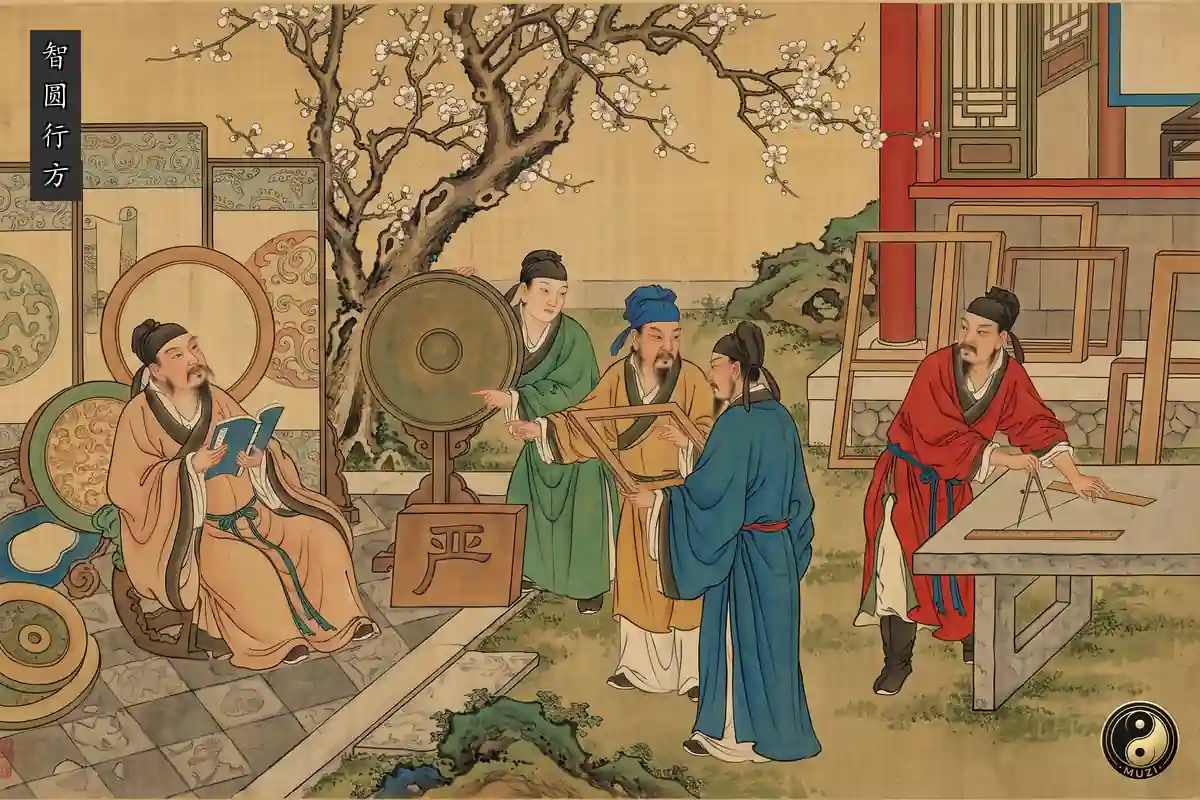
Confucius said: "The wise are not perplexed, the benevolent are not anxious, the brave are not afraid." (Analects, Zihan) In the Xianwen chapter he says again, "the ways of the gentleman are three, and I am equal to none of them", listing the same three, and Zigong answers: "The Master is describing himself!" It is the Doctrine of the Mean in the Book of Rites that calls wisdom, benevolence and courage "universal virtues": "Wisdom, benevolence and courage, these three are the universal virtues of the world." The same chapter quotes Confucius: "Love of learning is close to wisdom, effort in practice is close to benevolence, and knowing shame is close to courage." For Confucius wisdom began with honesty about oneself: "To know what you know and to know what you do not know, that is wisdom." (Analects, Weizheng)
In the Warring States Mencius called "the sense of right and wrong" the "sprout of wisdom", alongside the sprouts of benevolence, rightness and ritual (Mencius, Gongsun Chou I). Confucius also warned that wisdom alone is not enough: "If wisdom attains it but benevolence cannot keep it, though it is gained it will surely be lost." (Analects, Weilinggong) The saying "round wisdom, square conduct" comes from two books of about the Han period. The Western Han Huainanzi, in the chapter on the Art of Rulership, says: "In general, as people say, the heart should be small and the will great, wisdom round and conduct square, abilities many and affairs few." It explains: "Wisdom that is round turns and circles, without beginning or end"; "conduct that is square stands upright and does not bend, is plain and white and unstained, does not change its course in hardship nor indulge its will in success." The Wenzi, in its chapter on Subtle Insight, has nearly the same words: "Wisdom should be round, conduct should be square." Which of the two books came first is disputed: according to a paper by Ho Che Wah of the Chinese University of Hong Kong, Chen Li-kuei argued that some passages of the received Wenzi were taken from the Huainanzi, while Ho holds that the evidence for this is not firm enough.
Wisdom later became a standard for judging people. The Art of War, in Laying Plans, says of the general: "The general is wisdom, good faith, benevolence, courage and strictness." The five qualities of a general begin with wisdom. In the Western Han, Dong Zhongshu in his answers to the throne placed "wisdom" among "the way of the five constants", benevolence, rightness, ritual, wisdom and good faith (Book of Han, Biography of Dong Zhongshu), and wisdom became one of the virtues the court promoted. The Doctrine of the Mean was originally a chapter of the Book of Rites, and Zhu Xi took it into the Four Books; the Yuan made the Four Books the official canon in 1313, and from 1315 the examinations were based on them, and the saying on "wisdom, benevolence and courage" entered the books every candidate had to read. "Round wisdom, square conduct" was also used to speak of medicine. In the Tang, Lu Zhaolin suffered from a grave illness that "the physicians could not cure", and went to ask Sun Simiao. Sun answered: "Courage should be large and the heart small, wisdom round and conduct square", and explained: "'Not turned by profit, not troubled by rightness': that is the squareness of conduct; 'acting on seeing the sign, without waiting for the day to end': that is the roundness of wisdom." (Old Book of Tang, Biography of Sun Simiao)
Wisdom was also questioned and rewritten. Chapter 19 of the Laozi says: "Cut off sageliness, discard wisdom, and the people will benefit a hundredfold." In the Ming, Wang Yangming placed Mencius's "sense of right and wrong" within innate knowing: "Innate knowing is just the sense of right and wrong. Right and wrong are just liking and disliking." (Instructions for Practical Living, last juan) For him, the wisdom that tells right from wrong is itself innate knowing. The maxim also travelled abroad. On 15 June 1924 seven young women founded the Square and Circle Club in San Francisco Chinatown to raise relief funds for flood victims in China; its name comes from this passage of the Huainanzi, and its English motto reads "in deeds be square, in knowledge be all-round".
Wisdom seldom stands alone; it works together with other canons. With Benevolence: Confucius said "if wisdom attains it but benevolence cannot keep it", and the Doctrine of the Mean names wisdom, benevolence and courage together, so wisdom must be held by benevolence. With Art of War: the general's five virtues are "wisdom, good faith, benevolence, courage and strictness", with wisdom at the head. With Traditional Medicine: Sun Simiao answered Lu Zhaolin with "round wisdom, square conduct", speaking of the temper of a physician. With Confucian Classics: the "three universal virtues" of wisdom, benevolence and courage come from the Doctrine of the Mean, which went from a chapter of the Book of Rites to one of the Four Books and, through the examinations, into every scholar's course of study.
The weight of wisdom lies in its always being taught alongside other virtues: Confucius set it beside benevolence and courage, Mencius made the sense of right and wrong one of the four sprouts, the Huainanzi paired it with upright conduct, Sunzi put it at the head of a general's virtues, and Sun Simiao used it to speak of medicine. It was also questioned and rewritten: Laozi wanted to "cut off sageliness and discard wisdom", and Wang Yangming took it into innate knowing. From military books and medical books to a society overseas, "round wisdom, square conduct" has kept reminding people that cleverness must be used together with uprightness.
Wisdom is the class in the chapter on Values on wisdom and conduct. Confucius listed wisdom among the gentleman's three universal virtues; the Wenzi and the Huainanzi then say that "wisdom should be round and conduct should be square", asking for thought that is rounded and open and for action that is upright.
 Literature
 People
 Zhu Xi
 Duanfang
 Confucius (Kongzi)
 Mencius (Mengzi)
 Dong Zhongshu