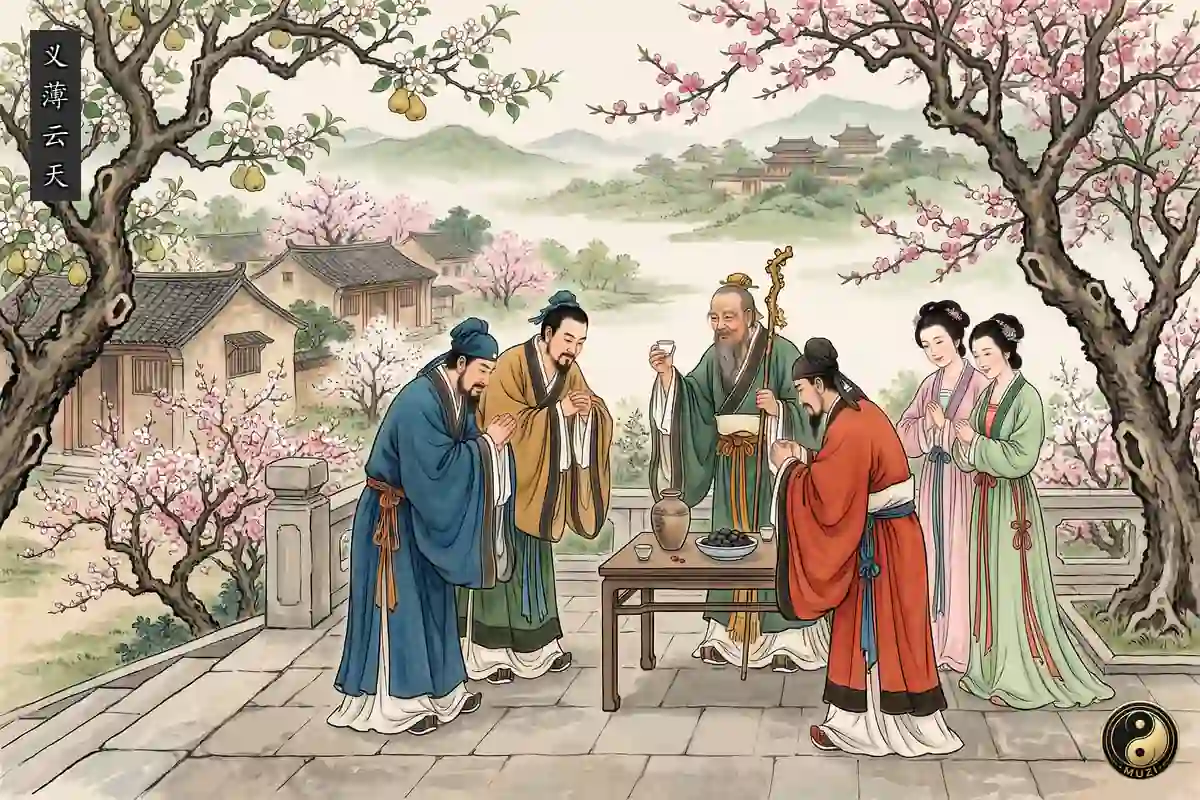
In the late Spring and Autumn period Confucius said: "The gentleman understands rightness; the petty man understands profit." (Analects, Liren) The same chapter says that "to act with an eye to profit is to draw much resentment", and the Weizheng chapter has "to see what is right and not do it is want of courage". For him rightness was the standard for choosing: faced with the same matter, the gentleman asks whether it is proper, the petty man whether it pays. He also set rightness at the base of a gentleman's character: "The gentleman takes rightness as his substance, carries it out through ritual, brings it forth with modesty and completes it with good faith." (Analects, Weilinggong)
In the Warring States Mencius carried rightness to the point of life and death. Comparing fish with bear's paw, he said: "Life is what I want; rightness is also what I want. If I cannot have both, I give up life and hold to rightness." (Mencius, Gaozi I) He called "the feeling of shame" the "sprout of rightness" (Gongsun Chou I), and said: "Benevolence is the human heart. Rightness is the human road." The debate over rightness and profit never had a single answer: the Mohist Canon I in the Mozi says "rightness is benefit", treating the two as one.
The debate over rightness and profit entered court policy early. In the sixth year of Shiyuan under Emperor Zhao of Han (81 BCE), the court ordered the chancellor and the imperial counsellor to confer with the worthies and literati sent up from the provinces, "asking what the people suffered from". The literati said that the way to govern people was to "restrain the profit of secondary pursuits and open the way to benevolence and rightness, not showing them profit", and charged that "now the commanderies and kingdoms have the salt, iron and liquor monopolies and the equitable transport, contending with the people for profit" (Discourses on Salt and Iron, Basic Discussion). The debate had real results: the Annals of Emperor Zhao in the Book of Han record that in the second month of that year "abolition of the salt, iron and liquor monopolies was discussed", and in the seventh month "the liquor monopoly office was abolished"; the salt and iron monopolies were not ended. Dong Zhongshu, as chancellor of Jiangdu, told King Yi of Jiangdu: "The benevolent man sets right what is fitting and does not scheme for profit; he makes clear the Way and does not count the gain." (Book of Han, Biography of Dong Zhongshu) The line later became a rule of the academies. According to an article by Zhang Gan and Zhao Lianwen in the Study Times, Zhu Xi visited and restored the White Deer Grotto Academy in the sixth year of Chunxi (1179), and the Articles of the White Deer Grotto Academy he set up made "set right what is fitting and do not scheme for profit; make clear the Way and do not count the gain" the rule for handling affairs; Emperor Lizong of Song, visiting the Imperial Academy, wrote out these rules in his own hand "to show the students", and they later "spread to academies and local official schools across the country".
The four words yi bo yun tian go back to the Southern Dynasties. According to the Author's Postface of the Book of Song, Shen Yue was ordered to compile the Book of Song in the spring of the fifth year of Yongming and finished it in the second month of the following year. In his comment after the biography of Xie Lingyun in the Book of Song he said of Qu Yuan, Song Yu, Jia Yi and Sima Xiangru that "their fine words enrich metal and stone, their lofty meaning reaches the clouds"; from the context, what he praised was the meaning of their poetry. Present-day dictionaries list the idiom yi bo yun tian and define it as "a figure for a deep sense of loyalty and honour", giving Guan Yu as the example; the praise has moved from a person's writing to a person's conduct. The first chapter of the Ming novel Romance of the Three Kingdoms is titled "Feasting in the Peach Garden, Three Heroes Swear Brotherhood", and Liu Bei, Guan Yu and Zhang Fei swear that "whoever betrays rightness and forgets kindness, may Heaven and men slay him"; sworn brotherhood became the model of friendship between men in the novel. The reading that puts rightness above profit was also challenged. According to a paper by Sheng Banghe, professor at East China Normal University, Yan Yuan of the early Qing said: "Later Confucians say 'set right what is fitting and do not scheme for profit'; this goes too far! It should read 'set right what is fitting so as to seek profit; make clear the Way and so count the gain'." Sheng Banghe holds that Yan Yuan saw rightness and profit as not opposed.
Rightness serves as a measure among several canons. With Benevolence: Mencius pairs the two in "benevolence is the human heart, rightness is the human road"; benevolence is what one holds within, rightness the road one walks. With Rituals: Confucius said "rightness as his substance, carried out through ritual"; rightness is the material and ritual the way of putting it into practice. With Trust: Master You said "good faith comes close to rightness, for one's word can be made good" (Analects, Xue'er); Mencius went further, "the great man's words need not be kept, his acts need not be carried through; he goes only where rightness lies" (Mencius, Lilou II), so that keeping one's word is itself measured by rightness. With Salt & Transit Monopolies: at the salt and iron debate the literati used the distinction between rightness and profit to oppose the salt, iron and liquor monopolies, and the liquor monopoly was abolished. With Academy Regulations: through Zhu Xi, Dong Zhongshu's words entered the Articles of the White Deer Grotto Academy as a rule of conduct for its students.
From Mencius to Yan Yuan, whenever there was a choice between taking and refusing, rightness was the measure used: Mencius weighed life and death by it, the literati at the salt and iron debate used it to challenge the monopolies, and the court then abolished the liquor monopoly; Dong Zhongshu's "set right what is fitting and do not scheme for profit" entered the White Deer Grotto rules through Zhu Xi and was given by Emperor Lizong to the students of the Imperial Academy. It was also argued over throughout: the Mohists said "rightness is benefit", and Yan Yuan wanted "do not scheme for profit" changed to "so as to seek profit". From the oath in the peach garden to the rules of the academies, rightness has remained the word that answers the question "is it proper?".
Righteousness is the class in the chapter on Values on putting rightness above profit: placing duty and responsibility beyond personal interest first. Confucius distinguished rightness from profit, Mencius said one may "give up life to hold to rightness", and Shen Yue of the Southern Dynasties wrote "high rightness touches the clouds", a line that later settled into the idiom yi bo yun tian.
 Literature
 Romance of the Three Kingdoms
 Book of Song
 People
 Zhu Xi
 Confucius (Kongzi)
 Mencius (Mengzi)
 Qu Yuan
 Song Yu
 Jia Yi
 Sima Xiangru
 Dong Zhongshu
 Zhang Fei
 Liu Bei
 Shen Yue
 History
 Discourse on Salt and Iron