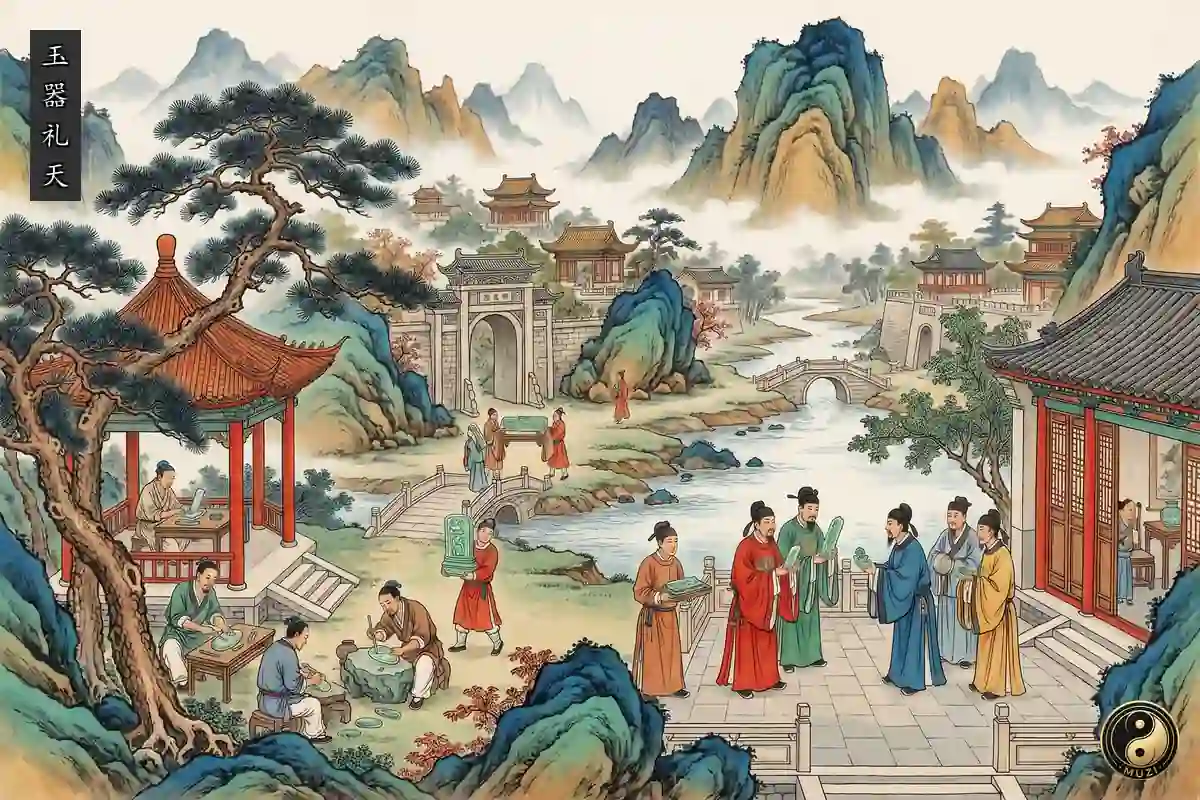
Within the landscape of ancient Chinese jade culture, Jade Culture represents the foundational guideline of the tradition of forced representing between physical attributes and ethical parameters. Under the historical pressures of early jade as a medium for divine communication, prehistoric jade as shamanic instruments, the institutionalization of jade ritual vessels, the Confucian ideal of the gentleman compared to jade, the moralization of jade as ethical metaphor, and the literati tradition of wearing jade, spanning from the Neolithic to the Qing dynasty (c. 8000 BCE to the 19th century CE), this tradition is defined by Neolithic jade jue earrings and jade huang pendants, the Lingjiatan jade eagle, the Hongshan jade dragon, and the Liangzhu jade cong and bi as prehistoric landmarks. By the 750 jade objects from Lady Fu Hao's tomb as the Shang dynasty culmination; by the Rites of Zhou dictum of offering blue green bi discs to Heaven and yellow cong tubes to Earth as the Zhou dynasty canonization; by Confucius's principle that the gentleman models his virtue on jade as the Confucian moralization; by the gold thread jade burial suit from the Mancheng Han tomb as the Han dynasty culmination. And by the Qianlong Emperor's Great Yu Taming the Flood jade mountain as the Qing dynasty culmination. To trace a single coherent lineage to its source: from early Neolithic jade jue and huang prototypes. The Lingjiatan culture jade eagle, jade turtle, and jade tablet as shamanic tools. The Hongshan culture jade dragon as the northern culmination. The Liangzhu culture jade cong as the symbol of theocratic authority. The Qijia culture jade bi and zhang that carried jade westward to the Jade Gate Pass. The Xia dynasty Erlitou jade gui tablets, zhang blades, and jade knives as the jade ritual system. The Shang Lady Fu Hao tomb's 750 jade objects as the Shang culmination. The Western Zhou jade gui, bi, cong and huang assembled into composite jade pendants as the institutionalization of jade ritual. The Rites of Zhou, Book of Spring Officials, Grand Liturgist section's canonization of offering blue green bi to Heaven and yellow cong to Earth, to Confucius in the Analerta (*Lunyu*) and the Record of Rites Betrothal Meaning chapter (*Liji Pinyi*) establishing the eleven virtues of the gentleman compared to jade as the Confucian moralization. The Han gold thread jade suit as the Han culmination, to the Ming Lu Zigang jade carvings and the Qing Qianlong Great Yu jade mountain as the Ming Qing culmination, to modern jade culture in the 21st century, tracing Jade Culture as a forced representing between physical attributes and ethical parameters through every author and text to its roots. The earliest textual anchor of this lineage is the early Neolithic jade jue and huang prototypes. The Xinglongwa culture (Inner Mongolia, Aohan Banner, Xinglongwa site) and the Hemudu culture (Zhejiang, Yuyao, Hemudu site) yielded jade jue earrings, jade huang pendants, and jade beads as the earliest Neolithic jade forms. The Lingjiatan culture (Anhui, Hanshan, Lingjiatan site) advanced jade as mid Neolithic shamanic tools with its jade eagle, jade turtle, and jade tablet incised with eight pointed star and gui shaped patterns. The Hongshan culture (Liaoning, Chaoyang, Niuheliang, Hongshan site) achieved the northern Neolithic culmination with its jade dragon, jade pig dragon, and jade horseshoe shaped vessel. The Liangzhu culture (Zhejiang, Yuhang, Liangzhu site) achieved the southern Neolithic culmination with its jade cong (square exterior, round interior, deity and beast face motifs), jade bi, and jade yue axes as symbols of theocratic power. The Qijia culture (Gansu, Guanghe, Qijiaping site) extended jade westward to the Jade Gate Pass with its jade bi discs (mostly unadorned, 5 to 10 cm in diameter), simplified Liangzhu style jade cong, and jade zhang blades. The Xia dynasty Erlitou culture (Henan, Yanshi, Erlitou site) consolidated the jade ritual system with jade gui tablets, jade zhang blades, and jade knives (over 60 cm long). The Shang Lady Fu Hao (consort of King Wu Ding) achieved the Shang culmination: the 1976 excavation of her tomb at Yinxu, Anyang, Henan, yielded 750 jade objects including jade dragons, phoenixes, human figures, elephants, bears, parrots, doves, cicadas, knives, ge blades, spears, axes, qi blades, hairpins, yuan rings, huan rings, jue slit rings, huang pendants, tubes and beads. The Western Zhou institutionalized jade ritual with jade gui, bi, cong and huang assembled into composite jade pendants strung together and suspended from the neck and waist. The canonization of offering blue green bi to Heaven and yellow cong to Earth was formalized by anonymous compilers during the Warring States period in the Rites of Zhou (*Zhouli*), Book of Spring Officials, Grand Liturgist section: *yi cang bi li tian, yi huang cong li di* (with blue green bi discs honor Heaven, with yellow cong tubes honor Earth), along with green gui for the East, red zhang for the South, white hu for the West, and black huang for the North. The Confucian moralization was established by Confucius (551 to 479 BCE) in the Analects (*Lunyu*) and in the Record of Rites. Betrothal Meaning chapter (*Liji Pinyi*), which lists eleven virtues of the gentleman compared to jade: *wen run er ze, ren ye* (warm and lustrous, this is benevolence); *zhen mi yi li, zhi ye* (dense and firm, this is wisdom); *lian er bu gui, yi ye* (sharp edged but not cutting, this is righteousness); *chui zhi ru zhui, li ye* (hanging down as if about to fall, this is propriety); *kou zhi qi sheng qing yue yi chang, qi zhong qu ran, yue ye* (struck, its sound is clear and lingering, then ceases abruptly, this is music); *fu yin pang da, xin ye* (its veins are visible throughout, this is sincerity); *qi ru bai hong, tian ye* (its aura is like a white rainbow, this is Heaven). *jing shen jian yu shan chuan, di ye* (its spirit appears in mountains and rivers, this is Earth); *gui zhang te da, de ye* (gui and zhang tablets stand alone, this is virtue); *tian xia mo bu gui zhe, dao ye* (all under Heaven prize it, this is the Way). The Han dynasty gold thread jade burial suit achieved the Han culmination through Prince Liu Sheng of Zhongshan (? to 113 BCE). The 1968 excavation of his tomb at Mancheng, Hebei, yielded the gold thread jade suit (1.88 m long, 2,160 jade pieces, over 1,100 grams of gold wire), along with Western Han jade bi discs, jade cicadas (placed in the mouth of the deceased), jade plugs for the nine orifices, and jade weng zhong figurines. The Ming Qing culmination was achieved by Ming dynasty master Lu Zigang (active 1581 to 1644, Suzhou) and the Qing Qianlong Emperor (1711 to 1799, r. 1735 to 1796). Lu Zigang's jade carvings bore his signature directly on the jade, and the Qianlong Emperor's Great Yu Taming the Flood jade mountain (over 5,000 kg, 2.24 m tall, now in the Palace Museum Treasure Gallery) is one of the largest jade carvings ever created. ,、,、《》,、,:、、、,、、、、,。,,。