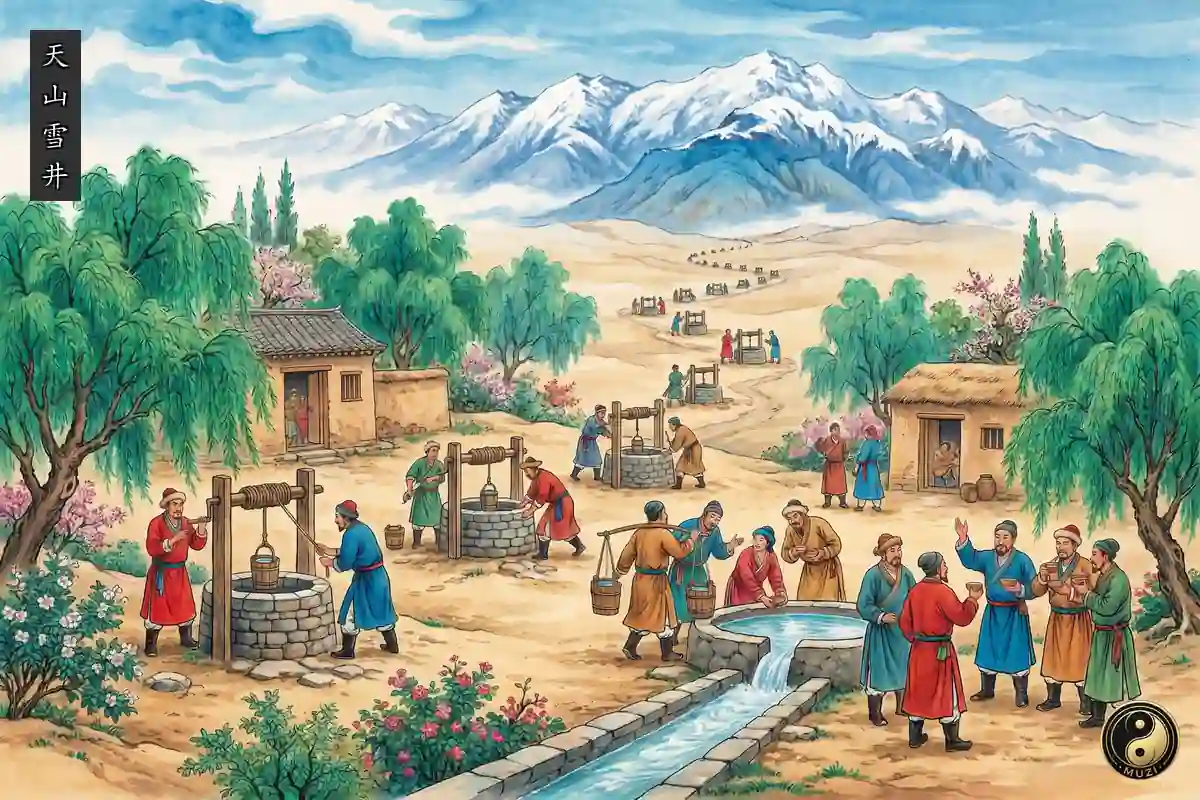
"Wells below, linked to carry water": these words are already in the Records of the Grand Historian, "Treatise on Rivers and Canals". It tells how Zhuang Xiongpi proposed cutting a channel from the Luo to irrigate land; when the channel reached the foot of Mount Shangyan, "the bank often collapsed, so wells were dug, the deepest over forty zhang. Wells were made one after another, linked below to carry water. The water fell and crossed under Shangyan, reaching east for over ten li to the hills. The well-channel began from this. Dragon bones were found in the digging, so the channel was called the Dragon-Head Channel. Work went on for ten years or more; the channel was fairly open but still had not given its profit." This passage gives no year; it is about a channel in Guanzhong, and the words "karez" or "kajing" do not occur on the page.
The waterworks of the Western Regions are written into the military farms. The Book of Han, "Account of the Western Regions", records that in Emperor Wu's time Sang Hongyang and the chancellor and censor memorialized that east of Luntai and at Quli there were "irrigable fields of five thousand qing and more", where "channels can be further opened and the five grains planted, ripening at the same time as in the central states"; they proposed sending military farm troops, "cultivating more irrigated fields, building more watchtowers, and linking walled posts westward to overawe the western states", and "setting three commandants to oversee them". Emperor Wu then turned the proposal down in an edict that "gave a deep account of his past regret", and the text goes on: "From then on no army was sent out again." This passage speaks of military farms and channels; it does not mention underground channels.
The origin of the karez is still disputed today. On 18 July 2026 China News Service's "East Meets West" column carried a summary of an interview with Li Gang, associate research librarian at the Xinjiang Turpan Studies Institute. He says there are three views in scholarship: first, the Han-period Guanzhong "well-channel method" view, first put forward by the late-Qing scholar Tao Baolian, stated clearly by Wang Guowei in his "Study of the Well-Channels of the Western Regions" and supported by Huang Wenbi; second, the "Persian transmission" view, put forward in 1906 by Ellsworth Huntington, who held that the Turpan karez was brought from Persia or Transcaspia around 1780, with Zhang Zhiyi and Huang Shengzhang holding similar views; third, the view that it was "created by the peoples of Xinjiang", in which Liu Hongliang holds that the Turpan karez arose after 1782 and was fully established by 1807. His conclusion is "opinions are many and there is no settled view", and he adds that "according to the carbon-14 dating samples taken by the local authorities with research bodies, the Turpan karez date at the earliest to around the middle Ming". This is the interview's account; no original test report is given. The interview also says the Uyghur name for it "is close in sound to the Persian", and that the Turpan karez's digging method is "largely the same as the karez at Kashan", the Kashan of the interview being in Iran.
Another written record is by Lin Zexu. The interview cites his account of passing through Turpan: "Along the road we saw many earth pits; asking their name, they said 'kajing'. They draw water across, from south to north, bit by bit climbing higher; the water goes through the earth by tunnelling, truly a thing beyond imagining." The interview does not give a year for this passage.
How it works is described in similar terms by the page of the national intangible heritage list and by the interview. A karez has four parts: shafts, underground channel, open channel and reservoir. The interview says that in construction the underground channel is dug from the village back up towards the Tianshan, with a shaft sunk "every 20 to 50 metres" for hauling out earth and for air. Turpan's yearly rainfall is 16 millimetres, against evaporation "above 3,000 millimetres". The interview says the water comes from "Bogda Peak in the north and the Karawucheng Mountains in the west". The page of the China Intangible Cultural Heritage website says the karez was anciently called "well-channel", that its features are "the flowing water is not easily polluted, the temperature is steady, and it suits drinking by people and animals", and that the karez digging technique was listed on the national intangible heritage list in 2014 (the fourth batch).
It has had a declining side too. The interview says that after the 1980s, with warming, falling rainfall and too rapid a rise in field pump wells, the water table fell and "many karez dried up or disappeared". From 2009 the central government and the autonomous region invested over 100 million yuan in emergency reinforcement of more than 200 karez, of which 165 were in Turpan. These figures come from the interview; no separate statistics are attached. The interview also says that the Xinjiang Karez Research Society announced in 2006 that its survey had found a "relatively old karez" near the Bashihaqian Grottoes.
Set beside other canons, a few points join. The entry Dujiangyan Water Project is about a water-diversion works on the Min River; the interview's introduction asks, in the form of a question, why the karez is set beside the Great Wall, the Grand Canal, Dujiangyan and the Lingqu. The entry Silk Road is about the Han and Tang merchant routes of the Western Regions; the interview says Turpan "has used at least 18 ancient scripts and 25 languages". The entry Loose-Rein Rule is about how the court governed the frontier; in the Account of the Western Regions, Sang Hongyang and the others asked for "setting three commandants to oversee them", a proposal to set up offices at a farming post, which Emperor Wu did not take up; the pages do not call it loose-rein rule either.
From the "well-channel" of the Treatise on Rivers and Canals, to the channels of the Han military farms, to Lin Zexu's "kajing", each text speaks of its own matter. The first of the views listed in the interview connects the karez with the well-channel of the Treatise; the pages do not connect the Han farm channels or Lin Zexu's "kajing" with it, and the three views differ from one another. What can be said is that the interview reports that in Turpan "people still use the karez for farming to this day", and that from 2009 more than 200 karez were given emergency reinforcement.
One phrase, "wells below, linked to carry water", one place of military farms with "irrigable fields of five thousand qing and more" in the Western Regions, one passage with Lin Zexu's "kajing": each text speaks of its own matter. The first of the interview's views ties the karez to the well-channel of the Treatise; the pages do not tie the Han farm channels or Lin Zexu's "kajing" to it; and Li Gang's conclusion is that "opinions are many and there is no settled view". What the karez leaves is not only an answer but the dispute itself, and the underground channels of Turpan that are still in use and have been given emergency reinforcement.
Karez Underground Channels is the class in the chapter on Infrastructure on the karez of the Xinjiang oases, the irrigation of underground channels. People used snowmelt and the slope of the land to link channels and shafts across the dry desert, and led the water to the oasis.
 Literature
 Book of Han
 People
 Lin Zexu
 Emperor Wu of Han (Liu Che)
 Sang Hongyang
 History
 Opening of the Silk Road