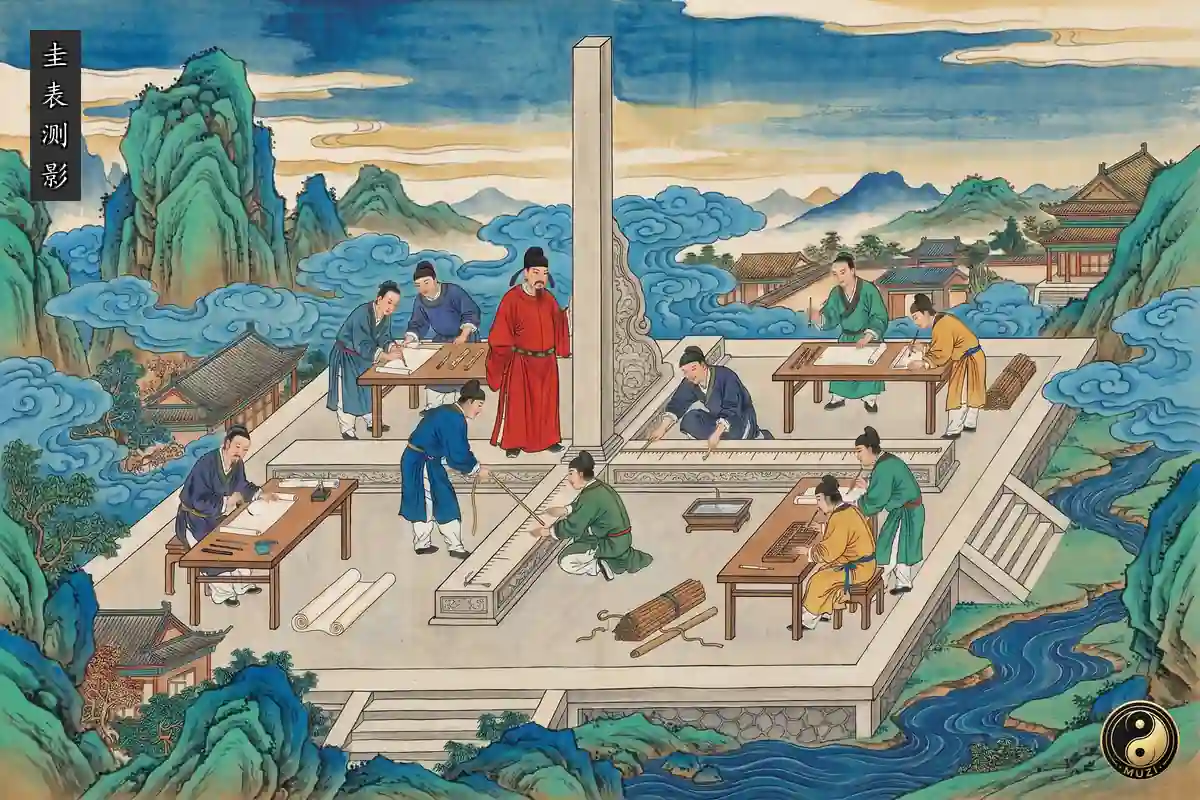
Shadow Measurement joins an upright gnomon to a measuring scale on the ground in one method of observation: the gnomon is a pole set upright, and the scale is a rule that receives its shadow and measures its length. The shadow cast by the sun has a length and a direction, so an observer can follow the seasons, tell north from south, and discuss the "centre of the earth" by a particular shadow. It is an instrument, and it is also an institutional method for turning the sky into a measure on the ground.
The early evidence comes from archaeology. The Institute for the History of Natural Sciences of the Chinese Academy of Sciences places a structure at the Taosi site in Shanxi in the late Neolithic age of the legendary Emperor Yao (about 2400–2100 BCE) and considers that it may be the remains of an early astronomical observatory in ancient China; its researchers also state that its function still needs archaeoastronomical study before a reliable conclusion can be drawn. The value of the material is that it gives clues to an observing space, not that it turns a guess into a verdict; later texts show how measuring the sun's shadow was given meaning for the calendar and for the order of the kingdom.
The textual tradition has two clear points. The authorship and date of the Rites of Zhou have long been questioned; Zhu Xi said it was "not necessarily written by the Duke of Zhou himself". The book records "using the method of the earth gnomon to measure the depth of the land, fix the sun's shadow and seek the centre of the earth", and calls the place where "the solstice shadow is one chi and five cun" the centre of the earth; shadow measurement thus entered a design for state offices. In the thirteenth year of Zhiyuan in the Yuan (1276), Xu Heng, Wang Xun, Guo Shoujing and others were ordered to reform the calendar; according to the Treatise on the Calendar in the History of Yuan, the gnomon they used "makes five eight-chi gnomons", that is, five times the eight-chi gnomon, the shadow was measured on the face of the scale, and "they newly created the shadow aligner to take the true shadow". The new calendar was completed at the winter solstice of Zhiyuan 17, was given by decree the name Shoushi Calendar, and was issued to the realm in Zhiyuan 18.
Its effect on history lies first in putting the space of the kingdom and public time on one scale. The Rites of Zhou ties shadow measurement to founding the kingdom and fixing the royal domain; the "centre of the earth" was not a centre given by nature, but one defined jointly by observation, choice of site and political order. The work of Guo Shoujing and his colleagues turned this ideal into a procedure of measurement for the state calendar: the gnomon was five times the eight-chi gnomon, the shadow aligner served "to take the true shadow", and repeated observation of the shadow became the basis of the new calendar. The History of Yuan also records that the new calendar was compiled on the basis of "observing the changes in the waxing, waning and motion of the sun, moon and stars", which shows that the gnomon was no isolated antique but part of the offices, the calendar officials and the power to issue the calendar.
Its influence on culture also goes beyond observation itself. The winter and summer solstices were points in sacrifice, farming and the seasonal round, and they could be checked again and again by the length of a shadow; the "centre of the earth" therefore became a term later writers used to discuss centre, direction and the order of the realm. Zhu Xi, speaking of the earth gnomon, said that the calendar makers' calculations, "when measured with the earth gnomon, all agree", bringing the old method into the textual inquiry of Neo-Confucian learning; at the same time he said, "but I fear that the Duke of Zhou laid down this method and it was never carried out in full", reminding readers to separate the normative ideal of a classic from historical practice. Recent study of Taosi likewise treats the function of the observatory as an open question, so shadow measurement continues to be reread between archaeology, textual scholarship and the history of astronomy.
Shadow Measurement has concrete ties to five other canons. It is linked with Solar Terms because the long and short solstice shadows give an observed basis for placing the solar terms, and with Lunisolar Calendar because fixing the winter solstice supports the arrangement of the new year, the seasons and the sacrifices. It is linked with Water Clocks because the sun's shadow fixes the solstices and equinoxes of the year while the water clock divides the day into marks, so that the two share the measures of the year and the day. It is linked with Meridian Measurement because the direction of the noon shadow sets north and south on the ground, so that direction exists not only in writing. And it is linked with Shoushi Calendar because Guo Shoujing and his colleagues used a gnomon as tall as "five eight-chi gnomons", the face of the scale and the shadow aligner in the service of the Shoushi Calendar, bringing the early method of shadow measurement into the checking of the Yuan state calendar.
Shadow Measurement holds its place as a canon because it turned the shadow of one pole into a measure that could be shared, checked and disputed: the Taosi site left possible early clues of observation, the Rites of Zhou defined the centre of the earth by "the solstice shadow is one chi and five cun" and wrote the search for it into a design for institutions, and Guo Shoujing and his colleagues fixed the Shoushi Calendar with a gnomon as tall as "five eight-chi gnomons" and a shadow aligner "to take the true shadow". It ordered the seasons, directions and the space of the kingdom together; those who came after could take up its ideal of measurement, but they also had to ask where the evidence ends on the function of the site, the making of the classic and the practice of its institutions, and Zhu Xi already feared that the method was "never carried out in full".
Shadow Measurement is the class in the chapter on Cosmos on fixing the seasons and directions from the shadow of an upright pole. Set up a gnomon and measure the length of its shadow, and the winter and summer solstices can be fixed, and so can the "centre of the earth". The painted gnomon ruler of Taosi in Shanxi, the earth-gnomon measurement of the Rites of Zhou and the tall gnomon of Guo Shoujing of the Yuan all rest on this method.
 Literature
 Rites of Zhou
 History of Yuan
 People
 Zhu Xi
 Guo Shoujing
 Xu Heng