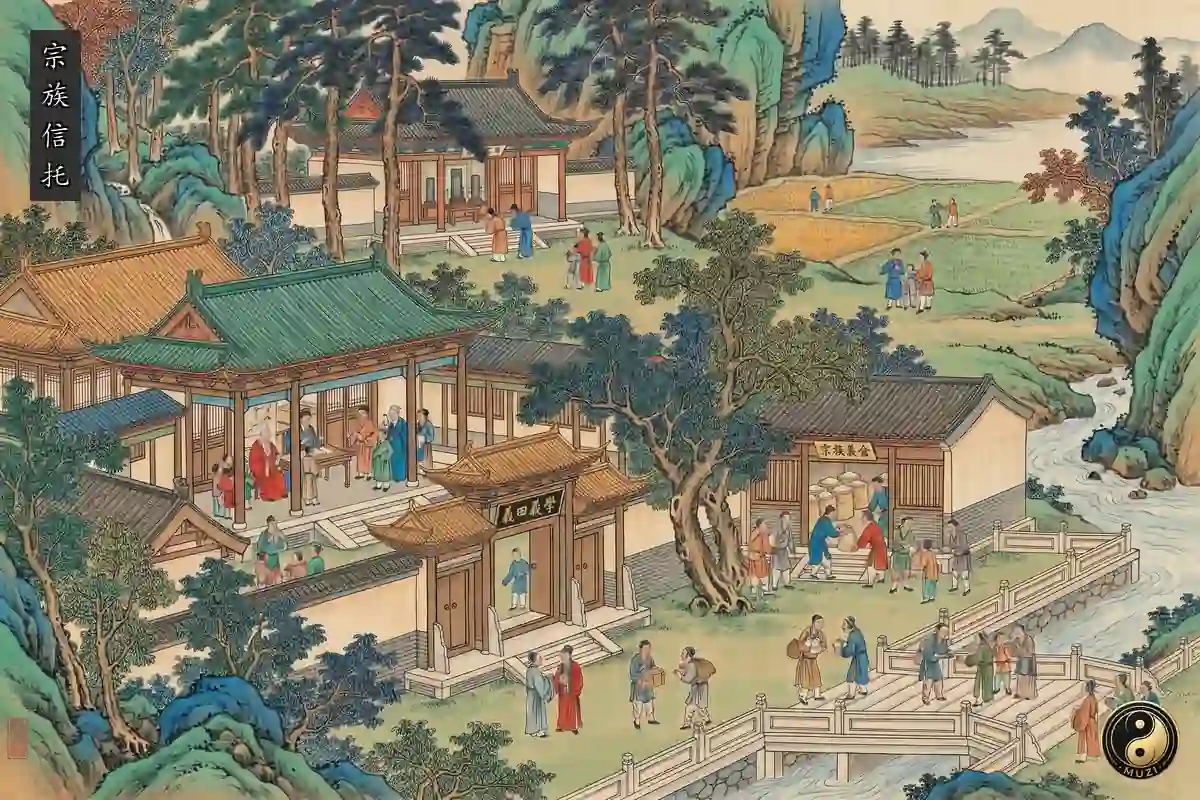
Qian Gongfu's "Record of the Charitable Fields" (Yitian ji, included in the Guwen guanzhi) tells it this way: Fan Zhongyan "bought a thousand mu of fields just outside the city that gave a steady yield, called them the Charitable Fields, and used them to support and relieve the members of the clan. Each day there was food, each year clothing, and for marriages, weddings and funerals there was provision". The figures are given in detail: "a sheng of grain a day per person, a roll of silk a year per person, fifty thousand cash for a daughter's marriage", and "the clan living together came to ninety mouths, and the yearly income supplied eight hundred hu of rice". The Wu jun zhi also copies this record, with slightly different wording: the Guwen guanzhi text says he "lacked the means for thirty years", while the Wu jun zhi quotation has "twenty years"; the two are set side by side, with no choice made between them.
The History of the Song says of him that he "loved to give, and set up a charitable estate in his home place to provide for his kin". The initial set of rules is dated "the tenth month of the second year of Huangyou" (lunar) and signed with the title "Administrator of Hangzhou, Fan". Its clauses require that "each household keep a rice-ticket book, to be marked at the end of each month at the manager's office, with no drawing in advance across the months", and fix that in a good year "grain for two years is set aside", while in a famine "apart from the dry rations, nothing at all is paid out". One clause reaches beyond the clan: for "relatives by marriage and others in the home district" in "unforeseen hardship", "some help is given from the rice of the charitable fields". The Record of the Charitable Fields gives "fifty thousand" for a daughter's marriage, while the rules give "thirty strings, at seventy-seven to the string"; the two pages differ in the figures, and they are set side by side here without conversion. For the year the land was bought, the pages give only a span: Fan Zhirou's memorial says "from the Qingli and Huangyou years onward, fields were bought in stages in the two counties of Wu and Changzhou in Suzhou"; the Record of the Charitable House copied in the Wu jun zhi says only that, while serving at Hangzhou, he returned to his home place and bought land, writing "in the Zaoyou years", with no year; the second year of Huangyou is the date on the initial rules, and it is not taken here as the year of the purchase. The Siku quanshu zongmu tiyao says that Zhongyan set ten rules to begin with, in the second year of Huangyou, that Chunren and his brothers later added twenty-eight, and that twelve more in the second year of Qingyuan were drawn up by Fan Zhirou.
After Fan Zhongyan's death, the History of the Song records of his son Chunren that "what he received in pay and gifts he used wholly to enlarge the charitable estate; when favours for sons came to him, he gave them first to distant relatives". Fan Zhirou's memorial tells of something else: in the first year of Zhiping (1064) Chunren, then magistrate of Xiangyi, was concerned, as the memorial puts it, "lest the wooden notice-board not last long", and that "among the households there are men who do not keep the rules, and since the prefecture and county have no statute on it, the family can hardly set it right", so he asked that the prefecture be ordered "to allow the officials to take such cases", and the court "carried it out as asked". After that the rules were revised again and again; the revisions on the page are dated from the sixth year of Xining (1073) to the fifth year of Zhenghe (1115), and the Continued Rules are signed at the end in the seventh year of Zhenghe (1117). After the move south, the memorial says "the fields alone survived, while the estate buildings were burned", and the Record of the Charitable House copied in the Wu jun zhi (its author calls himself only "Yue" in the text) records the old site's "seizure by local commoners" and says that Fan Liangqi repaired the house and that work began in late summer of the second year of Qingyuan (1196) and was done by the mid-autumn festival (both lunar).
The clauses keep the property apart from individuals: "kinsmen may not rent the charitable fields", "it may not buy kinsmen's land", and "even when the estate's expenses run short, it may not take up debts that carry interest"; if the manager commits "embezzlement", he must "be reported to the officials for judgment and repay, and may not set it off against the monthly rice". The penalties are of two kinds: one falls on the whole household, "a year's monthly rice of the whole household is forfeited"; the other on the man himself, "one who has committed a private offence and been allowed to redeem it forfeits a year of his own monthly rice, and a repeat offender has his name struck off and is never paid rice again". Fan Zhongxin (Huaqiao University, East China University of Political Science and Law Journal, no. 6, 2022, reprinted by the Rujia site) holds that the Fan charitable estate "meets the definition of both association and foundation as legal persons in civil law today"; Wang Xiangping (doctoral student, School of Law, Central South University, Yuandao no. 38, reprinted by the Rujia site) says its legal structure is "astonishingly consistent" with the modern charitable trust, and also that it "did not develop into a trust in the modern sense". There is criticism too; the "Close Kin" chapter of the Yuanshi shifan, writing of this kind of practice, says: "Set up a charitable estate to relieve the poor of the clan, and in time the clan grows large; not only does each share become smaller, but unworthy descendants who receive it do not use it against hunger and cold." His proposal is "better to use the land for charitable schools".
There is a share for study in the charitable estate. The added rules say: "each kinsman who sits the great examination is paid ten strings, at seventy-seven to the string"; the clan chooses "two men of scholarly conduct who have passed the prefectural examination or been recommended, to serve as tutors to all the households, with five dan of coarse rice a month"; and the Hall of the Cold Year, "except in examination years, is lent to the households' young men for study". A clause placed after Fan Zhirou's memorial (the page gives it no year of its own) states that for a young man who "passes the prefectural examination and goes up to the capital", the estate pays a hundred thousand in paper notes, the purpose being "that the young men of every household may know the beauty of reading, and be encouraged". This ties to the examinations that Imperial Examinations describes: part of the income of the clan fields went to the examination hall.
It meets other canons at three points. The Record of the Charitable Fields compares him with Yanzi, who put "first the father's kin, then the mother's, then the wife's, and only after them the worthy among the distant", and it quotes Mencius, "love your kin and then love the people"; this is the ordering of kinship that Filial Piety describes. The order of "funerals before weddings" and "elder mouths before younger" in the rules is the precedence of rank that Rituals describes, written into the accounts. The requirement that the rice-ticket book bear "the signatures of all households in full before it is paid" fits the proofs that Contractual Credit Culture describes.
What Fan Zhongyan's charitable estate leaves in these pages is a tract of land, a set of rules that could be revised, and a memorial asking the officials to take its cases. Its critic says that "in time the clan grows large" and each share smaller, and that it would be "better to use the land for charitable schools"; Qian Gongfu, for his part, says "the scale of the design reaches far".
A thousand mu of land, a set of rules signed "Administrator of Hangzhou", and a run of bans that kept money and rice apart from individuals. It gave kinsmen food, clothes and money for weddings and funerals, gave the young men sitting examinations money for the examinations, and chose "two men" from the clan as tutors; in hardship, "relatives by marriage and others in the home district" could also get some help. After the move south the estate buildings were burned and there was "seizure by local commoners"; Fan Liangqi repaired the house, and the rules went on being added to into the Qingyuan years. Later readers call it "trust" and "legal person"; the word on the pages is only "charitable".
Lineage Trust Funds is the class in the chapter on Commerce on lineage charitable estates, which supported clan members from the income of clan land. In the Northern Song Fan Zhongyan gave land at Suzhou and set up the Fan clan charitable estate; the land belonged to the whole clan and could not be divided, and its income went to support and relieve clan members and to run a school.
 Literature
 Inquiry into the True Way
 Annotated Catalogue of the Complete Library of the Four Treasuries
 History of Song
 Record of the Charitable Estate
 People
 Fan Zhongyan
 Mencius (Mengzi)
 Qian Gongfu