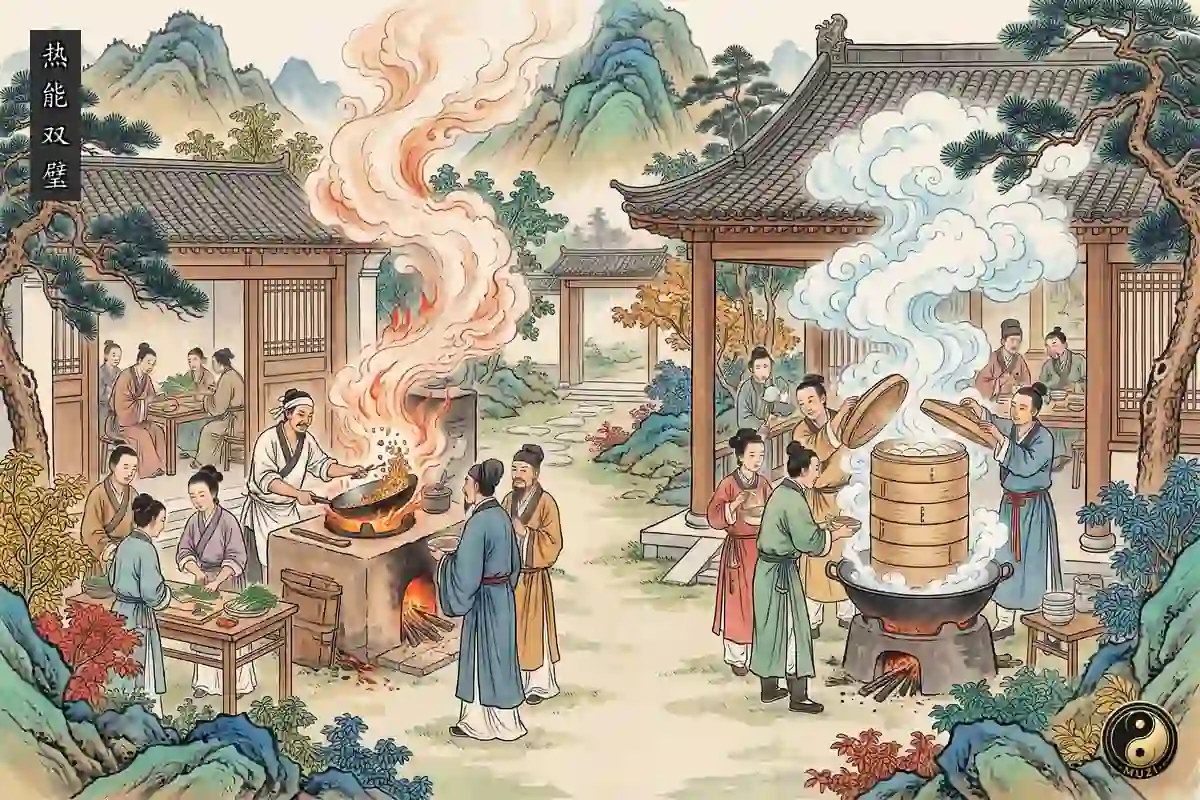
In a kitchen courtyard after snowfall, stacked bamboo steamers sit on two big woks over wood fires, sending up clouds of steam; cooks lift the lids while women carry trays and prepare food.
Stir-frying, steaming, stewing and simmering, red-braising, roasting and deep-frying, together with knife work and the control of heat and seasoning, form the shared technical base of the regional cuisines; the iron wok and the bamboo steamer are their best-known tools.
Cooking Techniques is not about any one dish. It is about how fire, water, oil and the knife are handled. It counts as canon because the craft was written in turn into ritual, into thought and into the marketplace, and then came back to change what people put on the table.
Start with ritual. The Record of Rites, in its chapter on the evolution of rites, says that later sages “cultivated the use of fire” and lists “roasting in clay, roasting over fire, boiling, and broiling.” The Rites of Zhou, in the Offices of Heaven, has a boiler official who “supplies the cauldrons and pans and provides the measure of water and fire”: how much water and how much fire went into a pot was handled by a named office. The Book of Changes, in the Ding (cauldron) hexagram, says “wood below, fire above: that is cooking,” and adds that “the sage cooks to make offerings to the Lord on High, and cooks in great quantity to nourish the worthy.” Cooking here is tied to sacrifice and to the support of the worthy. This end joins Ritual Bronzes: the vessel on the stove was also a ritual vessel.
Then thought. In the Zhuangzi, the butcher Ding, cutting up an ox, says “what I love is the Way, which goes beyond skill.” The Lüshi Chunqiu, in its chapter “The Root of Flavor,” has Yi Yin say that “of the five flavors and three materials, boiled nine times and changed nine times, fire is the rule,” and that “in blending, one must use sweet, sour, bitter, acrid and salty, in order and in amount, and the proportions are very fine.” The changes inside the cauldron are to be compared with “the subtlety of archery and charioteering, the transformations of yin and yang, and the count of the four seasons,” and here it meets Yin-Yang & Five Elements. The Laozi compares it to governing: “Govern a great state as you would cook a small fish.” And in the Analects, in the chapter on Confucius at home, Confucius on eating is recorded as “rice cannot be too fine, minced meat cannot be too thin,” which writes knife work into the daily life of a gentleman. On knife work, the story of the butcher Ding comes from “Nourishing the Lord of Life” in the Zhuangzi. It says there are gaps between the joints while the blade “has no thickness”, so a blade without thickness entering the gaps moves with room to spare; and that a good cook changes his knife once a year because he cuts, an ordinary cook once a month because he hacks.
The names of methods appear in writing a little at a time. The Qimin Yaoshu has a “method of stir-fried eggs”: “Break them, put them in a pan, and stir until yolk and white are mixed. Tear fine scallion whites, add salt, rice and whole fermented beans, and stir-fry in sesame oil; it is very fragrant and good.” An article in the Shanxi Evening News quotes the same passage (with “a bronze pan” for the pan) and takes it to mean that clear written records of stir-frying as a way of cooking dishes appear only in the Wei, Jin and Northern and Southern Dynasties. The Qimin Yaoshu came from the hand of Jia Sixie of the Northern Wei; in it, scroll eight has chapters headed “methods for thick soups and stews” and “methods for steaming and simmering”, and scroll nine one headed “methods for roasting”, so soups, steaming and roasting each have a chapter of their own. By the Song, the Dongjing Menghua Lu lists among the dishes of Kaifeng taverns “stir-fried clams, stir-fried crab,” and says customers called for dishes “as the hour required, and not one item was allowed to be missing.” The Mengliang Lu, describing the tea-and-wine restaurants of Lin'an, gives dish names such as “stir-fried mushrooms,” “wine-grilled green shrimp,” “cauldron-boiled mutton” and “steamed soft mutton,” so that stir-frying, grilling, boiling and steaming stand side by side in one run of dish names. Li Kaizhou, writing in Beijing Youth Daily (reposted by China News Service), says stir-frying became popular in the Song not because the iron pan was invented, since iron pans that could both boil and stir-fry already existed in the Warring States, but because oil pressing improved and plant oil became cheap. He cites the prices of Luoyang recorded in Jia Yan's “Yijia Fu” with its preface: sesame oil 120 coins a jin, rapeseed oil 47, lard between 150 and 190. On his account, a craft spreads when the sums work out.
Yuan Mei wrote these crafts down as clauses. The clauses are collected in the Suiyuan Shidan, published in the 57th year of the Qianlong reign (1792). The “Notes on What to Know” in his Suiyuan Shidan say: “In cooking, fire matters most. Some things need strong fire: frying and stir-frying; weak fire leaves the food limp. Some need gentle fire: slow-simmering and stewing; strong fire leaves it dry.” On utensils, “stir-frying suits an iron pan, simmering suits an earthen pot”; on seasonings, “use summer-brewed soy sauce, and taste it first for sweetness; use fragrant oil, and judge whether it is raw or cooked.” He also criticizes vulgar cooks who boil everything “in one soup, so a thousand hands turn out the same,” and argues that “each thing should give its own nature, each bowl make its own flavor.” And he says “a cook who knows the fire and watches it carefully comes close to the Way.” The Way of the butcher Ding, by the Qing, had come down to the fire at the stove.
Cooking Techniques also pulls against other canons. In “Beware of the Hotpot” Yuan Mei criticizes the winter-banquet hotpot: “each dish has its own proper heat, now gentle, now strong, now to be taken off, now to be added, and a moment's difference matters,” and a shared pot cannot attend to each; this is the techniques' objection to hotpot. In “Beware of Forced Courtesy” he opposes hosts who “pick up food with chopsticks and pile it in front of the guest,” and says the guest should be left to “follow his own wishes”; how a finished dish is served and eaten leads on to the table customs treated in Food Customs. In “What to Know About Seasonings” he asks that soy sauce, oil, wine and vinegar all be examined first, and the soy sauce among them is one of the fermented goods described in Fermentation Condiments.
Put together, the weight of Cooking Techniques is plain: in the Zhou it belonged to the boiler official; in the pre-Qin books it was a figure of speech for governing and nourishing life; in Song restaurants it was a craft that cooked to the customer's order; by the Qing it had been set down in clauses that could be learned and judged. Without this layer, the know-how of cooking could pass only by word of mouth, and heat could hardly have become a principle to be written down and argued over.
Yuan Mei says that a cook who “knows the fire and watches it carefully comes close to the Way,” and the line brings the Way of the butcher Ding back to the stove. Before him, the Rites of Zhou had a boiler official for “the measure of water and fire,” the Lüshi Chunqiu has Yi Yin say “fire is the rule,” and the Laozi compares governing to cooking a small fish; the Shanxi Evening News says clear records of stir-frying appear only in the Wei, Jin and Northern and Southern Dynasties, Song restaurant menus set stir-frying, grilling, boiling and steaming side by side, and Li Kaizhou puts the spread of stir-frying down to plant oil becoming cheap. Cooking thus became a craft that could be written down, taught and judged.
Cooking Techniques is the class for methods of cooking in the chapter on the Cuisine. It covers the main methods, stir-frying, steaming, stewing and simmering, braising, roasting, deep-frying, knife work and the control of heat and seasoning, which are the technical base shared by the regional cuisines; the iron wok and the bamboo steamer are its common, typical vessels. The same ingredient cooked by different methods makes different dishes. This class is about methods, not about particular dishes.
The flaming wok on the left shows high-heat stir-frying and wok hei.
Bamboo Steamer
The stacked bamboo steamer on the right releases clouds of steam, representing gentle steaming.
Preparation Table
Figures at lower left cut and prepare vegetables before cooking.
Steamed-Food Dining
The diners in the upper-right room connect steamed foods with table service.
In an ancient kitchen, a chef on the left tosses ingredients in a roaring iron wok while a master on the right lifts the lid of a bamboo steamer, releasing a cloud of fragrant vapour with dim sum inside. Intense wok hei heat retention balanced by layered steam moisture containment.
Cooking Techniques is like a fan beside the stove: fan quickly and the fire is fierce, fan slowly and it is gentle. From the same pile of wood, a different fanning gives a different fire, and the same ingredients become a different dish; how strong the heat is depends on how fast the fan moves.
The eating houses of Northern Song Bianjing already had stir-fried dishes such as clams and crab; the fan still stands beside the stove in the kitchens of today.
An old cook taught an apprentice to stir-fry, and in the first month let him only watch the fire.
The apprentice asked, "When may I put food in the wok?"
The old cook said, "First learn to read the fire, then we can talk about dishes."
Every day the apprentice crouched at the stove, watched the flame turn from yellow to white, listened to the oil go from still to sizzling, and held his hand over the rim of the wok to test the heat. A month later he stood at the stove and put food in the wok for the first time. When the dish came out the old cook tasted it, said neither good nor bad, and simply set the wok back on the stove, saying, "Once more." The apprentice cooked it again.
He cooked it many times. One day the apprentice no longer looked at the fire; he only listened to the sound in the wok and knew when to turn and when to lift. The old cook stood behind him watching and said not a word.
Later the apprentice took an apprentice of his own, and the first thing he did was also to have him crouch at the stove and watch the fire. Some thought this too slow; he said, "It is the hand that is quick and the eye that is slow, and if the eye has not learned, a quick hand is no use."
Someone asked the old cook, "What exactly did you teach him?" The old cook said, "Nothing. I only kept him from hurrying. Fire cannot be hurried, and neither can a dish." The apprentice heard it and slowed the ladle in his hand a little.
With the same ingredients, a small difference in heat changes the taste. Most of the skill lies in judging fire and time. This class is about those methods, not about any one dish, and a dish here is only an example of a method. (This is an illustrative story, not a historical account.)



 Boiling and PoachingCooking ingredients in water or stock until done, covering boiling, poaching, scalding and blanching.
 Pan-Frying and GriddlingPan-frying in a little oil, or griddling in a pan or on a griddle, so that the surface takes colour.
 Cold TossingThe method of dressing raw or cooked-and-cooled ingredients with seasoning and serving them cold.
 Stir-FryingCooking small pieces in a little oil over high heat, tossed quickly in the wok.
 SteamingCooking food with steam in a steamer.
 StewingSlow cooking in plenty of water or stock over low heat, with the broth kept.
 BraisingCooking in a moderate amount of liquid: red, white and dry braising and covered braising.
 RoastingCooking food by dry heat over charcoal or a fire, or in an oven.
 Deep-FryingCooking food submerged in plenty of hot oil until crisp and golden.
 Knife WorkCutting, slicing, chopping and carving food into the right shapes.
 Heat and SeasoningControlling fire and timing and balancing salty, sweet, sour, hot and savoury tastes.
 Canon
 Literature
 Zhuangzi
 Recipes from the Garden of Contentment
 Rites of Zhou
 Essential Techniques for the Common People
 People
 Yuan Mei
 Yi Yin
 Confucius (Kongzi)
 Jia Sixie
 Flavor