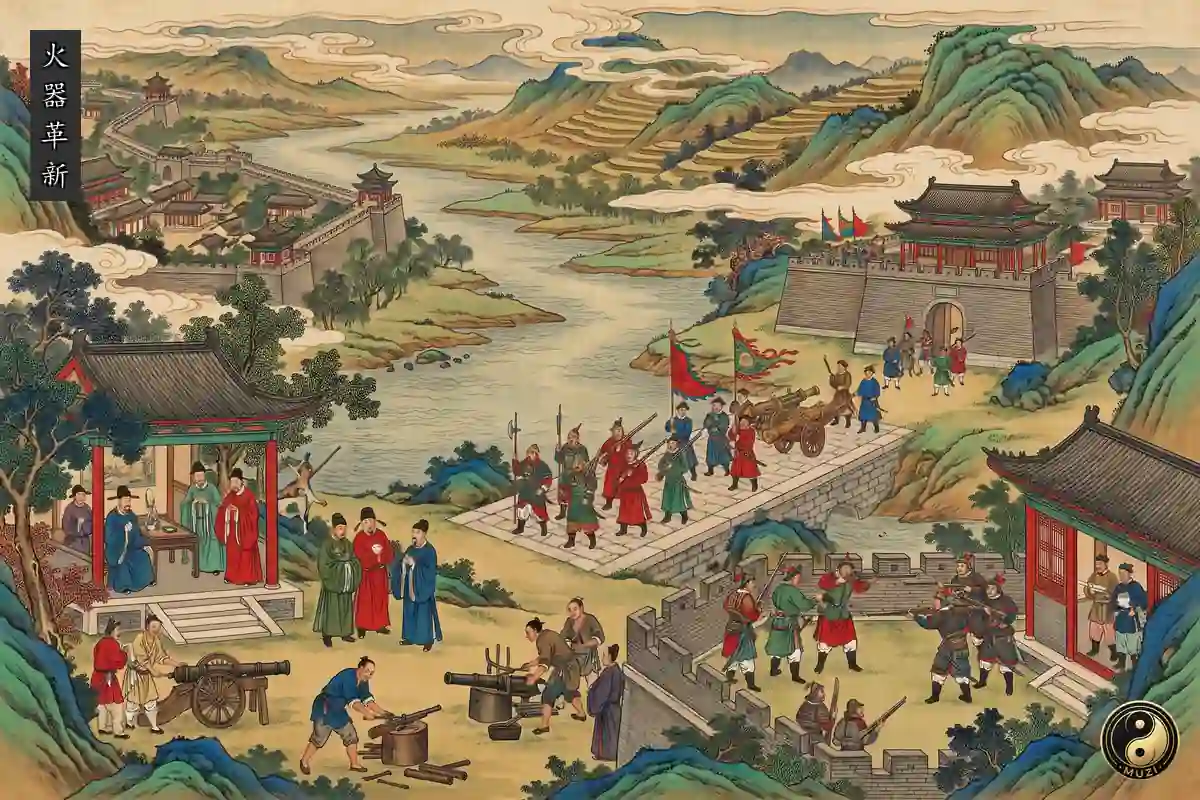
In a history of the Song, a besieged city put fire lances to use. The History of Song, in the Biography of Chen Gui, records that when Li Heng besieged De'an, his generals said "the siege has lasted seventy days," and Chen Gui "led sixty men with fire lances out of the west gate, burned the sky bridge, and used fire oxen to help, and in a moment all was gone, and Heng pulled out his stockades." The Record of the Defense of De'an in the Jianyan Years by Tang Shu (Tang Shu passed the jinshi examination in the fourteenth year of Chunxi and served as instructor at De'an) gives more detail: in the sixth month of the second year of Shaoxing (1132), Li Heng came with some five or six thousand soldiers and civilians from the armies and people of Xiangyang, Deng, Sui and Ying prefectures and set up seventy camps; Chen Gui "used fire-powder made of gunpowder to make more than twenty fire lances on long bamboo poles, and several each of ramming lances and hook-sickles, each to be held by two men together." The two books do not fully agree. On the length of the siege, the History of Song has the generals say "the siege has lasted seventy days," while a heading in the Record of Defense reads "withdrew after sixty-five days." On the sky bridge, the Record of Defense writes that after the sky bridge got stuck, the defenders pushed down "fire ox" bundles of brushwood from the wall, and men inside the outer wall piled the brushwood at the foot of the sky bridge and burned it.
Firearms were later cast bigger and bigger. An article by the China Maritime Museum states that, among bowl-mouthed guns found with a clear date, the earliest was made in the second year of Dade of the Yuan (1298); the barrel bears two lines of 'Phags-pa script, meaning roughly "Dade second year, counted at a full eighty," and according to the experts concerned it was probably a weapon used by the Yuan government against the rebels descended from Chagatai; the earliest surviving one with a clear Chinese date is a piece of the third year of Zhishun (1332), with the inscription "a lucky day in the second month of the third year of Zhishun, Suibian Army to Put Down Rebels, number 300, Mashan." A bowl-mouthed gun of the Laizhou Garrison from the eighth year of Hongwu (1375), found in Penglai in 1988 and weighing 73.5 kilograms, was judged by experts to be a coastal-defense gun against Japanese pirates.
By the Ming, firearms had become a matter for the court. The Treatise on the Military in the History of Ming records that Emperor Chengzu, after settling Jiaozhi, obtained the method of divine-mechanism guns and cannon and set up a Divine Mechanism Camp for training; in the tenth year of Yongle he ordered that five cannon stands be set up on the hilltops from Kaiping to Huailai, Xuanfu, Wanquan and Xinghe. But the court was careful with it: in the fifth year of Xuande it ordered the Commander of Xuanfu, Tan Guang: "Divine guns are weighty to the state; give them to border towers and forts only in measure to lift the army's spirit, and do not issue them lightly"; in the Zhengtong years a border commander set up a divine gun bureau at Xuanfu, and the emperor, because "firearms made outside might leak their art in being taught," ordered it stopped. In the eighth year of Jiajing, on the advice of the Right Censor-in-Chief Wang Hong, Frankish cannon were cast; the treatise says "Folangji is the name of a country," whose ships had come to Guangdong and whose pattern He Ru, the inspector of Baisha, obtained. In the Wanli years, "ships from the Great West came, and large guns were obtained again, called Red Barbarian guns," "over two zhang long, the heavy ones up to three thousand jin, able to split a stone city wall, shaking the ground for tens of li." In the Tianqi years, "they were granted the title of general and officials were sent to sacrifice to them"; under Chongzhen, Xu Guangqi asked for Westerners to be told to make them and send them to the garrisons.
Firearms did not work every time they were used. The same treatise says that under Chongzhen "commanders were often unfit, city defenses were not firm, and some abandoned their posts," that when rebels attacked the capital the soldiers of the Three Great Camps broke without a fight, and that "the guns were all taken by the rebels and used to attack the city in turn." The section on chariot warfare also says that Qi Jiguang trained seven chariot camps at Jimen, "but only to check charges and use firearms, and they were never used in battle."
The battle of Ningyuan in the first month of the sixth year of Tianqi (1626) is where these threads meet: Yuan Chonghuan "burned all the houses outside the city, took his defense gear into the city, and cleared the fields to await them"; the next day, when the army attacked, he ordered the Fujian soldier Luo Li to "fire the great Western guns and wound the troops outside the walls," and when they attacked again and failed, "the siege was lifted." The text says "great Western guns" and does not use the two characters for "Red Barbarian."
The treatise also explains why it treats firearms at length: "Firearms were scarce in earlier ages, so they are set out in detail." Several canons are tied to it. The gunpowder treated in Gunpowder Weaponry is what Chen Gui's fire lances used, the "fire-powder"; the coming of Frankish and Red Barbarian guns joins the Western knowledge treated in Western Learning, and Xu Guangqi asking Westerners to make them is one example; the treatise records chariot camps mounting guns on side-box carts, which meets the chariot formations treated in Weapons & Formations; the clearing of the fields before Ningyuan meets Scorched Earth; and the cannon stands set on the northern hilltops in the tenth year of Yongle stood along the northern line of defense, which meets the defense treated in Great Wall.
Below the walls of De'an the attackers relied on a sky bridge, and the defenders went out with fire lances to burn it; on the walls of Ningyuan the great guns wounded the troops outside. What firearms changed was the reach and the means by which defenders could harm attackers, and they also led the court to control them and give them titles, while later historians gave them a detailed section. They did not simply win every time either: guns can be taken by the enemy and turned on one's own city.
A bamboo pole and gunpowder stood ready on De'an's wall against the attackers' sky bridge; a bronze gun cast with 'Phags-pa script records the second year of Dade of the Yuan; Western guns wounded the troops outside the walls at Ningyuan, and the "Red Barbarian" guns won the title of general in the Tianqi years. Firearms were cast ever larger, yet what they left was more than objects: the court prized them and feared they would leak, and in times of chaos they could fall to the enemy and be turned on the city, so how to keep them, grant them and guard against them went into the histories as much as how to cast them.
Firearms Evolution is the class in the chapter on Strategies on firearms. It covers how firearms advanced step by step to the centre of the battlefield, from the bamboo fire lance at the siege of De'an in the Southern Song and the bronze Xanadu Gun of the Yuan to the European-style Hongyi cannon at the battle of Ningyuan in the Ming.
 Literature
 History of Song
 People
 Cha Hetai
 Qi Jiguang