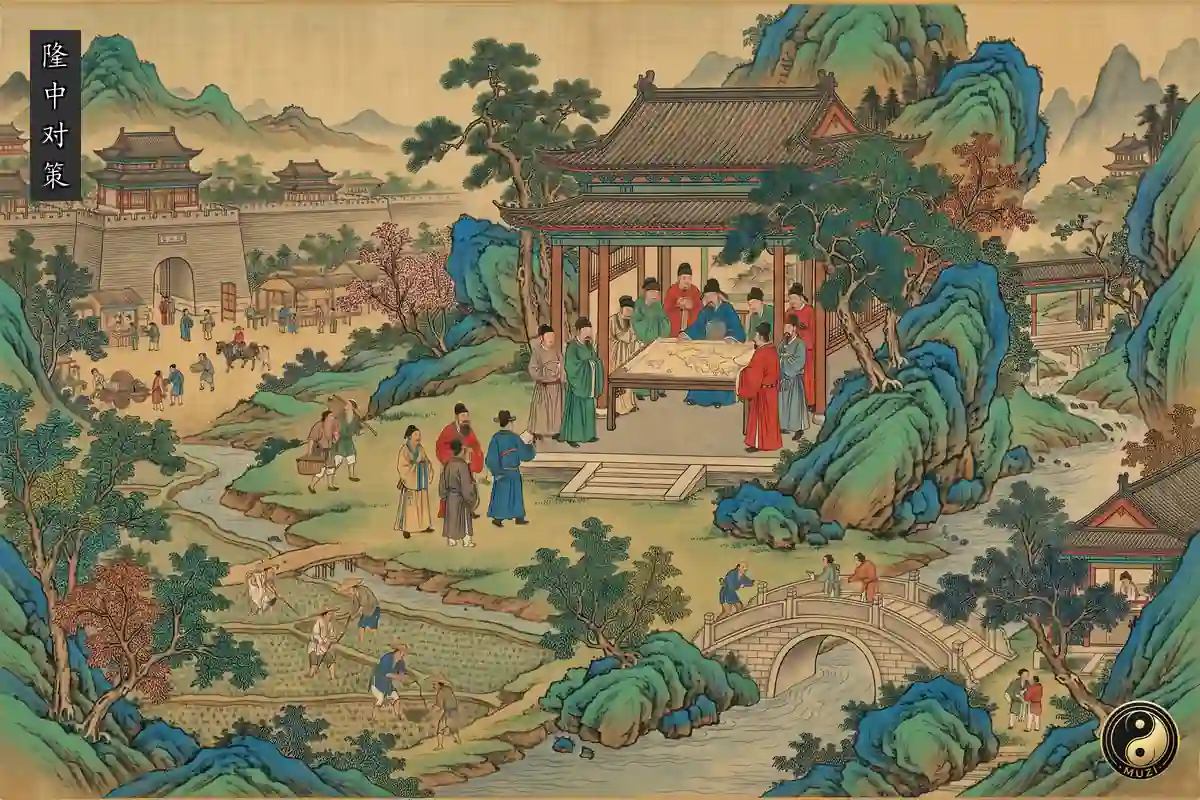
Liu Bei asked: "What plan do you see for me?" Before that question came three visits to the door. The Records of the Three Kingdoms, in the Biography of Zhuge Liang, says that Xu Shu told Liu Bei of Zhuge Liang: "This man can be called on, but cannot be summoned"; and so "the First Ruler went to see Liang, three times in all, before he met him." The Comprehensive Mirror to Aid Government places this talk in the twelfth year of Jian'an (207).
Zhuge Liang's answer has four layers. First, rivals and allies: Cao Cao "already has a million men, holds the emperor and gives orders to the lords, and cannot be matched in a contest of edges," while Sun Quan "holds the land east of the river, has held it for three generations, its terrain is hard and its people loyal, and able men serve him; he can be an ally, but cannot be taken." Second, a place to stand: Jingzhou is "a land for war whose master cannot hold it," Yizhou has "strong passes and fertile plains for a thousand li, a storehouse of the heavens," and Liu Zhang is weak and dim. Then the method: "If you hold Jing and Yi both, guard their rocky heights, make peace with the western tribes, soothe the Yi and Yue in the south, ally yourself with Sun Quan outside, and set your government in order within." Last, the moment: "when the world changes," send one senior general with "the army of Jingzhou toward Wan and Luo," while "you yourself lead the host of Yizhou out of Qinchuan," and then "the hegemon's work can be done and the house of Han restored."
The first half came true. Zhuge Liang went to Wu on a mission and said to Sun Quan: "When Cao's army is broken it must go back north, and then the strength of Jing and Wu will be great and the shape of a tripod will be formed." Sun Quan sent Zhou Yu, Cheng Pu and Lu Su with thirty thousand marines, and "Lord Cao was beaten at Red Cliff." Liu Bei took the lands south of the river and then Yizhou in the west, and Zhuge Liang rose to be Army Counselor and General. Chen Shou, in the memorial he wrote when presenting the Collected Works of Zhuge, also says that Zhuge Liang "allied himself with Eastern Wu abroad and pacified the Nanyue at home."
The second half fell through. In the twenty-fourth year of Jian'an, Guan Yu attacked Fan, and Cao Cao "discussed moving the capital from Xu to avoid his edge." Sima Yi and Jiang Ji urged him to "send someone to persuade Quan to come at his back, promising to cut off Jiangnan and enfeoff him with it," and Cao Cao followed the plan; Sun Quan "already held Jiangling and took Yu's soldiers, wives and children," and Guan Yu was beheaded at Linju. The Longzhong Plan needed "the army of Jingzhou" to go north toward Wan and Luo; with Jingzhou lost, that road was cut.
Zhuge Liang still marched north from Yizhou. Pei Songzhi's annotation says that in the fifth year of Jianxing he presented the Memorial on Leading the Army: "Now the realm is split in three and Yizhou is worn out; this is truly a time when survival and ruin hang in the balance," and he meant to "pacify the Central Plain, give all my poor strength, clear away the wicked and restore the Han"; in the spring of the next year (the sixth year of Jianxing, 228) he marched out to Qishan, was defeated at Jieting, and sent up a memorial asking "to be demoted three ranks"; later he camped at Wuzhang Plain, "dividing his troops to farm, to make a base for a long stay," and "Liang was always troubled that grain did not follow," and in the autumn of the second year of Qinglong (234) he died in the field at fifty-four. Sima Yi walked through his camp and said: "A rare talent under heaven!"
Later readers have disagreed sharply about this plan. Chen Shou's verdict reads: "Year after year he moved the host and could not finish the work; perhaps shifting generalship to meet change was not his strength!" Su Xun said: "Zhuge Kongming gave up Jingzhou for western Shu, and I know he could do nothing," adding that Shu's land is such that "its defense cannot be attacked, but its sallies cannot be sustained." Zhu Xi said: "If there had been no accident, Cao would not be worth defeating; with two columns advancing, who could stand against them?" Huang Pumin and Sun Jianmin, in A History of Chinese Military Thought, take neither side: Su Xun's view is "an attempt to startle," Zhu Xi "praised it too highly"; they grant that the goal of "two columns advancing" was too ideal. Yet they still hold that, once carried out, the plan gave Liu Bei his victory at Red Cliff and finally the state of Shu-Han and the three-way balance, and that its flaws do not harm Zhuge Liang's standing.
How the talk began is also told two ways. Pei Songzhi's annotation quotes the Wei Lue, which says that Zhuge Liang went to see Liu Bei first; Pei Songzhi, relying on Zhuge Liang's own Memorial on Leading the Army, "he visited me three times in my thatched hut," judges: "It is clear that Liang did not call on Bei first."
The talk entered people's reverence. In the spring of the sixth year of Jingyao (263), the court ordered a temple built for Zhuge Liang at Mianyang; Pei Songzhi's annotation quotes the Record of Xiangyang, which says that at first the court discussion refused on grounds of ritual rank, and the people made private offerings by the roadside at festivals. When the Wei general Zhong Hui entered Shu and reached Hanchuan, he sacrificed at Zhuge Liang's temple and ordered his soldiers not to graze animals or gather firewood near the tomb. Other canons take the talk up too: Chen Shou wrote it into the Records of the Three Kingdoms and the Comprehensive Mirror copied it out again, so that, like the figures in the book treated in Records of the Grand Historian, it has come down through the histories; the alliance with Wu against Wei is the art of alliance treated in Balance of Power; the Memorial on Leading the Army says "this is how I repay the late emperor and do my duty to Your Majesty," which matches the sense of duty treated in Loyalty; and the note to "borrow a knife to kill" in Thirty-Six Stratagems takes "Zhuge Liang's peace with Wu to resist Wei, and Guan Yu's siege of Fan and Xiangyang" as its example, while the note to the empty city stratagem says "after Zhuge, there have been many like him."
The place of the Longzhong Plan lies in setting Cao Wei, Jiangdong, Jingzhou and Yizhou out clearly on one map. Later readers, whether they agree or object, use it to measure one idea: for the weak to grow strong there must be a place to stand, allies and the right moment, and when any link breaks, the plan must be rewritten. In 219 Jingzhou was lost, yet Zhuge Liang still marched north from Yizhou until his death; Chen Shou judged that "shifting generalship to meet change was not his strength," and also recorded that "to this day the people of Liang and Yi, when they speak of Liang, speak as if his words were still in their ears."
Liu Bei asked for a plan; Zhuge Liang answered with two columns from Jing and Yi and an alliance with Wu against Cao; once Jingzhou was lost, two columns became one, but the northern campaigns did not stop. Chen Shou said "shifting generalship to meet change was not his strength," Su Xun and Zhu Xi each held a different view, and the people of Liang and Yi spoke as if his words were "still in their ears," while the enemy general Zhong Hui forbade his soldiers to gather wood by the tomb. Read and argued over like this, a single conversation became more than an episode of history: it became a rule by which later readers measured a plan.
The Longzhong Plan is the class in the chapter on Strategies on one particular plan. It covers the scheme Zhuge Liang put to Liu Bei at Longzhong in 207, the twelfth year of Jian'an, to hold Jing and Yi provinces, ally with Wu against Cao Cao and divide the realm in three: in 219 Jing Province was lost and the premise of the plan collapsed, yet Zhuge Liang kept it as the groundwork of his northern campaigns until he died in 234.
 Literature
 People
 Su Xun
 Zhu Xi
 Guan Yu
 Cao Cao
 Liu Bei
 Zhuge Liang
 Chen Shou