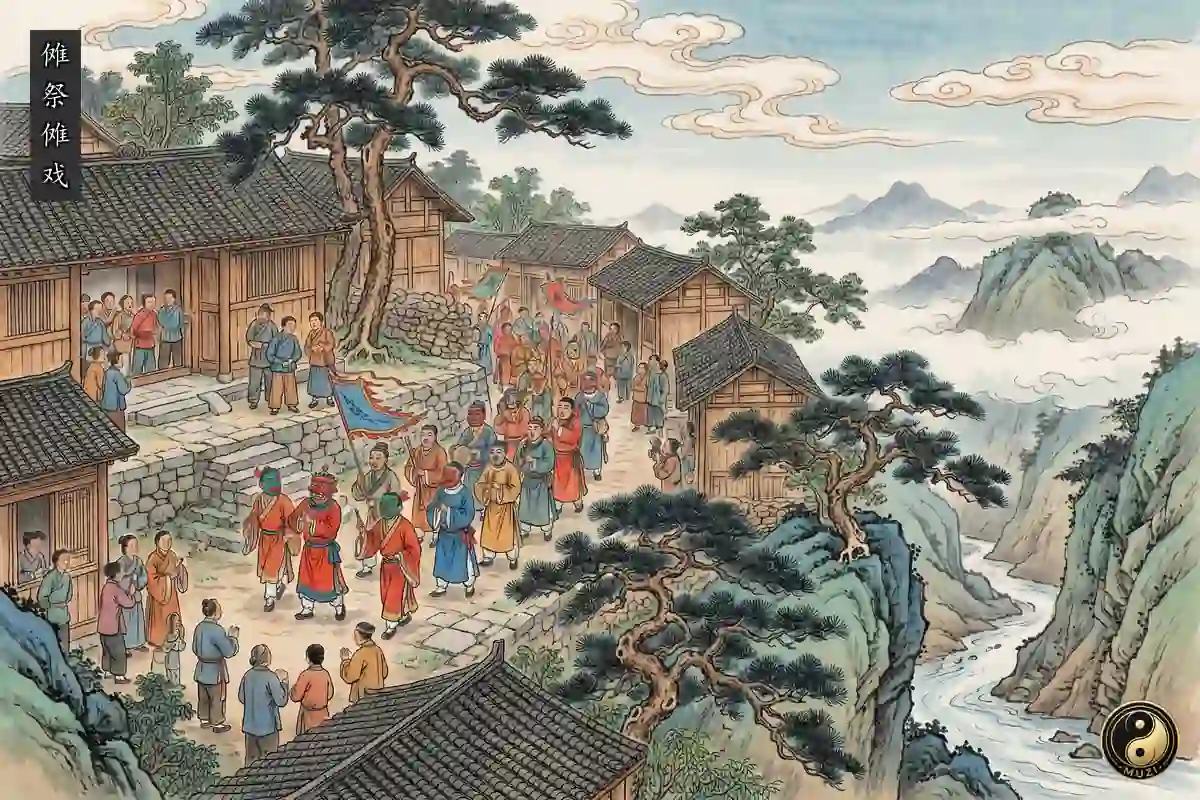
Nuo-ji Nuo-xi (Nuo rituals and Nuo opera: the millennia-spanning masked-shamanic-performance-art living fossil of the East, with the mask-wearing as the facilities-key that hard-cuts the wearer's identity from the daily-life LAN and elevates to a supernatural-permission root-admin clearance) is, in the map of the Chinese classical ritual and early-drama tradition, the first-generation source-rule of the identity-physical-standardizing and virtual-permission-elevation mechanism tradition that. under the historical pressure of plague-fear and tribal collective-unconscious panic-noise-reduction and imperial ritual-institutionalization and commoner regionalization and dramatization from antiquity to Ming-Qing (13th century BCE to 19th century CE), defined as the mask-wearing as facilities-peripheral and fang-xiang-shi and wu-xi as execution-node and plague-expulsion / blessing-invocation / dramatization as the three-stage evolution-path the most-fundamental civilizational answer that, in the Chinese classical ritual and early-drama system. the Nuo-ji Nuo-xi is the identity-physical-standardizing and virtual-permission-elevation mechanism that hard-cuts person-god boundary as the mask and fang-xiang-shi and wu-xi three-in-one, in the wake of imperial ritual-institutionalization and commoner regionalization and dramatization convergence, as the millennia-spanning oldest and longest-stretch masked-ritual tradition's first-generation source-rule. To trace a single coherent lineage down to its source, you have to start from the Shang oracle-bone graph of the character nuo to the Western-Zhou Zhou-li fang-xiang-shi state-nuo institutionalization to the Spring-and-Autumn Lun-yu Confucius village-persons do the nuo. court-robed stand at the zu-jie-step ritual-custom interaction to the Warring-States Li-ji Yue-ling four-time-segment state-nuo system to the Qin-Han Lv-shi-chun-qiu Ji-dong-ji commission the officials to do the great-nuo side-pieces-of-sacrifice continuation to the Western-Han Han-jiu-yi Zhuan-xu three-sons became the plague-spirits mythic-origin systematization to the Eastern-Han Fan-ye Hou-Han-shu Li-yi-zhi the day before la-festival, the great-nuo, called the plague-expulsion state-ritual crystallization and Zhang Heng (78-139 CE) Dong-jing-fu year-end great-nuo, drive-out the myriad-pestilences fu-poetry crystallization to the Tang Duan An-jie Yue-fu-za-lu Qu-nuo use four fang-xiang. wear crown-and-mask, golden four-eyes... palace-nuo specification to the Northern-Song Meng Yuan-lao Dong-jing-meng-hua-lu (1127) on the day-before-new-year, the palace great-nuo ceremony Bian-jing crystallization to the Southern-Song Zhou Mi Wu-lin-jiu-shi (1270s) and Zhu Xi annotating nuo Lin-an palace-nuo and Confucian-ritualization annotation to the Ming-Qing regional-nuo-opera final-dramatization landing (Anhui Guichi and Jiangxi Nanfeng and Hunan Yuanling and Guizhou Weining and Guizhou Anshun and Tibet Samye). To trace Nuo-ji Nuo-xi as the identity-physical-standardizing and virtual-permission-elevation mechanism you have to do the most-complete back-trace author-by-author book-by-book. The earliest textual anchor is the Shang oracle-bone graph of the character nuo: with the character nuo in the Yin-xu oracle-bones (c. 13th-11th century BCE) as the written-form expression of the plague-expulsion-and-dispelling-ritual , so that the character nuo in the Shang first acquires the fundamental position of the written-form expression of the plague-expulsion-and-dispelling-ritual. The Western-Zhou state-nuo institutionalization: the Zhou-li Xia-guan Fang-xiang-shi section (c. 11th-8th century BCE) , with the marker sentence the Fang-xiang-shi controls the bear-skin-wearing, the golden four-eyes, the dark-robe red-skirt, the halberd-holding shield-raising, leading the hundred-bondservants to do the time-nuo, to sweep-the-room drive-out the plague , so that Fang-xiang-shi in the Western-Zhou first acquires the fundamental position of the state-nuo execution-node. The Spring-and-Autumn ritual-custom interaction: the Lun-yu Xiang-dang (Confucius, c. 500 BCE) , with the marker sentence when the village-persons do the nuo, the court-robed stand at the zu-jie-step , so that village-persons nuo in the Spring-and-Autumn first acquires the fundamental position of the ritual-custom interaction. The Warring-States four-time-segment state-nuo systematization: the Li-ji Yue-ling (c. 5th-3rd century BCE) , with the marker sentences in the last-month-of-spring, command the state-nuo, the nine-gates piece-and-expel, to finish the spring-vital-force and in the middle-month-of-autumn, the Son-of-Heaven does the nuo, to arrive-at the autumn-vital-force and in the last-month-of-winter, command the officials to do the great-nuo, the side-pieces-of-sacrifice, the earth-ox-issuing, to send-off the cold-vital-force , so that Li-ji Yue-ling in the Warring-States first acquires the fundamental position of the four-time-segment state-nuo system. The Qin-Han continuation: the Lv-shi-chun-qiu Ji-dong-ji (239 BCE) , with the marker command the officials to do the great-nuo side-pieces-of-sacrifice , so that Lv-shi-chun-qiu in the late-Warring-States first acquires the fundamental position of the Qin-Han state-nuo continuation. The Western-Han mythic-origin systematization: the Han-jiu-yi (c. 1st century BCE to 1st century CE, anonymous-attributed to the Qin-Han ritual-codification-collection) , with the marker sentence Zhuan-xu had three sons, who died and became the plague-spirits, one dwelling in the Jiang-river becoming the malaria, one dwelling in the Ruo-river becoming the wang-liang, one dwelling in the people's palace-corner-corner, good-at-startling the human-infant, thus at the year-end the day-before-la-festival the great-nuo , so that Han-jiu-yi in the Western-Han first acquires the fundamental position of the Nuo mythic-origin. The Eastern-Han state-ritual crystallization: Fan-ye (398-445 CE) Hou-Han-shu Li-yi-zhi , with the marker the day-before-la-festival, the great-nuo, called the plague-expulsion , so that Fan-ye and Li-yi-zhi in the Liu-Song first acquires the fundamental position of the state-ritual crystallization. The Eastern-Han fu-poetry crystallization: Zhang Heng (78-139 CE) Er-jing-fu's Dong-jing-fu , with the marker year-end great-nuo, drive-out the myriad-pestilences, the Fang-xiang holds-the-axe, the wu-xi hold-the-broom-wand, the dwarves-and-giants, the play-and-jest only , so that Zhang Heng and Dong-jing-fu in the Eastern-Han first acquires the fundamental position of the Nuo fu-poetry crystallization. The Tang palace-nuo specification: Duan An-jie (9th century, active in the late-Tang) Yue-fu-za-lu Qu-nuo section , with the marker sentence use four fang-xiang, wear crown-and-mask, golden four-eyes, bear-skin-wearing, dark-robe red-skirt, halberd-holding shield-raising, also one-person big-and-tall, red-forehead-band, big-sleeved-robed, dances , so that Duan An-jie and Yue-fu-za-lu in the late-Tang first acquires the fundamental position of the palace-nuo specification. The Northern-Song Bian-jing crystallization: Meng Yuan-lao (c. 1090-1150 CE) Dong-jing-meng-hua-lu (completed 1127 CE, post-south-crossing) , with the marker on the day-before-new-year, the palace great-nuo ceremony , so that Meng Yuan-lao and Meng-hua-lu in the Southern-Song first acquires the fundamental position of the Bian-jing palace-nuo crystallization. The Southern-Song Lin-an palace-nuo and Zhu-Xi annotation: Zhou Mi (1232-1298 CE) Wu-lin-jiu-shi (completed in the 1270s) with the marker the palace-internal great-nuo ceremony and Zhu Xi (1130-1200 CE) Confucian-ritualization annotation of the character nuo , so that Zhou Mi and Zhu Xi in the Southern-Song first acquires the fundamental position of the Lin-an palace-nuo and Confucian-ritualization annotation. The Ming-Qing regional-nuo-opera final-dramatization landing: the various Ming-Qing two-dynasty Nuo-opera , with Anhui Guichi Nuo-opera (one of the oldest drama-material-objects existing, the Ming Zheng-de / Jia-jing period hand-copied-edition existing, including Liu-jia-jing and Yin-jia-hui and Dang-li-Yao and other 30 and nuo-opera-societies) and Jiangxi Nanfeng Nuo-dance (Ming-mid-to-late origin, Qing-copied-edition and nuo-shrine-temple existing) and Hunan Yuanling Chen-zhou Nuo (Qing) and Guizhou Weining Cuo-tai-ji (Yi-ethnic primal Nuo form. Qing) and Guizhou Anshun Di-xi (Ming-early transfer-north-attack-south garrison-people military-nuo relic) and Tibet Qiang-mu / Tiao-shen (8th century CE origin, Padmasambhava Sam-ye Buddhist-esoteric-nuo-ritual) , so that Ming-Qing regional-nuo-opera in the Ming-Qing two-dynasty first acquires the fundamental position of the Nuo dramatization final-landing. ,《》《》《》,,《》《》,、、、、,:、,、、。,,。