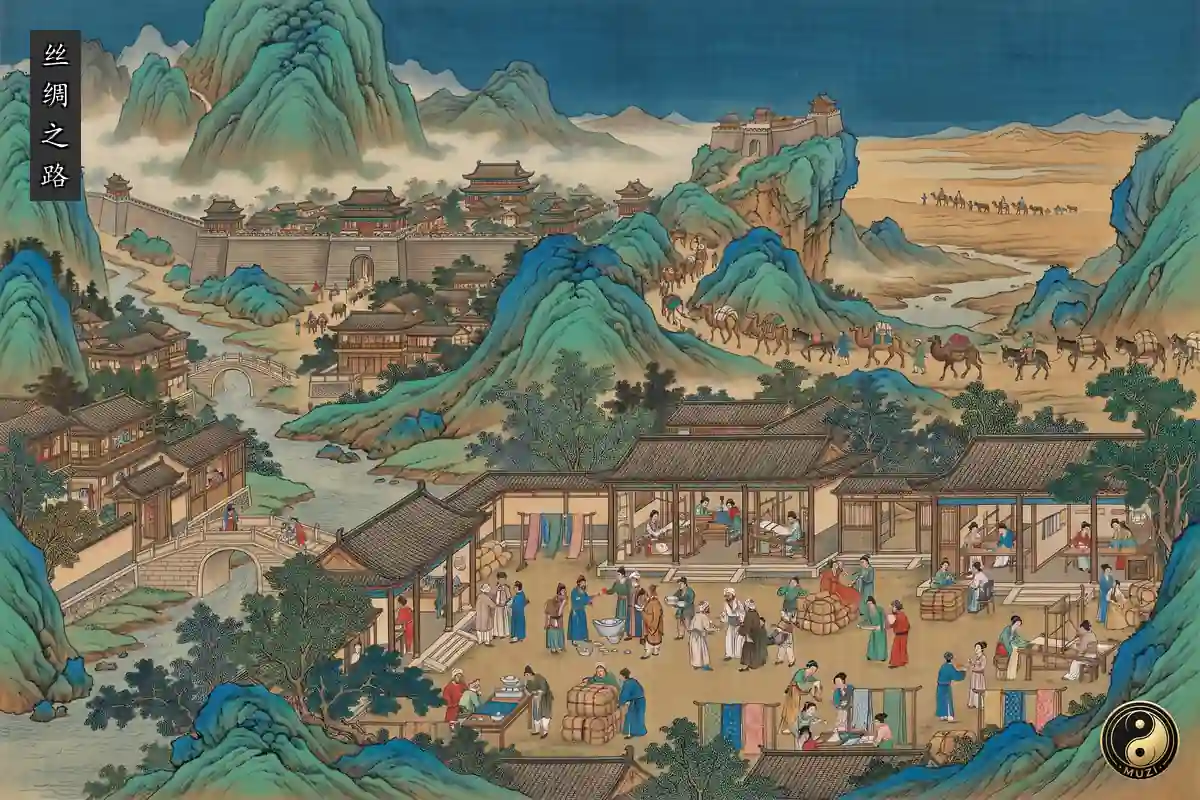
The name Silk Road is a later one. An article in volume 17 (2019) of the American journal The Silk Road, by Matthias Mertens, says that Richthofen is usually thought to have coined the term in 1877, yet it already appears in earlier German books. The earliest case he finds is in volume 8 of Ritter's Die Erdkunde, of 1838; he says it "may represent the first usage", while warning against simply crowning Ritter as its inventor. After that the term was used in Johann Kaeuffer's History of East Asia of 1858, in a book by Guthe of 1868 and in Robert Mack's dissertation of 1874. Richthofen's part, it says, was to give it a more exact definition and to consolidate it as a single term. What the old books leave is a concrete record of the road.
The "Account of Dayuan" in the Records of the Grand Historian (Shiji) begins with Zhang Qian: "Zhang Qian was a man of Hanzhong. In the Jianyuan period he was a palace attendant." Sent to make contact with the Yuezhi, he was held by the Xiongnu for "over ten years"; "when Qian set out there were over a hundred men; in the thirteen years he was away, only two got back". The book says only "in the Jianyuan period" and gives no year of departure, and this entry gives none. Reporting to the emperor he said: "When I was in Daxia I saw bamboo staffs from Qiong and cloth from Shu"; the Daxia people said merchants bought them in Shendu, and from this he concluded: "so it cannot be far from Shu." The same Account adds: "Yet Zhang Qian had bored open the way, and the envoys who went after him all took the title Marquis Bowang."
The road was walked by people, and they carried goods. The Account of Dayuan says that from Wusun westward to Anxi, Han envoys "could not get food without offering silk goods"; from Dayuan westward to Anxi, "the land has no silk or lacquer" and the people are "good at trading, haggling over the smallest weight"; and that Han envoys took back the fruit of alfalfa and grape, so that "the Son of Heaven began to plant alfalfa and grapes on rich soil." The book notes both ends at once: that region had no silk or lacquer, and what the envoys brought back was planted beside the detached palaces.
The Han court then took the road in hand. The "Account of the Western Regions" in the Book of Han (Hanshu) describes two roads: "Going out from Yumen and Yangguan into the Western Regions there are two roads: from Shanshan, following the foot of the southern mountains, then along the river westward to Shache, is the southern road ... from the royal court of Anterior Cheshi, following the northern mountains, then along the river westward to Shule, is the northern road." It also says "from Dunhuang west to the Salt Marsh, relay posts are raised here and there". The setting up of the Protector-General is recorded under Emperor Xuan: the Xiongnu's Rizhu king came to submit, Zheng Ji met him, and "that year was the second of Shenjue. He was then made to protect the northern road as well, and so the post was called Protector-General. The Protector-General began with Ji." The second year of Shenjue is 60 BCE. The Protector-General's duty was "to oversee Wusun, Kangju and the other foreign states and report any stir or change".
Around the Sui and Tang the court wanted to understand the road. The Book of Sui (Suishu), in the biography of Pei Ju, says that the western peoples "came in numbers to Zhangye to trade with China", that Emperor Yang had Pei Ju take charge of it, and that he "drew the merchants who came to tell the customs, mountains and rivers, and dangers and easy ground of their countries" and compiled the Xiyu tuji (Illustrated Record of the Western Regions). In its preface: "Starting from Dunhuang and reaching the Western Sea there are three roads in all"; the northern, central and southern roads all "reach the Western Sea", and the reason the affairs of the states were all known was "the rich merchants and great traders, who travelled and passed through". He also judged: "Yiwu, Gaochang and Shanshan are the gateways to the Western Regions. All converge on Dunhuang, which is their throat."
In the Tang one end of the road was Chang'an. The Zizhi tongjian records an event of the third year of Zhenyuan under Emperor Dezong (787 CE): since Tianbao, the memorialists from Anxi and Beiting and the envoys from the Western Regions who were in Chang'an found their way home cut off. Li Bi found "Hu guests who had stayed in Chang'an a long time, some for over forty years, all with wives and children, who had bought fields and houses and lent money at interest, and were settled and unwilling to go back", and ordered that those with fields and houses "have their allowance stopped", four thousand people in all. Li Bi said he would send them home through Huihe territory, and that those who did not want to go back should declare so to the Court of State Ceremonial and be given posts; the result was that "not one of the Hu guests was willing to return", and they were afterwards enrolled in the Shence armies. This page records foreign envoys staying on in Chang'an; it is not an account of trade.
UNESCO's statement on the Chang'an-Tianshan corridor of the Silk Roads sets the road in a wider setting: from the second century BCE, long-distance trade in high-value goods grew, and China supplied silk to Central, South and West Asia and the Mediterranean world; the corridor flourished from the sixth to the fourteenth century, and remained in use as a major trade route until the sixteenth century. Along it stand posthouses, beacon towers and sections of the Great Wall, and also pagodas and cave temples from Kucha to Luoyang that record the eastward transmission of Buddhism from India.
The dates these pages give each stand on their own: Zhang Qian's mission has only "in the Jianyuan period", the Protector-General dates from the second year of Shenjue (60 BCE), the Hu guests from the third year of Zhenyuan (787), and UNESCO writes of the second century BCE to the sixteenth. Which year counts as the opening of the Silk Road, these pages do not say.
The Silk Road is linked to several other canons. Silk & Brocade covers silk weaving, and UNESCO puts China's supply of silk at the head of this road; Grotto Art covers cave carving and painting, and UNESCO says the caves and pagodas from Kucha to Luoyang record the eastward spread of Buddhism; Great Wall covers the frontier walls, and UNESCO lists sections of the Great Wall among the remains along the corridor; Merchant Guild Commerce covers how merchants banded together and traded, and the Book of Sui says Pei Ju knew the affairs of the states through "rich merchants and great traders".
What the road left, besides goods, was a set of things officials did: they set up a Protector-General, raised relay posts, took charge of trade at Zhangye, and let the Hu guests who would not go home declare so to the Court of State Ceremonial and take posts. UNESCO also writes that the posthouses and beacon towers of the Chinese court made trade easier.
Mertens found the name Silk Road in a German book by Ritter of 1838, and German books of 1858, 1868 and 1874 used it after him; but the road had long been walked. The Records of the Grand Historian say of Zhang Qian that he "had bored open the way", and record what he concluded from the cloth of Shu; Ban Gu recorded two roads and the founding of the Protector-General; Pei Ju recorded three roads and what merchants told him; Sima Guang recorded that after their allowance was stopped "not one of the Hu guests was willing to return". A road gets its order of events from such records, and through them one can see how people and goods came along it, stage by stage.
The Silk Road is the class in the chapter on Commerce on the Eurasian trade routes centred on the silk trade, from the Han to the Ming. In 138 BCE Zhang Qian was sent to the Western Regions and opened communication between east and west; the Han set up the Protectorate of the Western Regions to keep the routes open; and in the Tang Chang'an became a city where Eurasian merchants, religions and cultures met.
 Literature
 Records of the Grand Historian
 Comprehensive Mirror for Aid in Government
 People
 Sima Guang
 Zhang Qian
 Emperor Wu of Han (Liu Che)
 Ban Gu
 History
 Zhang Qian's Mission
 Buddhism Spreading East