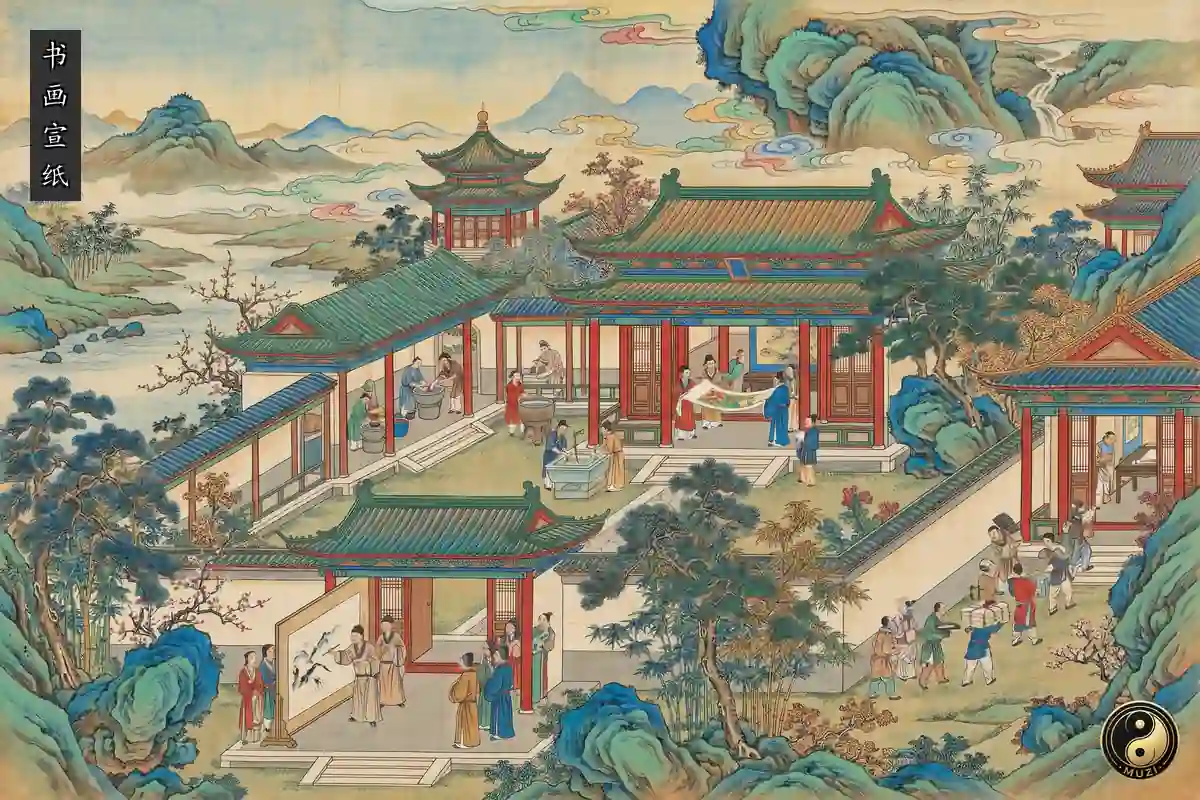
The technical soul of Chinese ink painting and calligraphy lies in the precision interaction of three materials at the microscopic level.
Xuan paper is made from blue sandalwood bark as the primary material, blended with paddy straw, through over a hundred steps including soaking, steaming, rinsing, pulping, sheet forming, and drying. Its fiber structure creates countless irregular capillary channels at the microscopic level, giving the paper surface a unique absorption capacity. The instant ink contacts the paper, moisture diffuses through the fiber gaps while carbon particles are trapped by the fibers, producing brushstroke edges with a sense of depth and gradation.
Ink sticks are made from pine soot or lampblack mixed with animal glue, pounded thousands of times to form solid sticks. When ground, they produce a colloidal solution of suspended nanoscale carbon particles. The brush tip, made of goat hair, weasel hair, purple hair (rabbit), or a blend, can gather to a fine point like an awl or spread flat like a spatula. When the three materials combine, the brush's ink load, travel speed, and pressure angle determine the distribution of carbon particles, producing the five ink tones: scorched, dense, heavy, light and pale.
Plant fiber paper first appeared in the Western Han. A paper map fragment from Fangmatan, Tianshui, Gansu (c. 179 to 141 BCE) is the earliest known physical specimen of paper. The Baqiao paper from Xi'an, Shaanxi (c. 2nd century BCE) is another important early specimen. Cai Lun of the Eastern Han (c. 63 to 121 CE), in the first year of the Yuanxing era (105 CE), presented his improved papermaking technique using tree bark, hemp ends, rags and old fishing nets, lowering cost and raising quality, enabling paper to gradually replace bamboo slips and silk as the primary writing medium.
In the Jin Tang period, calligraphy flourished alongside the spread of paper. Wang Xizhi's Preface to the Orchid Pavilion (353 CE), written on cocoon paper with a rat whisker brush, was hailed by later generations as the greatest running script work under heaven. Wang Xianzhi's Mid Autumn Letter likewise became a model of calligraphic mastery. Tang Sun Guoting's Shu Pu (Treatise on Calligraphy, 687 CE) is the first systematic calligraphy treatise. Xuan paper took its definitive form in the Xiaoling area of Jing County, Anhui, where the long and supple blue sandalwood bark fibers earned it reverence as the finest paper for calligraphy and painting.
Xie He's Guhua Pinlu (Classification of Ancient Painters, c. 5th century) proposed the Six Principles: *qi yun sheng dong* (spirit resonance brings life), *gu fa yong bi* (bone method employs the brush), *ying wu xiang xing* (correspond to the object to depict its form), *sui lei fu cai* (apply color according to category), *jing ying wei zhi* (plan and arrange the composition), and *chuan yi mo xie* (transmit and copy models). This established the aesthetic direction of Chinese painting as line based form with brush and ink as its soul. Zhang Yanyuan's Lidai Minghua Ji (Record of Famous Paintings of All Dynasties, 847 CE) in ten volumes is China's first comprehensive painting history.
From the Five Dynasties through the Song, landscape and flower and bird painting reached their zenith. Fan Kuan's Travelers Among Mountains and Streams uses raindrop texture strokes to capture the substance of northern rock faces. Guo Xi's Early Spring uses curling cloud texture strokes and crab claw branches to express the vitality of spring's arrival. The Southern Song Four Masters, Li Tang, Liu Songnian, Ma Yuan, and Xia Gui, pioneered the vigorous monochrome ink wash of the academy painting style.
From the Yuan dynasty onward, literati painting rose to prominence and Xuan paper replaced silk as the preferred medium. Zhao Mengfu advocated that calligraphy and painting share the same origin, bringing calligraphic brushwork directly into painting. The Four Yuan Masters (Huang Gongwang, Ni Zan, Wang Meng, and Wu Zhen) worked primarily on paper in monochrome ink, emphasizing spontaneous brushwork without concern for formal likeness. Huang Gongwang's Dwelling in the Fuchun Mountains (1350 CE) uses the long handscroll shape to unfold the four seasons landscape along the Fuchun River.
Ming dynasty Dong Qichang (1555 to 1636) proposed the Southern and Northern Schools theory, tracing the literati painting lineage back to Wang Wei. Xu Wei pushed splash ink expressionism to its severe; his Ink Grapes, with its wild brushstrokes and exuberant ink, became a milestone.
Qing dynasty Shitao's Huayu Lu (Monk Bitter Gourd's Remarks on Painting, c. 1700), through his Single Stroke Theory (*yi hua lun*), connected brush and ink philosophy to cosmic ontology, completing the elevation of Chinese painting theory from technique to metaphysics. The Four Wangs (Wang Shimin, Wang Jian, Wang Hui, and Wang Yuanqi) synthesized traditional brushwork techniques through emulation of ancient masters. Bada Shanren (Zhu Da) expressed Ming loyalist sentiment through spare, stark compositions and cool, detached brushwork.
In civilizational impact, the Four Treasures of the Study tradition profoundly influenced all of East Asian art. Japan's Sesshu Toyo (1420 to 1506) crossed the sea to Ming China to study ink painting and upon return founded the Japanese kanga (Chinese painting) tradition. Korean literati painting is also rooted in Chinese brush and ink. In the 18th century, Chinese painting entered Europe through Jesuit missionaries, influencing the chinoiserie of Rococo art.
At the materials science level, Xuan paper's durability is equally remarkable. Premium Xuan paper has a neutral to slightly alkaline pH (7.5 to 8.5), with fibers containing no lignin or acidic compounds, making it resistant to yellowing and embrittlement. Accelerated aging tests on Red Star brand Xuan paper from Jing County demonstrate a lifespan exceeding a thousand years, confirming the saying *zhi shou qian nian* (paper endures a thousand years). Song dynasty ink paintings on Xuan paper preserved in the Palace Museum collection remain in excellent condition.
Chinese painting theory has an equally long lineage. Tang Zhang Huaiguan's Shu Duan (Judgments on Calligraphy, 727 CE) classified calligraphy into divine, marvelous and competent grades. Song Su Shi argued that *lun hua yi xing si, jian yu er tong lin* (judging painting by formal likeness shows the understanding of a child), steering Chinese painting toward self expression rather than representation. Yuan Zhao Mengfu's poem, *shi ru fei bai mu ru zhou, xie zhu huan ying ba fa tong* (rocks should be painted like flying white script, trees like ancient seal script, and bamboo must follow the eight principles of calligraphy), made the correspondence between calligraphy and painting explicit. Ming Dong Qichang's Southern and Northern Schools theory, though expressed through Chan Buddhist metaphor, established a historical aesthetic lineage for literati painting.
During the Qing Kangxi, Yongzheng and Qianlong reigns, court painting developed a distinctive Sino Western fusion style. The Jesuit painter Giuseppe Castiglione (Chinese name Lang Shining, 1688 to 1766) combined Western perspective with Chinese gongbi (meticulous brushwork) technique, creating works like One Hundred Horses that bridged two artistic traditions. This cross cultural painting practice foreshadowed the modernization of Chinese painting.
In the 20th century, Chinese painting underwent a profound transformation from tradition to modernity. Huang Binhong systematized traditional brush and ink language with his Five Brushes and Seven Inks theory. Qi Baishi's principle of *miao zai si yu bu si zhi jian* (the sublime lies between likeness and unlikeness) fused literati elegance with folk art simplicity. Xu Beihong introduced Western realism to reform Chinese painting. Lin Fengmian blended Western modernism with Chinese folk art. These explorations have given this ancient minimalist aesthetic tradition new vitality in the contemporary global art context.
The internal logic of ink painting is the transformation of subtle material interactions, the capillary absorption of fiber paper, the fluid sedimentation of nanoscale carbon particles, and the elastic deformation of animal hair brush tips, into a minimalist aesthetic norm that transmits the richest spiritual content through the most economical material means. That is why this monochrome tradition could carry the full spiritual world of Chinese literati for two millennia.