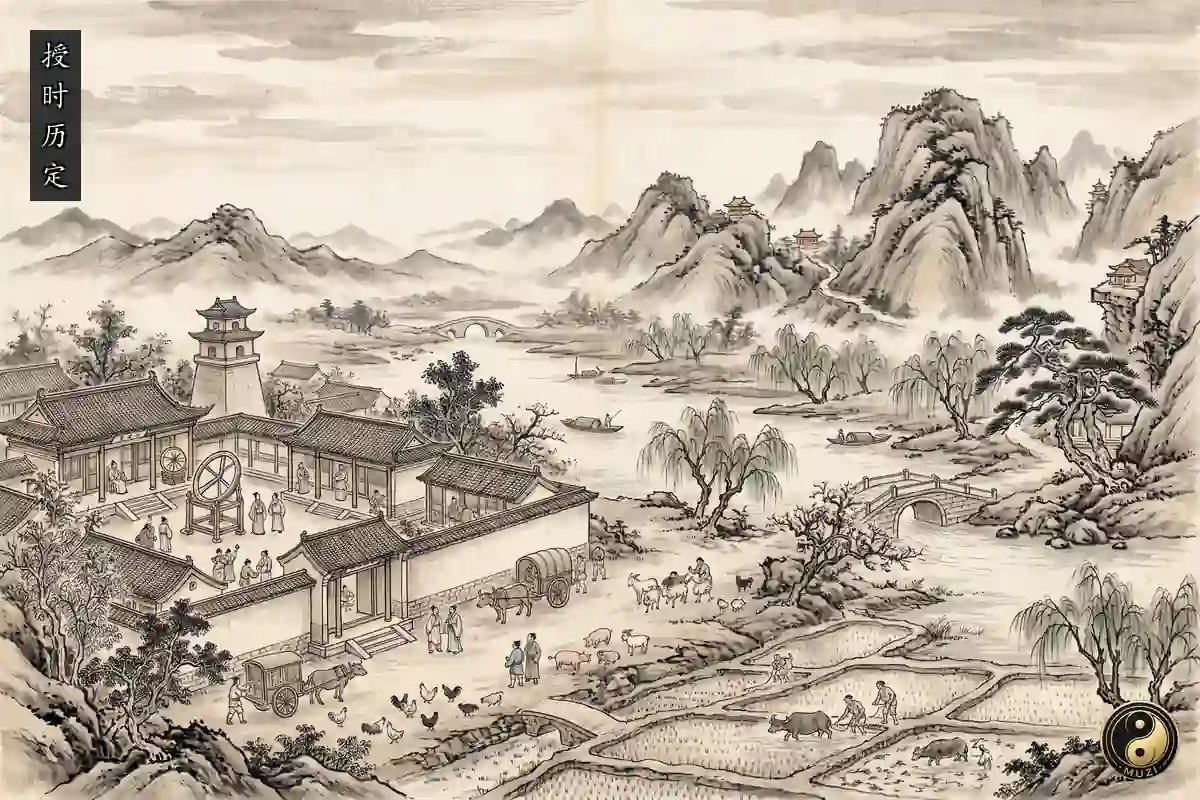
Shoushi Calendar was not an isolated almanac, but an institutional achievement in which the Yuan state combined observation, calculation, instruments and government orders to fix the seasons. It answered not only the question "what day is it today", but also questions of the winter solstice, new and full moons, intercalary months and eclipses of the sun and moon, and of how officials in every region should arrange the seasonal points accordingly. It turned the continuous changes of the heavens into an order of time that could be issued and checked.
In the thirteenth year of Zhiyuan in the Yuan (1276), Xu Heng, Wang Xun, Guo Shoujing and others were ordered to reform the calendar; Guo Shoujing was responsible for making and improving instruments and organising observation, and Wang Xun and others led the calculation. According to the Treatise on the Calendar in the History of Yuan, "at the winter solstice of the seventeenth year the calendar was completed, and by decree it was named the Shoushi Calendar" (1280), and "in the eighteenth year it was issued to the realm" (1281). It set the tropical year at 365.2425 days, the same value adopted by the Gregorian calendar issued in 1582, about three hundred years earlier; but its meaning lies not only in this figure, but in correcting the old methods by measurement and in making measurement, calculation and reckoning into a calendar the state could put into effect.
Its first effect on history was to make calendar reform a public work of Yuan rule. Guo Shoujing made the simplified armillary, the upturned sundial, the direction-finding table, the shadow aligner and other instruments, set up observing places, and tested the old calendar against records of the winter solstice, lunar eclipses and the motion of the sun and moon; the New History of Yuan likewise records "in the seventeenth year the calendar was completed" and that it was "issued to the realm". Its second effect was to become the frame of the Ming calendar: the Ming Datong calendar was based on the Shoushi Calendar, and in the seventeenth year of Hongwu (1384) its epoch was changed to the jiazi year of Hongwu; the History of Ming states plainly that "the reckoning of the Datong is wholly based on the Shoushi, only dropping the secular variation", and the Ming huiyao also records "taking the jiazi year, the seventeenth of Hongwu, as the epoch". In this way a Yuan calendar entered the epoch, the reckoning of the solar terms and the calculation of eclipses of the Ming state; the regime changed, but the inheritance of the order of time was not broken.
Its influence on culture lay first in reorganising how people felt the seasons, farm work, sacrifices and state rites. The calendar made the winter solstice, new and full moons, intercalary months and the solar terms into dates kept in common, so that the issuing of the calendar at court, local administration, the work of the people and seasonal custom shared one language of time. Second, it changed the way of "watching the sky": observation was no longer only the experience of diviners, but became a learning in which instruments, measurement and reckoning checked one another. The tradition Guo Shoujing left through measuring shadows, observing eclipses and reforming the calendar made the calendar both astronomical knowledge and a document through which officials managed social order.
Shoushi Calendar was also reread again and again by later ages. The Ming Datong calendar kept the basic reckoning of the Shoushi but adjusted its epoch and rules; Ming sources also record disputes among officials over the Hongwu jiazi epoch, the old Yuan xinsi epoch, and whether calculation agreed with observation. This shows that the authority of a calendar was not a conclusion fixed for ever, but public knowledge upheld, and also questioned, by observation, calculation, institutions and politics together. It symbolised the dynasty's power to give the seasons, and it also left a measure by which that power could be checked.
It and five neighbouring canons support one another. With Shadow Measurement: the Shoushi Calendar took gnomon shadows and the measurement of the winter solstice shadow as key evidence, and the length of the shadow turned the sun's yearly motion into observations that could be compared. With Armillary Spheres: Guo Shoujing made the simplified armillary, the upturned sundial and other instruments, which turned the motion of stars and sun into the quantities the reckoning needed. With Solar Terms: the calendar divided the sun's year into solar terms, giving farm work and custom points in time that could be spread abroad. With Lunisolar Calendar: new and full moons, intercalary months and the order of months let lunar time and the solar seasons be used together. With Water Clocks: the state had to fix the seasons of sun and moon and also put the hours into effect through day and night, and the Ming huiyao records that the Astronomical Bureau "set up four divisions" and had "Erudites of the Water Clock", so that time-telling and calendar reckoning belonged to one office.
Shoushi Calendar became a canon because Guo Shoujing, Wang Xun and others corrected the old methods by measurement; the calendar was completed at the winter solstice of Zhiyuan 17 (1280) and issued to the realm in Zhiyuan 18 (1281), fixing the year at 365.2425 days. The History of Ming says that "the reckoning of the Datong is wholly based on the Shoushi", and in the seventeenth year of Hongwu (1384) the Ming took the jiazi year as its epoch. It joins the gnomon, the instruments, the solar terms, the order of months and the water clock, so that the heavens, government orders, farm work and custom share one order of time that can be tested and can also be disputed, and the Ming disputes over the epoch carried that testing on.
The Shoushi Calendar is the class in the chapter on Cosmos on the Yuan Shoushi calendar and what followed it: Guo Shoujing, Wang Xun and others completed it in the seventeenth year of Zhiyuan and it was promulgated the next year, setting the tropical year at 365.2425 days, the value of the Gregorian calendar some three centuries later; the Ming based the Datong calendar on it and used it until the dynasty fell.
 Literature
 History of Ming
 People
 Guo Shoujing
 Xu Heng