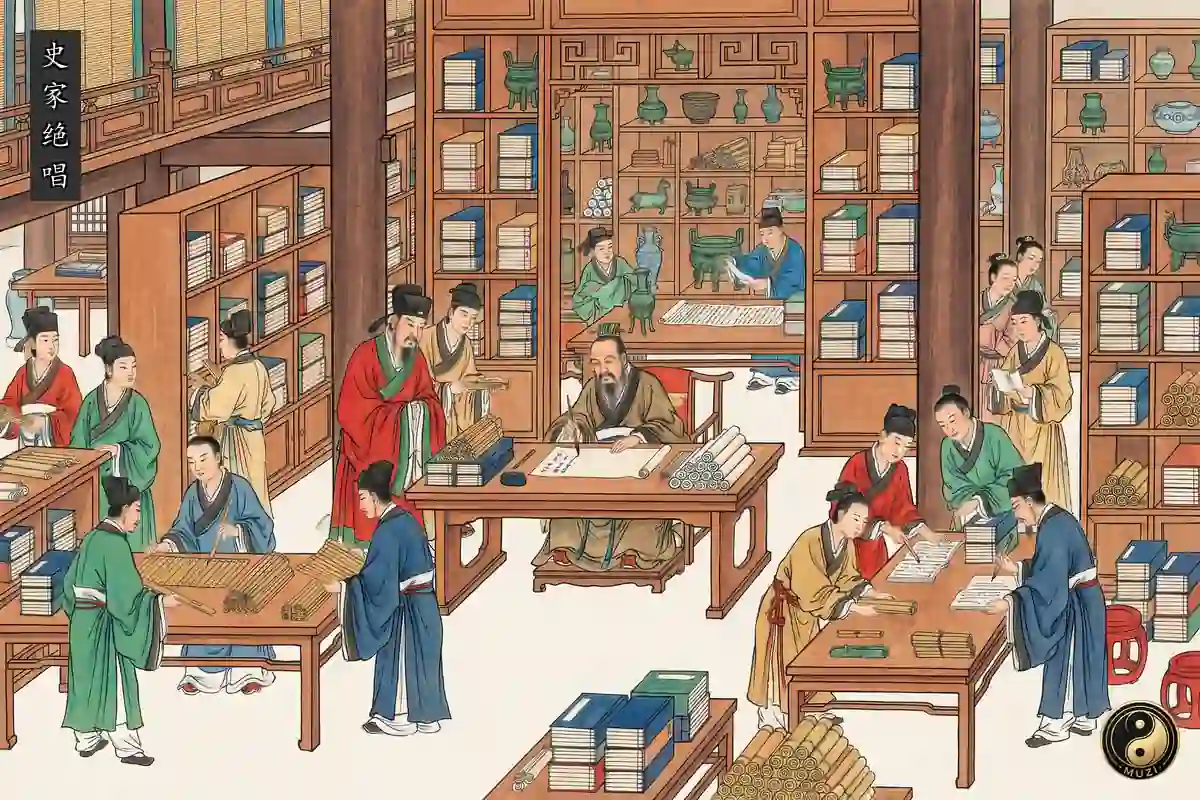
Sima Qian's father, Sima Tan, charged him on his deathbed: "When I die, you must become Grand Historian; when you are Grand Historian, do not forget what I wished to write." Sima Qian became Grand Historian and from the first year of Taichu began to arrange the text; "seven years on, the Grand Historian met with the misfortune of Li Ling". In his Letter to Ren Shaoqing he says he wrote the book "to examine the boundary between Heaven and humankind, to comprehend the changes from antiquity to the present, and to complete the words of one school". The Records of the Grand Historian has 130 chapters and 526,500 characters in five forms: basic annals, tables, treatises, hereditary houses and biographies; it "begins with the Yellow Emperor" and "ends with Taichu" (Postface of the Grand Historian). Neither the Postface nor the Letter to Ren Shaoqing states the year of completion; the New World Encyclopedia gives 91 BCE, with the writing done between 109 and 91 BCE.
The work's effect on history lies in the form it set for later histories. Because the Records "left out everything after Taichu", Ban Biao of the Eastern Han wrote several dozen chapters of sequel, and his son Ban Gu built on them to write the Book of Han, running from the founding emperor to the killing of Wang Mang, "twelve reigns, two hundred and thirty years", "pursued with close thought for over twenty years, finishing in the Jianchu years" (Book of the Later Han, Biography of Ban Biao); according to the New World Encyclopedia, when Ban Gu died in prison in 92 the eight tables and the treatise on astronomy were unfinished, and his sister Ban Zhao completed them in 111. The Records "begins with the Yellow Emperor" and runs through the ages; the Book of Han covers the Western Han alone. The New World Encyclopedia says that the Book of Han established the format for the writings of later dynasties, and that these official histories were usually produced by the next dynasty under official patronage. In the Tang, Liu Zhiji, in his Generalities on History, completed in Jinglong 4 (710), compared "the two forms of Ban and Xun", that is, the annals-biography form of Ban Gu's Book of Han and the annalistic form of Xun Yue, who recast Ban's history on the pattern of the Zuo Commentary, and said that "later authors did not go beyond these two paths", judging of the Book of Han school that "from then to now, this way has not changed". In the Qing, when the Complete Library of the Four Treasuries was compiled, the preface to the standard-histories section of its catalogue said that the standard histories "come to twenty-four in all" and that "without an imperial ordinance, none dares add to them privately", and its list begins with the Records of the Grand Historian in 130 chapters. The New World Encyclopedia gives the Twenty-Four Histories as 3,213 volumes and about forty million words in all.
In literature, the Records became a model that later writers learned from. Liu Zongyuan of the Tang, describing how he wrote in his Letter in Reply to Wei Zhongli on the Way of the Teacher, said he "drew on the Li Sao to reach its depth, and on the Grand Historian to make plain its purity". In 1926 Lu Xun taught Chinese literary history at Xiamen University, and his lecture notes, the Outline of Han Literature, call the Records "although it departs from the principles of the Spring and Autumn, still the supreme song of the historians, a Li Sao without rhyme", valuing that it was "not bound by the rules of history, not confined by phrasing, arising from feeling and written from the heart". The New World Encyclopedia also says that its prose has been acclaimed and imitated by later poets and novelists. Judgements of it have differed from the start. The appraisal in the Book of Han reports the view of Liu Xiang and Yang Xiong that "its writing is straight and its facts are sound; it does not gloss over the good or hide the bad, and so it is called a true record", while also criticizing it because "its right and wrong differ much from the sages". In 1902 Liang Qichao, in New Historiography, criticized the old histories for "knowing the court but not the nation" and cited what "our circle often says", that "the Twenty-Four Histories are not history but the family records of twenty-four surnames"; he granted that "the saying seems somewhat excessive", but added that, judged by the spirit in which the histories were written, "in substance it is not unfounded"; the Twenty-Four Histories he criticized were the very set headed by the Records of the Grand Historian.
The Records and four other canons shaped one another. With the Confucian Classics: in the Postface Sima Qian quotes his forebear and takes on himself the task to "continue the Spring and Autumn", and aims to "harmonize the differing commentaries on the Six Classics and bring order to the miscellaneous words of the hundred schools"; the appraisal in the Book of Han in turn judges him by the standard of the sages, and Lu Xun too says it "departs from the principles of the Spring and Autumn". With Chu Poetry & Li Sao: Lu Xun calls the Records "a Li Sao without rhyme", and Liu Zongyuan sets the Li Sao and the Grand Historian side by side as models for writing. With Masters' Prose: the Postface aims to bring order to "the miscellaneous words of the hundred schools", and Liu Zongyuan, in writing, drew on Mencius, Xunzi, Zhuangzi and Laozi together with the Grand Historian. With Vernacular Fiction: according to the New World Encyclopedia, its prose was acclaimed and imitated by novelists.
The Records set rules for both history and prose. Ban Biao and Ban Gu wrote on because it stopped at Taichu, and so the Book of Han came about; of the "two paths" Liu Zhiji compared, one is the annals-biography form of the Book of Han; and the catalogue of the Four Treasuries, fixing the standard histories at twenty-four, puts it first. Liu Zongyuan drew "on the Grand Historian" in his writing, Lu Xun called it "a Li Sao without rhyme", and novelists imitated its prose. Even its critics could not get round it: Ban Gu said that "its right and wrong differ much from the sages", and the Twenty-Four Histories that Liang Qichao attacked begin with it.
Records of the Grand Historian is the class in the chapter on Letters on the Records of the Grand Historian and the official histories in biographical form. Sima Qian wrote the Records of the Grand Historian and began the biographical general history; Ban Gu's Book of Han used the same form to write the history of a single dynasty; and for the two thousand years after, the official histories kept to it.