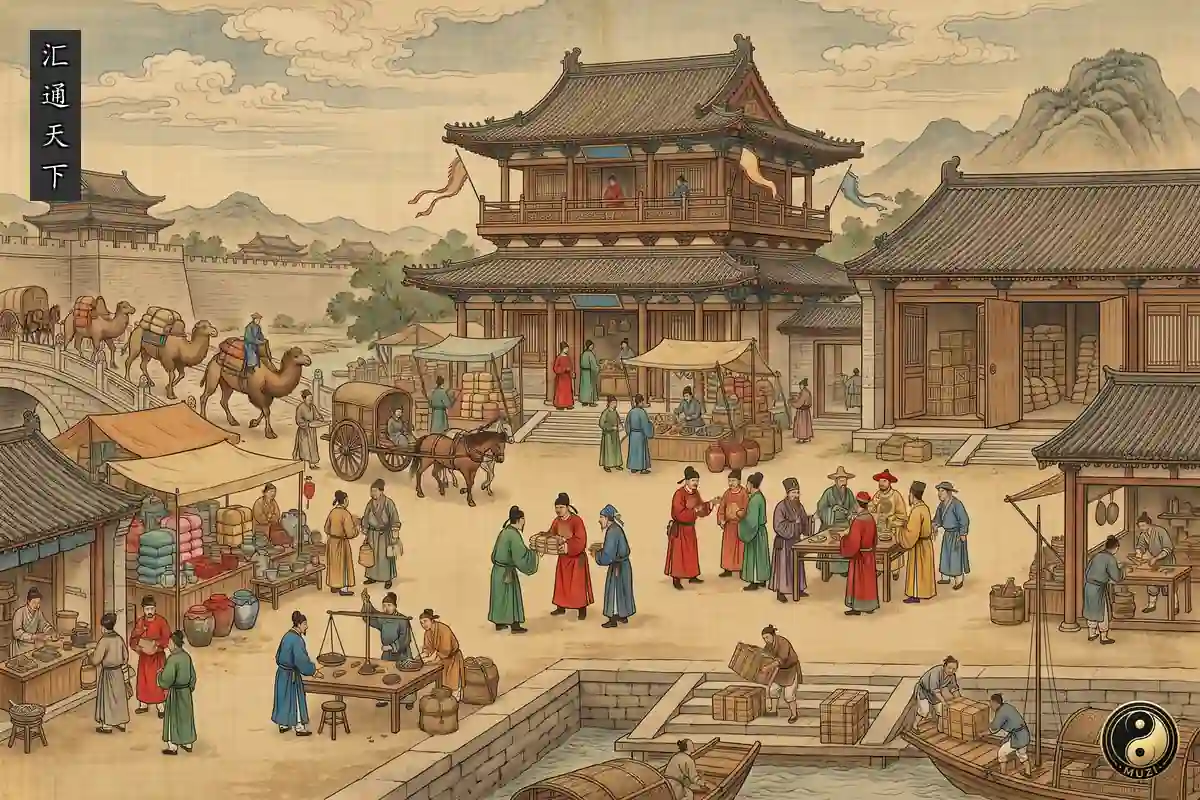
How the Shanxi remittance houses (piaohao) began is told in different ways. On 26 July 2010 China News Service reposted an article from Shanxi Daily whose editor's note calls it "a fairly rigorous scholarly piece"; the article says that as to which was the first Shanxi house, "historians have never reached a conclusion," and that the stories of origin fall into four kinds. The Qing bai leichao gives two views within one page: "the Shanxi piaohao began in the late Ming," and Rishengchang was "the one founded earliest among the piaohao," which "in the early Daoguang years changed to remittance business." The same page writes "it is said that at the end of the Ming Li Zicheng, defeated, fled to Shanxi with great wealth," that "the people of Shanxi got his money and set up piaohao," and that the house rules "were set by Gu Yanwu"; the book marks this with the words "it is said."
When Rishengchang turned to remittance is told three ways. A China News Service report of 23 July 2023 writes "in 1823 Rishengchang was founded in Pingyao, Shanxi"; a Caijing Times article of 21 January 2006 by He Jiangbing (reposted on Sina Finance) also gives 1823, saying that the dye-shop owner Li Daquan, on the advice of his general manager Lei Lutai, "renamed the dye shop a piaohao." The Shanxi Daily article, citing Shanxi piaozhuang kaolue, says the manager of the Pingyao head office gave the founding as "the early Daoguang years," and the manager of the Beijing branch said the dye shop was first named Rishengzhang and "became a piaozhuang in Daoguang 11," which the Kaolue passage marks as 1831. The three are set side by side, not merged. The article's authors reach a conclusion of their own: "Rishengchang was not 'China's first piaohao' either; it was the Zhichengxin piaohao of Taigu." As to whose credit it was, Liu Chenghu, director of the Jin Merchants Institute at Shanxi University, gives it to "Lei Lutai, the head manager of the Xiyucheng dye shop"; the authors of the Shanxi Daily article write that it is said to be Lei Lutai, "but there is no direct evidence."
Liu Chenghu places the cause in the difficulty of "moving cash": Xiyucheng's business lay across Beijing, Tianjin, Shanxi and Sichuan, Sichuan was the main source of dyes, and "moving cash" was very inconvenient; Lei Lutai reorganized staff and business and "carried Chinese finance to a new stage," which is his own assessment. The Kaolue also says Lei Lutai settled distant accounts by remittance "because moving cash was difficult," but names the shop as the Rishengzhang dye shop of Tianjin: at first it was "tried among the shops that dealt with Rishengzhang between Chongqing, Hankou and Tianjin, with marked success," and then, "with Tianjin Rishengzhang as backing, it remitted for others." Both shop names are kept as the pages give them.
The Qing bai leichao describes the method: "Great capital was pooled, and a few men noted for good faith were chosen to manage it. Those who put in money held silver shares; those who put in labor held body shares"; young apprentices, "after some years, if they proved promising, were given a body share," and "accounts were settled every three years and profit divided by shares." It also says "the Shanxi piaohao have always valued trust over written bonds and take no pledges," and that Rishengchang "set up branches, as many as twenty-four." Liu Chenghu says that once merchant families across Shanxi followed, they "set up more than 500 branches across the country"; the first counts one house and the second many, so the two figures cover different things, a distinction this entry draws from the two pages.
The Qing bai leichao says "in the Xuantong years there were twenty-two piaohao," of which Tianshunxiang had a Yunnan owner and the other twenty-one were Shanxi houses, in three groups, Qi, Tai and Ping: "the Qi group six houses, the Tai group five, the Pingyao group ten," adding that the Pingyao group's "rules were also stricter than those of the Qi and Tai groups." UNESCO inscribed the Ancient City of Ping Yao in 1997; under criterion (iii) it says the city was a financial center of China from the 19th century to the early 20th. A caption to a China News Service photograph says the old premises hang a plaque from the Guangxu emperor reading "Huitong tianxia."
What did the houses do? Liu Chenghu holds that they "greatly speeded the turnover of financial capital, saved on trading costs, lowered the risks of trade, and also drew the regional financial markets of the country together," and says that in the forty years after Shanghai was opened as a port, remittances between Shanghai and the interior "were largely carried out by Shanxi houses"; this is his assertion. He cites Qing wenxian tongkao, juan 18 (the original book not separately checked): "The great merchants of Shanxi set up piaohao whose methods were very careful, whose people were honest, and whose trust was well known."
What became of the houses later is told by two pages about different things. The Qing bai leichao, on the money market of the capital, says that after the geng-zi year foreign banks gradually opened branches in Beijing, and that piaohao silver notes, "though tied to remittance and not to be swept away, saw their range shrink once there were bank notes"; it is speaking of piaohao silver notes in the Beijing money market. The Caijing Times is about Rishengchang alone: citing Tian Hong of Accenture, it says that when the Qing government set up the Daqing Bank and asked Rishengchang to take shares, the Pingyao head office "refused"; it calls the "trigger" of the collapse the suit of 1914, when the Beijing branch manager Hou Yuan, caught up in another house's affairs, was sued by creditors and the general manager Guo Shubing fled, so that Rishengchang was "sealed"; the house closed in 1932. Each page speaks of its own matter.
The remittance houses also connect with other canons. For Jiaozi Banknotes, the Song shi says huizi and jiaozi "took something from the Tang flying cash," and Liu Chenghu says Pingyao merchants "founded the piaohao" after drawing on the experience of flying cash and huizi; for Contractual Credit Culture, the Qing bai leichao says the piaohao "valued trust over written bonds," and Liu Chenghu says separately that the Pingyao houses' way of keeping credit showed "the spirit of contract"; for Merchant Guild Commerce, Liu Chenghu says that as merchant groups multiplied and long-distance trade grew in the Ming and Qing, Jin merchants "founded biaoju and zhangju"; for Currency Evolution, the time had "many kinds of money, troublesome exchange of metal coin, and inconvenient transport."
Liu Chenghu and the Kaolue both place the start of the piaohao in the difficulty of "moving cash," while the Shanxi Daily article decides that Zhichengxin of Taigu was the first house; whether Rishengchang began in 1823, in the early Daoguang years or in Daoguang 11, the pages each say their own. The Qing bai leichao writes that the houses "valued trust over written bonds," and that once bank notes came, the "range" of piaohao silver notes "shrank"; for the collapse of Rishengchang, the Caijing Times tells of the refused shares in the Daqing Bank and calls the suit of 1914 the "trigger." One of UNESCO's grounds for inscribing Ping Yao is that it was a financial center of China from the 19th century to the early 20th.
Shanxi Remittance Houses is the class in the chapter on Commerce on remittance between distant places. It covers the financial houses, chiefly the Shanxi remittance houses, of the Qing to the Republican era: a merchant paid in silver in one place, received a draft, and drew the silver at a branch in another place without carrying it on the road. The houses managed this through jointly run branches and secret marks against forgery, and at their height had over 400 branches in more than 30 cities.
 Literature
 History of Song
 People
 Li Zicheng
 Gu Yanwu
 History
 Taiping Rebellion