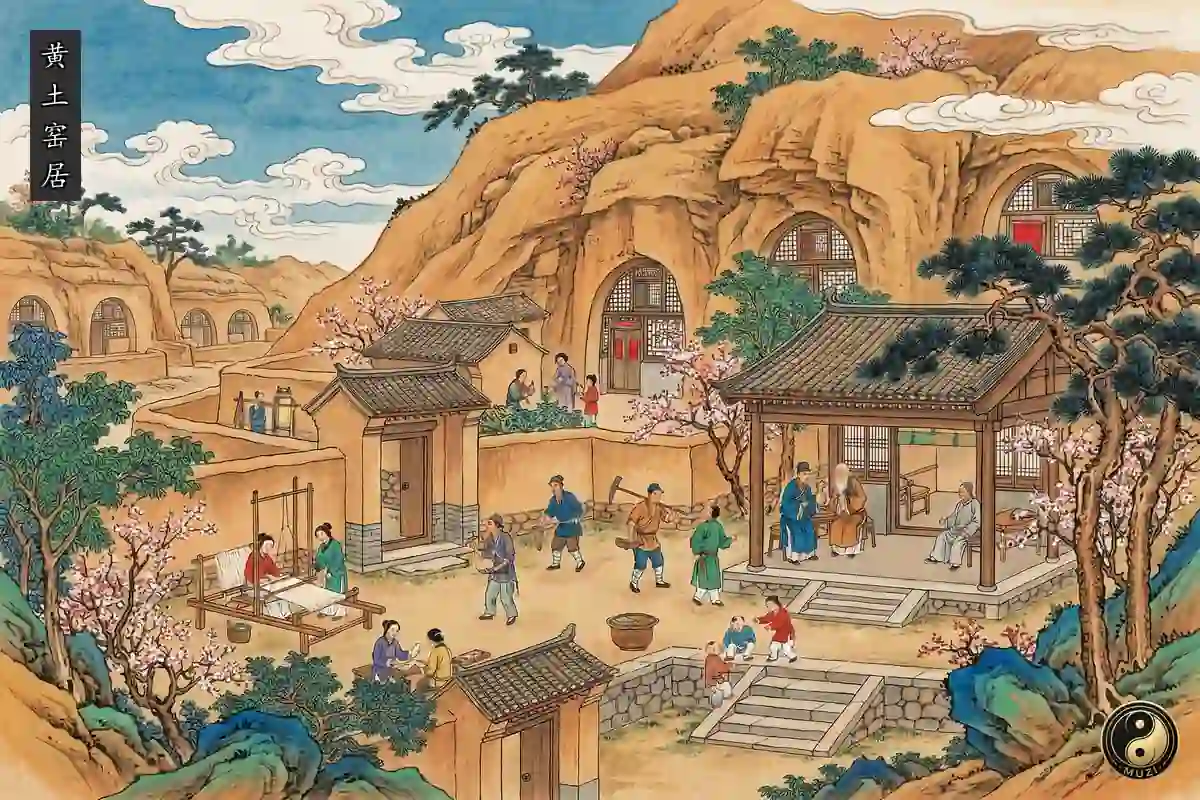

The cave dwelling is the house of the Loess Plateau. The entry "Yaodong Construction Techniques" on China's Intangible Cultural Heritage website (supervised by the Ministry of Culture and Tourism and run by the Chinese National Academy of Arts and its Intangible Cultural Heritage Protection Center; this entry is the item of Qingyang in Gansu, announced in the second batch of the national list in 2008; the pit-courtyard technique of Shaan County in Henan is an extension item of the third batch, 2011) calls it "a surviving physical form of the development of early cave dwelling, widely found in Shanxi, Shaanxi, Gansu and elsewhere"; loess with "very strong vertical stability" supplied the conditions, and "dry and rainless weather, cold winters and few trees" gave a building technique that "needs no timber" the chance to continue.
The memory of cave dwelling is written in the classics. The Mencius (Teng Wen Gong II) says that in Yao's time "the waters ran backward and flooded the Middle Kingdom", and the people, "on low ground, made nests; on high ground, made caves"; the Book of Rites (Liyun) says "in the past the former kings had no houses and palaces; in winter they lived in caves, in summer in nests of branches"; and the Book of Songs (Greater Odes, "Mian") says of the Zhou ancestor, "Gugong Danfu dug out kilns and pits, and had no house or home". All three speak of earlier ways of living, and none says that it was in the loess region.
The physical remains underground are in Lüliang, Shanxi. At the Xinyi site, announced by the Shanxi Provincial Institute of Archaeology and excavated as a rescue dig in June 2020 for the rerouting of a national highway, "12 cave-style house foundations were dug into the cliff faces of the ridge, in the edge of the earthen ridge, as earthen caves with a rounded-square floor plan and a domed upper part, and set in rows following the natural terrain"; the report says this earthen form and the stone buildings of the Hetao region "formed two distinct building traditions of the middle Yellow River" (reporter Song Zhenxing of the CCTV news group, CCTV News client, reposted by Huanqiu). At the neighbouring Fengyi site there are six cave-style houses of the early Longshan, and the project head Zhao Hui says: "This choice of site and this way of living are the tradition of this area and of the wider loess hills" (China News Service reporter Hu Jian, reposted by Huanqiu).
There are several ways of building. The same entry says the cliff-side type "is made by shaving one face of a slope vertical and then cutting into the flat surface"; the courtyard type first digs a pit in level ground, "about seven metres" deep, and then cuts caves in the lower parts of the walls. The entry on Shaan County pit courtyards says the pit goes down "about 6 metres", that a geomancer fixes the layout "following the requirements of 'backed against the rear, braced by the front' and 'high above, low below'", that a seepage pit is dug for drainage, and that "the kang and stove in the cave are joined"; it says the semi-subterranean houses of the Yangshao period "are thought to be its prototype", and it quotes the Xizheng daoli ji (Record of the Westward Journey) by Zheng Gangzhong of the ninth Shaoxing year of the Southern Song (1139): "West of Xingyang it is all earthen hills, and people mostly live in caves." The two entries differ on the depth of the pit, and both are given here.
Why such a house can be lived in is now measured. A study by Chen Feiyu and others of Xi'an University of Architecture and Technology, published in Building Energy Efficiency in 2024, measured the summer indoor conditions of three types of cave dwelling and of brick-and-concrete farmhouses, and found that "the indoor thermal environment of cave dwellings is better than that of brick-and-concrete farmhouses; the indoor temperature of cave dwellings fluctuates little and the relative humidity is high", because "the relatively closed space and the large thermal inertia of the heavy enclosure can effectively resist outdoor temperature fluctuation", which is the main reason caves are "cool in summer".
The number of people living in them changed with the times. The entry cites the Qingyang fangzhi (Gazetteer of Qingyang): at the end of the 1940s the caves of the Xifeng district of Qingyang made up 88% of the total floor area of rural housing, and at the end of the 1960s 47% of the floor area of housing in the district; after the 1990s caves collapsed from lack of residents, and the building technique "may vanish completely along with the caves". The caves also entered modern history: an article on the Communist Party Members website says that "from 1935 to 1948" the central leadership of the Party, with Mao Zedong and others, lived and worked in Yan'an for thirteen years, nine of them at Yangjialing; and another article on the same website says that the Central Auditorium, where the Seventh Congress met in 1945, "is built inside in the manner of a northern Shaanxi cave dwelling".
The cave dwelling also touches several other canons: the same entry says that the "underground (di xia) courtyards" of Pinglu are also called "pit courtyards" and "skylight cave courtyards", and the folk rhyme "see trees, not the village; see the village, not the houses; caves born in the earth, courtyards hidden below" describes courtyards sunk underground, which can be compared with the courtyard layout treated in the entry on Courtyard Compounds; the surveying of the site by a geomancer before work begins is a use of the practice treated in the entry on Geomancy; Mencius speaks of living in caves in the time of the flood and goes on to say that Yu channelled it so that water "ran through the land: the Jiang, Huai, He and Han", and the relation of loess to the river is the matter of harnessing the river in the entry on Yellow River Harnessing; and caves that "need no timber" are a different way of building from the timber construction of the entry on Timber Building.
The main types of cave dwelling, the cliff-side and the courtyard, are dug out, not built up: loess that stands upright supplied the conditions, and a dry, cold land with few trees gave a way of building that "needs no timber" its use. The rows of earthen caves cut into the ridge cliffs at Lüliang and the openings in the walls of the deep pits at Shaan County all ask the earth for rooms; today's measurements say that the thick earth keeps out the heat of summer. Yet the entry warns that once no one lives in the caves, the building technique "may vanish completely along with the caves": whether a way of living can be handed on depends on whether anyone still lives in it.
Earthen Building is the class in the chapter on Architecture on houses made of earth: cave dwellings, rammed-earth houses and tulou. The cave dwelling is the dwelling form of the Loess Plateau in which houses are dug into hillsides and the ground: examples already exist in the late Yangshao period, cave living became a major dwelling form in the loess region in the Longshan period, and in the Ming and Qing it spread widely across the northern loess plateau. Rammed-earth houses and tulou are houses raised above ground out of rammed earth; the tulou example is Huaiyuan Lou in Nanjing County, Fujian, a double-ringed round tulou. The layout of courtyard houses belongs to Courtyard Compounds, the gabled walls and white walls of Huizhou houses to White Walls & Horse-head Gables, and the layout of streets and settlements to Streets & Settlements.
 People
 Yu the Great (Da Yu)
 Gugong Danfu
 Atlas
 Shanxi
 Su Ning County
 Xi Feng District
 Huaiyuan Lou in Nanjing (Fujian)