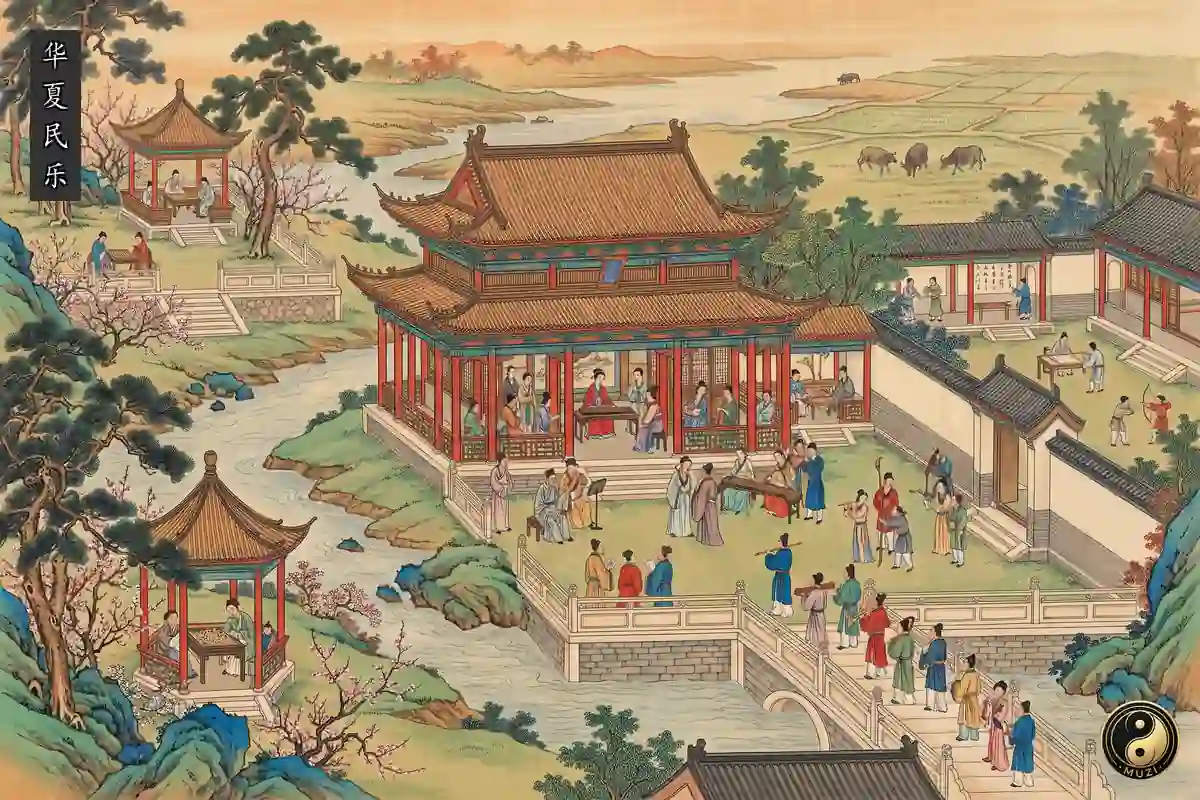
Under a blossoming veranda as the sun sets over a lake, four musicians play together by a stone balustrade: a woman with a pipa, a man in red on a fiddle, one on flute and one at a long zither.
Music made mainly on instruments. It runs from Neolithic bone flutes and clay ocarinas, through the guqin played by scholars and the gong-and-drum, shengguan, silk-and-bamboo and wind bands of town and village, to the modern Chinese orchestra of the twentieth century, and includes solo traditions such as pipa, erhu and suona and regional genres such as Nanyin and Jiangnan sizhu.
7000 BCE · OriginBone flutes were unearthed at the Jiahu site; a 1999 press release of Brookhaven National Laboratory gives them an age of about 7,000 to 9,000 years.1425 · ImpactZhu Quan of the Ming published the Shenqi mipu in 1425; the China ICH website calls it "the earliest surviving qin score".
The material evidence for instrumental music comes early. Research published in 1999 reported that the Jiahu site in Henan yielded six complete red-crowned-crane bone flutes, between seven and nine thousand years old, and fragments of about thirty other flutes; the flutes are made from the ulnae of the red-crowned crane and have five, six, seven or eight holes. A well-preserved one was played and tested for pitch, and the scale that its seven holes correspond to led the researchers to suggest that the musicians of that time could play more than single notes.
By the Zhou, instruments had entered the institutions, and the poetry. The Rites of Zhou records that the Master of Mouth-organs "taught the blowing of the yu, sheng, xun, yue, xiao, chi, di and guan". The Classic of Poetry has "the qin and se befriend her", "bells and drums delight her", "play the se, blow the sheng", and also "the elder brother blows the xun, the second brother blows the chi". The bells of Marquis Yi of Zeng, unearthed in 1978 at Suizhou in Hubei and of the early Warring States, are made up of 65 bronze bells, with an inscription of 3,755 characters; the same tomb held chime-stones, qin, se, panpipes and bamboo chi, nine kinds and 125 instruments in all, and the hanging of its bells and stones shows the Zhou lords' "xuan" arrangement. In the mid-1970s some experts had already put forward the idea of "two tones from one bell" for bells unearthed in various places, but only when the bells of Marquis Yi of Zeng were unearthed was "two tones from one bell" in pre-Qin bells widely accepted.
The qin entered scholars' lives in these centuries. The Records of the Grand Historian says Confucius studied the qin with Master Xiang and "made no progress for ten days", and kept on until he could sense in the piece the man who had made it. The Book of Later Han says Cai Yong, hearing a fire burn paulownia wood, knew it was good timber and had a qin made of it, whose tail was still scorched, so people called it "the scorched-tail qin". The Imperial Readings of the Taiping Era quotes Liu Xiang's Garden of Stories: when Bo Ya played the qin, Zhong Ziqi heard in it "towering like Mount Tai" and "surging like flowing water"; when Ziqi died, Bo Ya "put away the qin, cut its strings, and never played again". The story also appears, in similar words, in the Benwei chapter of Master Lü's Spring and Autumn Annals, which ends with Bo Ya, after Ziqi's death, “breaking his qin, cutting its strings, and never playing the qin again”; the Tangwen chapter of the Liezi has Bo Ya's playing “set on climbing a high mountain”, with Ziqi saying “lofty, like Mount Tai”, and, when it was set on flowing water, “vast, like the great rivers”. The Book of Jin records Ji Kang, about to be executed, asking for a qin and playing it, saying "the Guangling Melody is gone from today". Qin pieces also came down through scores. You Lan (Solitary Orchid), handed down by Qiu Ming of the Sui, is the only surviving Tang hand-copied score in written notation, and copies came back to China from Japan only in the late Qing; the Ming prince Zhu Quan (the seventeenth son of Zhu Yuanzhang) directed the compiling of the Shenqi mipu (Wondrous and Secret Notation), printed in 1425, the earliest surviving qin handbook. The qin is an art practised by scholars and was not meant for public performance, was proclaimed in 2003 and listed in 2008, and has seven strings and thirteen marked pitch positions.
Another line came from the Western Regions. The Book of Sui writes: "The bent-neck pipa and upright konghou are all from the Western Regions and are not old Chinese instruments." The same book records the words of Zheng Yi: in the time of Emperor Wu of Zhou, Su Zhipo of Kucha "came in with the Turkic empress and was good at the foreign pipa"; hearing him play, Zheng Yi found "seven notes within one mode". He checked the seven modes against the seven notes of the court scale, "and they matched as if by a tally". In the preface to Bai Juyi's Song of the Pipa, he says that in the tenth year of Yuanhe he was demoted to Jiujiang, and "the next autumn" heard someone play the pipa by night; the poem has "the big strings clamour like sudden rain, the small strings murmur low like whispered words"; taking the tenth year of Yuanhe as 815, the next year is 816. The suona came from outside too: the instrument used in the suona art of Fengning takes its name from Arabic and came into China by the Jin and Yuan at the latest.
In the Song, books record the instruments in use among the people. Chen Yang's Book of Music places the xiqin in its "section of foreign music" and says "the xiqin was originally foreign music", with a method of "rubbing it with a strip of bamboo, and it is still used among the people today". The genres took separate paths: Nanyin and the Xi'an wind and percussion ensemble were both listed in 2009; the Xi'an ensemble's scores use a notation system derived from the Tang and Song, record about three thousand pieces, and survive in about one hundred and fifty handwritten volumes; the China Broadcasting Chinese Orchestra belongs to the China Broadcasting Performing Arts Troupe, which was founded in 1953.
From the Qing on, scores were copied and printed, and pieces were recorded. China's only full score, the Xiansuo beikao, was collected and arranged by the Mongol scholar Rongzhai and copied in 1814; Hua Qiuping's Nanbei erpai miben pipa pu zhenchuan (True Transmission of the Secret Pipa Scores of the Northern and Southern Schools) was first cut and printed in the twenty-third year of Jiaqing (1818), and is the first printed collection of pipa music in our country. The Datong Music Society grew out of the Qinse Society founded by Zheng Jinwen. Liu Tianhua's Song of Illness and Towards Brightness were published in the Music Magazine. The Moon Reflected on the Second Spring by Hua Yanjun (known as Abing) and five other pieces were recorded in 1950.
Instrumental music is tied to four other canons. With Record of Music: the chapter's "the zither of the ancestral temple had red strings and widely spaced sound holes" is the sound of qin and se entering the discourse of government and teaching. With Ritual Music and Dance: the hanging of the bells of Marquis Yi of Zeng is a material form of the "xuan" arrangement. With Silk Road: the pipa, the konghou, and Su Zhipo of Kucha all came from the Western Regions. With Songs and Folk Tunes: the Collection of Yuefu Poems quotes the Treatise on Music in the Book of Jin on Wu songs, "at first all were sung without accompaniment, and later set to pipes and strings", and also the Record of Past and Present Music, "the old instruments of the Wu songs were the chi, konghou and pipa".
The tradition of instrumental music has been carried on by three things: objects, writing and the people who play. The Jiahu bone flutes and the nine kinds of 125 instruments from the tomb of Marquis Yi of Zeng are objects; the Rites of Zhou's Master of Mouth-organs, Confucius learning the qin and Ji Kang's Guangling san (Guangling Melody) are writing; the "seven notes" that Su Zhipo brought and the xiqin that Chen Yang says "is still used among the people today" show that instruments and modes from outside were taken in. Zhu Quan's Shenqi mipu, Rongzhai's Xiansuo beikao and Hua Qiuping's pipa scores set the pieces down in notation, Abing's The Moon Reflected on the Second Spring was recorded in 1950, Nanyin and the Xi'an ensemble are on the list, and these instruments are still played.
Chinese instrumental music is the traditional music of China that is made mainly on instruments rather than carried by sung words. It includes solo traditions such as the guqin, pipa, erhu, dizi and xiao, and suona; regional ensemble genres such as gong-and-drum music, shengguan, Jiangnan sizhu, Nanyin and Chaozhou music; the instrumental traditions of the ethnic minorities; and the modern Chinese orchestra formed in the twentieth century. The bell-and-chime music of state rites belongs to Ritual Music and Dance, and folk song and opera accompaniment have their own entries.
The left-side woman in green holds the pipa vertically with clearly visible plucking fingers, the pipa performer in the ensemble.
Erhu Player
The central man in red holds the erhu soundbox on his knee and draws the vertical bow with his right hand, the erhu performer.
Flute Player
The right-center man in yellow raises the flute to his lips with clearly visible finger holes, the wind performer in the ensemble.
Guzheng Player
The long horizontal guzheng with many visible strings rests on the right-side table, played by the man in blue with both hands pressing the strings.
An ensemble of Chinese folk instruments fills a courtyard: pipa, guzheng, erhu, and bamboo flutes each take their part while listeners stand hushed, moved by the collective melody. A pure instrumentation tradition exploring five-tone aesthetics through virtual leave-spaces.
Chinese instrumental music is like a river flowing from far away. Its source is a single bone flute at Jiahu. Along the way the pipa from Central Asia, the fiddle from the steppe, the suona from West Asia and the yangqin from across the sea flowed in one after another, and all became water in the same river.
The river splits into many streams: a qin in a scholar's study, a set of gongs and drums at a temple fair, a table of silk-and-bamboo players in a teahouse. Each sounds different, but it is one river.
After school a child was practising the erhu in the courtyard, playing Liangxiao (A Fine Night). His grandfather sat nearby, listening.
The child stopped and asked, "Grandpa, is the erhu China's oldest instrument?"
"No. Its ancestor was the xiqin, an instrument of the Xi people in the north, and it first appears in books of the Song. At first people rubbed a strip of bamboo between the two strings."
"What about the pipa?"
"The bent-neck pipa came from Central Asia. The suona came even later, from the west, in the Jin and Yuan."
The child looked let down. "Then which instruments are our own?"
"Flutes of crane bone, eight or nine thousand years old, were dug up in Henan; they are the earliest material evidence of instrumental music we know of. But think: the erhu has been played on this land for several hundred years, and The Moon Reflected on the Second Spring and A Fine Night were written for it. It has long been part of Chinese music."
The child looked down at the instrument in his hands and began to play again.
Chinese instrumental music has native roots such as the Jiahu bone flutes, and it has kept taking in instruments from outside. Over long use the pipa, huqin, suona and yangqin gained local pieces, techniques and genres and became part of Chinese music. From the scholar's qin to the gongs, drums and silk-and-bamboo of the villages and on to the modern orchestra, the tradition has lived on by absorbing. (This is an illustrative story, not a historical account.)





 Xun and Ancient FlutesThe Jiahu bone flutes and prehistoric clay xun, the earliest wind instruments known in China
 Gong-and-Drum MusicFolk percussion ensembles of drums, gongs and cymbals
 Shengguan EnsemblesNorthern temple and village ensembles led by the guan oboe with sheng mouth organs
 Dizi and XiaoThe side-blown dizi and the end-blown xiao, China's bamboo flutes
 GuzhengA long plucked zither rooted in the music of Qin, played in regional schools north and south
 PipaThe pear-shaped, bent-neck lute, once played flat with a plectrum and now upright with the fingers
 Ruan and SanxianThe round-bodied, straight-necked ruan and the long-necked, skin-faced sanxian
 ErhuThe two-string bowed fiddle descended from the xiqin, leading voice of the huqin family
 Suona and Drum-and-Wind BandsThe suona, brought in under the Jin and Yuan, and the folk wind bands it leads
 Chaozhou MusicThe gong-and-drum bands and string music of eastern Guangdong, in their own notation
 Jiangnan SizhuSilk-and-bamboo chamber music of southern Jiangsu, western Zhejiang and Shanghai
 NanyinQuanzhou's string-and-wind ensemble of pipa, dongxiao and clappers
 Shifan EnsemblesFolk ensembles of some ten silk, bamboo, drum and gong instruments, played from Jiangnan to Fujian, Guangdong and Hainan
 Xiansuo String EnsemblesNorthern ensembles of plucked and bowed strings, without gongs or winds
 YangqinThe trapezoid hammered dulcimer, from a foreign import to a mainstay of Chinese ensembles
 Xi'an Wind and Percussion EnsembleXi'an's wind-and-drum music of the temple fairs, handed down in old manuscript notation
 Cantonese MusicSilk-and-bamboo ensemble music of the Pearl River Delta, led by gaohu, yangqin and qinqin
 Instrumental Music of Ethnic PeoplesMorin khuur, lusheng, dombra and bronze drums: the instrumental heritage of China's many peoples
 Modern Chinese OrchestraThe modern Chinese orchestra in four sections: winds, plucked strings, bowed strings and percussion
 Chinese Works for Western InstrumentsChinese melodies and stories played on piano, violin and symphony orchestra
 Canon
 Literature
 Song of the Pipa
 Classic of Poetry
 Records of the Grand Historian
 Book of the Later Han
 Rites of Zhou
 People
 Zhu Yuanzhang
 Confucius (Kongzi)
 Liu Xiang
 Cai Yong
 Ji Kang
 Bai Juyi
 Stage
 Guangling San
 Solitary Orchid in Jieshi Mode
 The Moon Reflected on the Second Spring
 Soliloquy of a Convalescent
 Towards Brightness
 Treasures
 Bianzhong Bells of Marquis Yi of Zeng
 Jiahu Bone Flute
 History
 Princess Xijun Marries into Wusun
 Opening of the Silk Road
 Zhihua Temple Forms Music Ensemble
 Zheng Jinwen Founds Datong Music Society
 Abing's Music Recorded in Wuxi
 Xi'an Wind and Percussion Ensemble Inscribed
 Atlas
 Beijing
 Inner Mongolia
 Shanghai
 Linfen
 Wuxi
 Suzhou
 Huai'an
 Hangzhou
 Zhoushan
 Fuzhou
 Xiamen
 Putian
 Quanzhou
 Longyan
 Heze
 Nanyang
 Xiangxi
 Guangzhou
 Shantou
 Foshan
 Chaozhou
 Hechi
 Haikou
 Xi'an
 Qingyang
 Ili
 Dongcheng
 Pudong
 Fengxian
 Chongming
 Zheng Ding County
 Fu Ning District
 Yong Nian District
 Xiong County
 Su Ning County
 Gu An County
 Ba Zhou City
 Xin Jiang County
 Wu Tai County
 Xiang Fen County
 Qian Guo Er Luo Si Meng Gu Zu Autonomous County
 Hui Shan District
 Tai Cang City
 Jiang Du District
 Xiao Shan District
 Yu Yao City
 Ping Hu City
 Sui Chang County
 Ling Bi County
 Jin Jiang City
 Nan An City
 Xun Yang District
 Jia Xiang County
 Yun Cheng County
 Juan Cheng County
 Jin Shui District
 Qin Yang City
 Wu Yang County
 Tong Dao Dong Zu Autonomous County
 Pan Yu District
 Chao Yang District
 Tai Shan City
 Da Bu County
 Bei Liu City
 Mao County
 Zhen Ning Bu Yi Zu Miao Zu Autonomous County
 Yu Ping Dong Zu Autonomous County
 Zhen Feng County
 Dan Zhai County
 Chu Xiong City
 Chang An District
 Zhou Zhi County
 Zi Zhang City
 Ten Thousand Buddha Cave & Apsaras in Longmen