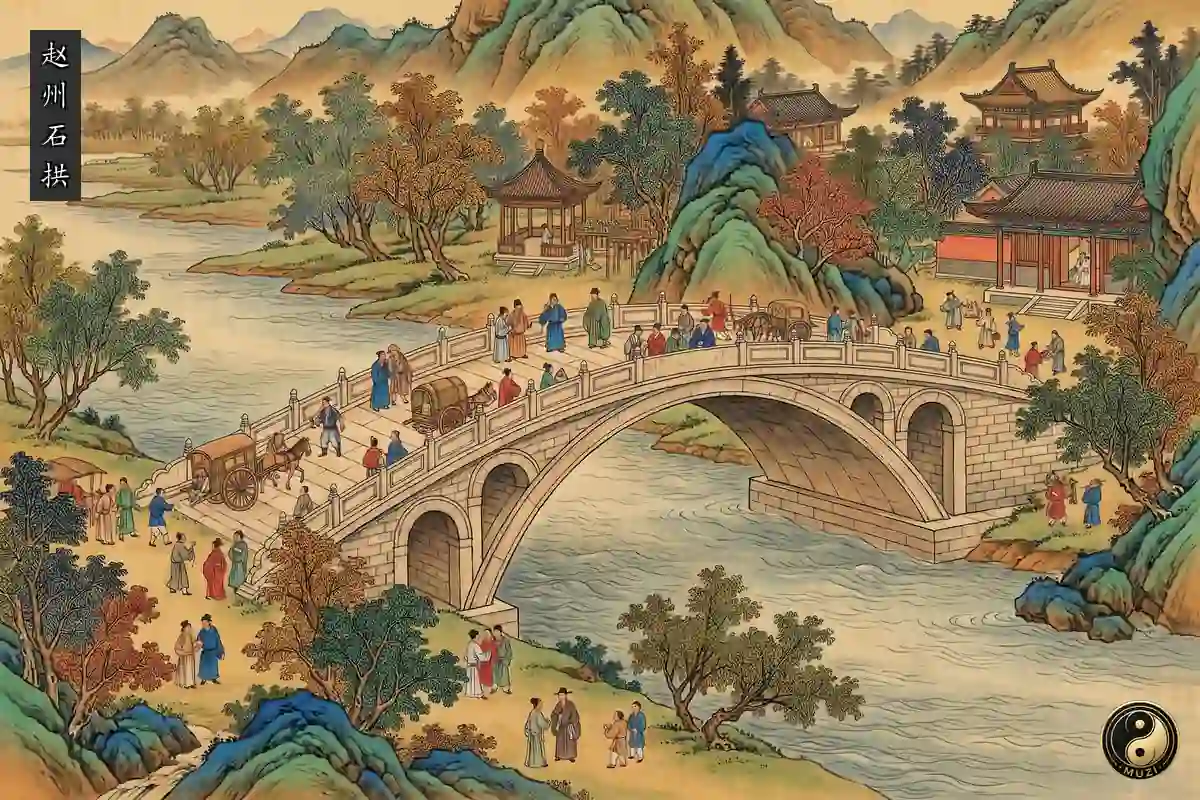

Bridges covers bridges as built structures: stone arch, stone beam, cable, covered, timber-beam and pontoon bridges, their form and construction. Canals, weirs, roads and seawalls belong to Infrastructure; the layout of streets and settlements belongs to Streets & Settlements, which also treats how a bridge joins the streets.
The Zhaozhou Bridge is the lead example of this class, and it had to face a river that rose and fell sharply. The Tang wencui (Essence of Tang Prose), Volume 67, contains two inscriptions titled “Inscription on the Stone Bridge”, and in one of them Zhang Yu writes of the Xiao River: “the streams of many prefectures converge; in autumn rains and summer floods it rushes along far and wide”. The bridge is called the Zhaozhou Bridge because Zhao County was anciently called Zhaozhou, and locals call it the Great Stone Bridge. One account places it on the north-south imperial road from the eastern capital Luoyang to Zhuojun, and says that when the Sui emperor Yangdi campaigned in the east the convoys of military supplies all crossed over it; the two inscriptions do not say this.
Among those who wrote an inscription for the bridge is Zhang Jiazhen of the Tang. The Jifu tongzhi (General Gazetteer of the Capital Region) records “Zhang Jiazhen, Director of the Secretariat of the Tang, wrote an inscription for it”, and the Old Book of Tang also records that he rose to be Director of the Secretariat. His “Inscription on the Stone Bridge” opens: “The stone bridge over the Xiao River in Zhao commandery is the work of the Sui craftsman Li Chun; its making was extraordinary, and people do not know how it was done.” Of the small arches he writes: “set in four openings, to break the fury of the raging water, so that even when it carries off a mountain the bridge holds fast”, and adds that “without great depth of wisdom and foresight no one could have begun it”. The inscription gives the craftsman's name but not the year of building. The stele set up at the bridge by the Chinese Society of Civil Engineers reads “the Sui craftsman Li Chun built it from the fifteenth Kaihuang year to the first Daye year of the Sui (595 to 605)”; Zhang Yu's inscription says the bridge “took more than a ji to complete”, a ji being twelve years, and the two accounts stand side by side.
The structure has a set of figures: total length 64.40 meters, built of 28 side-by-side rings of stone, the main span 37.02 meters in the clear, the rise 7.25 meters; another account gives the rise as 7.23 meters. The four small arches save 26 cubic meters of stone and add about 16% to the area through which water can pass. Mao Yisheng compared the side-by-side construction to “this many bows of the same shape put together”; if one of the parallel rings is damaged, only that ring need be repaired. The abutments are only five courses of slabs, 1.55 meters thick in all, set directly on natural earth and stone. In 1933 Liang Sicheng went to Zhao County to survey and draw the bridge, and wrote “The Great Stone Bridge of Zhao, or the Anji Bridge”, sent to America for publication; in it he wrote: “A single-span arch of this size, in a China where the lintel-and-post method was the chief way of building, and more than thirteen hundred years ago, is truly a thing to wonder at.”
The bridge also entered story. The Taiping guangji (Extensive Records of the Taiping Era) cites the Chaoye qianzai (Records of Court and Country): “The stone bridge at Zhaozhou is most skillful, ground and fitted close as if shaved. Seen from afar it is like the first moon coming out of cloud, a long rainbow drinking from a stream.” In the Longshuo years (661 to 663) a Goryeo spy stole two stone lions, and “later craftsmen were sought to mend it, but none could match it”; under the Dazu year of the Empress (701), the date the book gives, when Mochuo broke Zhao and Ding prefectures, the raiders came to the bridge and “their horses knelt on the ground and would not go on”, and they saw only “a green dragon lying on the bridge”. The people sang “Xiao fangniu” (The Little Cowherd): “The Zhaozhou bridge was built by Lu Ban, the jade rails were left by the sage; Zhang Guolao rode his donkey over it, and Prince Chai pushed a cart and rubbed a groove”. One guess is that the rut and the donkey-hoof marks on the roadway were traffic markings, separating carts and horses from people on foot.
The bridge has been in use throughout. Until the Zhaozhou Bridge Park was built in 1984 it served as an ordinary traffic bridge; in the 1950s Mao Yisheng organized a load test, with the conclusion that it could carry 8 metric tons; in August 1996 great floods struck the rivers nearby and the bridge “came through unharmed”. In March 1961 the State Council announced it among the first batch of national key cultural relics protection units, and in October 1991 the American Society of Civil Engineers selected it as the twelfth “International Historic Civil Engineering Landmark”. On its influence, one account says the country most influenced abroad was Japan, and that the Spectacles Bridge at Nagasaki of 1634 was designed by the Fujianese monk Ru Ding; another, citing the History of Chinese Bridge Technology, says the technique of the open-spandrel segmental stone arch was “more than 1,200 years ahead of the West”. These are reports at second hand, and no further judgment is made here.
Its relations to other entries: Wang Zhenhua, an inheritor of the intangible heritage of mortise-and-tenon building, has reproduced a miniature Zhaozhou Bridge entirely in mortise-and-tenon joints, so the bridge meets the entry on Timber Building in craft; Liang Sicheng's “China where the lintel-and-post method was the chief way of building” points to just the post-and-beam timber building treated in the entry on Timber Building, and the arch bridge is another way of building; on one account the bridge lies on the north-south imperial road, a land route that can be set beside the Qin Straight Road treated in the entry on Qin Straight Road, both being roads built by the state.
The Zhaozhou Bridge has come down to us through two things: words, in that Zhang Jiazhen wrote Li Chun's name and the “four openings” into his inscription, and the Chaoye qianzai made it a long rainbow and a green dragon; and use, in that it has stood over the Xiao River since it was built in the Sui, surveyed by Liang Sicheng, load-tested by Mao Yisheng, and chosen as an International Historic Civil Engineering Landmark. The craftsman's name has a source, and the bridge was walked over until the park was built in 1984. Beside the stone arch, stone-beam, cable, covered, timber-beam and pontoon bridges also belong to this class, and its pattern starts from this bridge, which has a name, an inscription, and was both measured and walked over.
Bridges is the class in the chapter on Architecture on the form and construction of bridges. It covers bridges as built structures: stone arch, stone beam, cable, covered, timber-beam and pontoon bridges, their form and construction. Its lead example is the Zhaozhou Bridge over the Xiao River, an open-spandrel single-arch stone bridge that the craftsman Li Chun directed in the Sui: small arches in the spandrels let floodwater pass, and the arch rings were laid in parallel courses; Zhang Jiazhen's Stone Bridge Inscription of the Tang recorded Li Chun's name and the structure of the four small arches. Canals, weirs, roads and seawalls belong to Infrastructure, and the layout of streets and settlements to Streets & Settlements.
 Literature
 Old Book of Tang
 People
 Lu Ban
 Atlas
 Zhao County