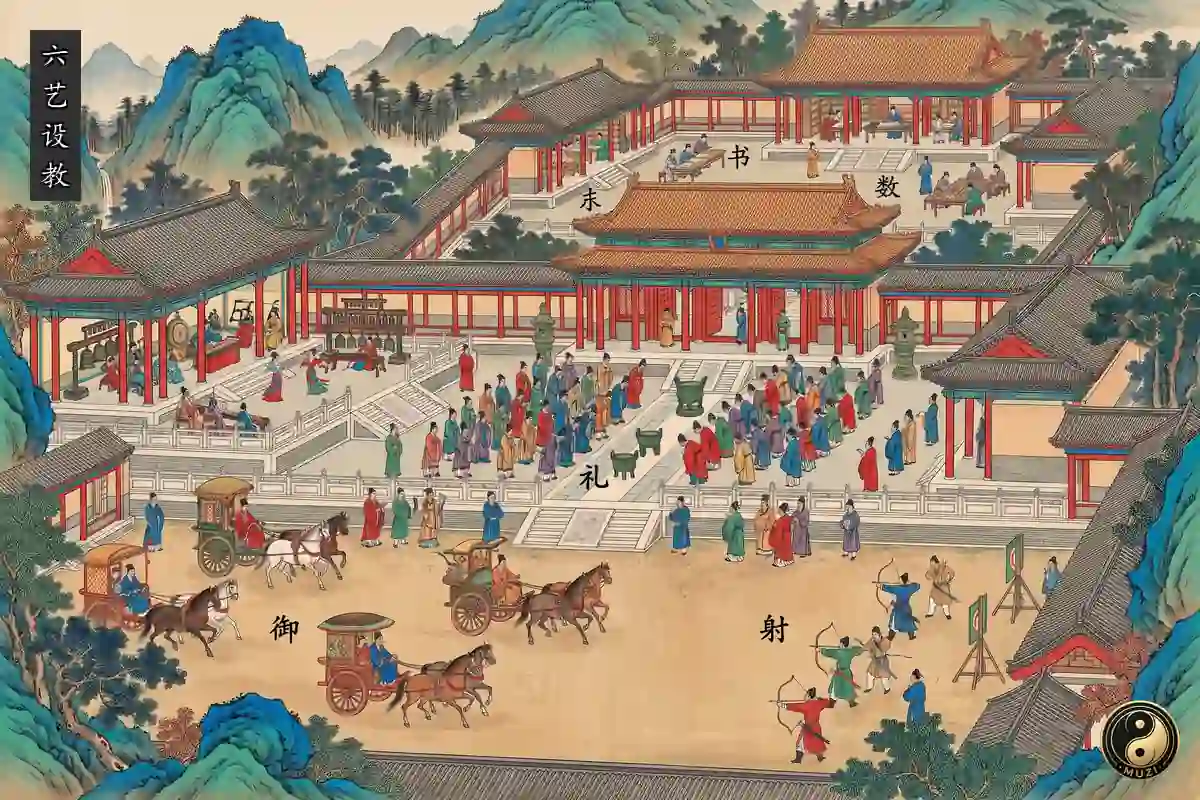
The term "six arts" has two faces, and they must be told apart first. The Records of the Grand Historian, in the Biography of the Jesters, quotes Confucius: "The six arts are one in governing. The rites regulate people, music draws out harmony, the documents recount affairs, the songs convey meaning, the Changes works change like a spirit, the Spring and Autumn Annals sets out right." The six arts here are six books. The six arts in the Rites of Zhou are six subjects: rites, music, archery, charioteering, writing and number. Huang Kaiguo, in an article on Aisixiang, points out that those who hold that the six classics existed before Confucius rest partly on a misreading of the Rites of Zhou on the six arts, "confusing the six arts with the six classics." This entry deals with the second kind.
The Rites of Zhou, in the chapter on the Minister of Education, records the Protector's duty: "He admonishes the king's faults and nurtures the sons of the state in the Way. He teaches them the six arts: first the five rites, second the six musics, third the five archeries, fourth the five charioteerings, fifth the six scripts, sixth the nine numbers." The Minister of Education himself "teaches the myriad people by the three things of the district and raises the able," the three being six virtues, six conducts and six arts, the six arts being "rites, music, archery, charioteering, writing, number." One name taught both the royal sons and the people of the villages. The Book of Rites, in the Nei Ze, arranges it by age: "At ten he went out to a tutor, lodged away from home, and studied writing and reckoning"; "at thirteen he studied music, recited the songs, and danced the Shao; as a youth he danced the Xiang and studied archery and charioteering." On the date when the Rites of Zhou was composed, Li Linzhi says in his article on the Chinese Social Sciences Net that "opinions are many and divided," so this curriculum can only be an outline arranged by later hands.
The curriculum joined civil and martial, but its weight was uneven. Sun Xiaoxia says in Literary Contention that the six arts "ran through the different levels of society from top to bottom" and were learning that "both teaches reasoning and trains the body"; she cites Yang Kuan's view that although the six arts were the content of teaching in the Western Zhou great school, "the great affairs of the state are sacrifice and war," so in practice rites and music and archery and charioteering came first; she also cites Gu Jiegang: "Of the six arts, only writing and number are tools for governing the people." She also says archery and charioteering were first the skills of bow-hunting and horse-driving, and when taken into the six arts they acquired the rules of ritual, the archery rite requiring "the will upright within, the body straight without"; Confucius also said, "What shall I take up? Charioteering? Archery? I shall take up charioteering."
Later writers, when they spoke of where a body of learning came from, often went back to it. Rites and music: the Rites of Zhou itself says "by the five rites guard the people against falsehood and teach them the mean; by the six musics guard the people's feelings and teach them harmony," and the observances described in Rituals can be set beside the five rites. Writing: the Treatise on Literature in the Book of Han says "in ancient times at eight they entered the small school, and so the Protector of the Zhou offices nurtured the sons of the state and taught them the six scripts, namely pictograph, indicative, ideograph, phonetic, transfer and loan, the basis of making characters," and the six scripts described in Chinese Characters have a source here. Number: Liu Hui, writing his commentary on the Nine Chapters on the Mathematical Art, says in the preface "the Duke of Zhou made the rites and so had the nine numbers, and the descendant of the nine numbers is the Nine Chapters," and also "calculation is among the six arts; in ancient times it was used to raise the able and to teach the sons of the state," and so the mathematical text described in Nine Chapters on the Mathematical Art acknowledged its ancestry.
The relation of Confucius to the six arts must be seen from both sides. The Records of the Grand Historian, in the Hereditary House of Confucius, says of his editing of the songs and music that he "completed the six arts," and goes on: "Confucius taught with the songs, documents, rites and music; his disciples numbered three thousand, and seventy-two were thoroughly versed in the six arts." The "six arts" in this sentence follows directly after the songs, documents, rites, music and Changes, and reads more like six books (this is a reading of the context; the sentence itself does not say). In the Analects, Shu Er, the phrase "wander in the arts," Sun Xiaoxia says, was later mostly taken to mean the six arts, and points to the side of skills; she also cites Zhu Xi's reading of it as "enjoying things to suit the feelings," which is the other side. The Book of Rites, in the Wang Zhi, has another set: "The music master honored four skills and set up four teachings, following the former kings' songs, documents, rites and music to form scholars," which teaches four things. So to say that Confucius taught by the six arts, the two kinds of six arts should not be merged; how it passed from official to private teaching is told in Teaching for All, while Schooling Roots describes the schools where these subjects were taught.
With this timetable, schools had a yardstick by which to judge what they taught and what kind of person they produced: rites and music, archery and charioteering, writing and number set on one timetable. Those who later spoke of writing, of mathematics and of rites and music had a source to which they could turn back.
The six arts are both a timetable and a word with two layers. As a timetable it set rites and music, archery and charioteering, writing and number before the sons of the state together, used in the royal house and in the villages alike; as a list of books it points to the six books Confucius arranged. Only by separating the two layers can we see what these six subjects handed down: Chinese characters gained a source for the six scripts, mathematics took the nine numbers as its ancestor, rites and music gained observances to compare, and schools gained a yardstick balancing civil and martial.
Six Arts Curriculum is the class in the chapter on Education on the early curriculum. It covers the six arts of ritual, music, archery, charioteering, writing and arithmetic: the state schools of the Western Zhou used them to teach the sons of the nobility, forming a curriculum that joined civil and military training, and in the late Spring and Autumn period Confucius taught the six arts to his disciples, carrying them from official schools to private teaching.
 Literature
 Rites of Zhou
 People
 Zhu Xi
 Gu Jiegang
 Confucius (Kongzi)
 History
 Duke of Zhou Codifying Rites