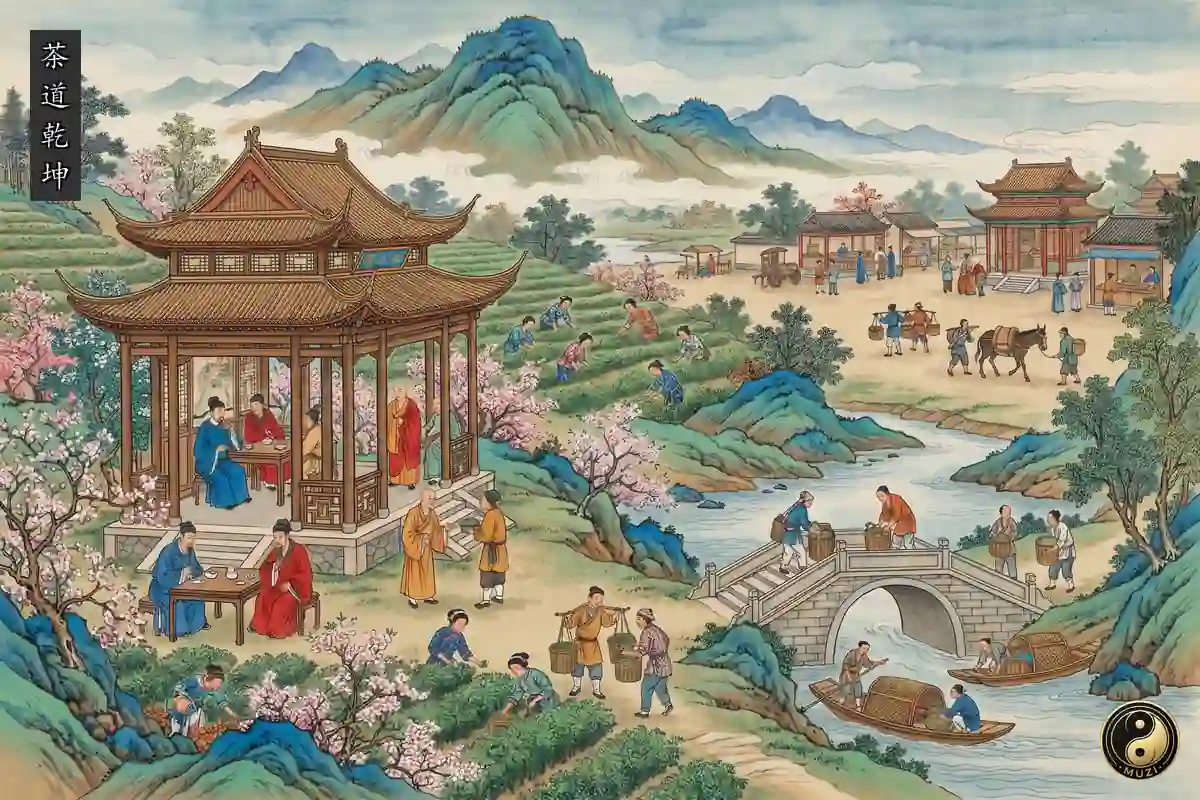
In spring hills, pickers work the tea terraces while scholars sip tea at a table in a pavilion; outside, others spread and roast the leaves amid peach blossom, beside a stone bridge and small boats.
From tea residue in a Warring States tomb at Zoucheng to Tang decocted tea, Song whisked tea and Ming and Qing steeped loose leaf, with white, yellow, dark and scented teas.
430 BCE · OriginBoiled tea leaves from an early Warring States tomb at the ancient Zhu capital in Zoucheng, Shandong are the earliest physical evidence of tea drinking.141 BCE · EvolutionTea was found in the Yangling tomb of Emperor Jing of Han (buried in 141 BCE); researchers suggest tea was already travelling toward Tibet along early trade routes (Scientific Reports, reported by Smithsonian Magazine).59 BCE · EvolutionWang Bao's Contract for a Servant of the Western Han, written in the first month of Shenjue 3 (59 BCE), requires the servant to "boil tu" and to "buy cha" at Wuyang; the Guwen Yuan commentary explains tu as a bitter vegetable and cha as tea.730 · EvolutionIn the Kaiyuan years of the Tang, the Record of Things Heard and Seen by Master Feng records that towns had many shops selling boiled tea, a custom that began in Zou, Qi, Cang and Di and spread to the capital, and that the Huihe came to court and drove away fine horses to trade for tea.760 · EvolutionLu Yu of the Tang wrote the Classic of Tea, systematizing tea cultivation, processing and brewing, and giving form to the way of tea.1059 · ImpactIn the second month of Jiayou 4 (1059) a Song edict said that "since the Jianzhong years of the Tang there have been tea prohibitions, with the high and low seeking profit, for nearly two hundred years" (History of Song, Treatise on Food and Money).1074 · EvolutionIn Xining 7 (1074) the Song court sent Li Qi into Sichuan to arrange tea purchases, to trade tea for horses in Qinfeng and Xihe (History of Song, Treatise on Food and Money).1391 · ImpactIn 1391 the Hongwu emperor ended tribute of pressed dragon-cake tea in favour of loose leaf, making steeped loose tea the dominant way of drinking.
How tea was first used is still unsettled; Smithsonian Magazine reports researchers as saying that the exact origins of tea remain unclear. As for physical evidence, China Daily reports that a Shandong University team tested the residue in a bowl from Xigang tomb no. 1 at the ancient Zhu capital in Zoucheng, Shandong, and concluded that it was what is left of tea after boiling or brewing, dated to 453-410 BCE. As for written evidence, Wang Bao's Contract for a Servant of the Western Han was written in Shenjue 3 (59 BCE) and contains the two lines "boil tu" and "buy cha at Wuyang"; the commentary in the Guwen Yuan explains tu as a bitter vegetable and cha as tea, so readers in the past already read the two lines differently.
In the Tang, Lu Yu wrote the Classic of Tea, about 760-780; it set out as entries the steps of picking, steaming, pounding, pressing, roasting, stringing and sealing and the method of brewing over three boils, and said that tea suits "people of refined conduct and frugal virtue". In the Song, Emperor Huizong's Treatise on Tea of the Daguan Era and Cai Xiang's Record of Tea discussed whisked tea and prized dark blue-black bowls. The History of Ming, Treatise on Food and Money, says that the Ming founder stopped the making of dragon cakes and "ordered only tea buds to be picked and sent up", without a year; Lang Ying's Seven Categories of Manuscripts, citing a manuscript Record of Sage Government, gives Hongwu 24 (1391), and Shen Defu's Unofficial Gleanings of the Wanli Era gives the ninth month of that year, adding that people then took the young buds and "steeped them once and drank", and that loose tea already existed in the Song but was ranked as a low grade.
Tea's effect on history shows clearly in state finance and frontier defence. A Song edict of the second month of Jiayou 4 (1059) said: "Since the Jianzhong years of the Tang there have been tea prohibitions, with the high and low seeking profit, for nearly two hundred years." The Song set up six monopoly bureaus at Jiangling, Zhenzhou and other places and thirteen state tea yards in Huainan, and the state sold the tea; after the campaigns of the Yongxi years the court ordered merchants to carry fodder and grain to the frontier in exchange for vouchers, which they then redeemed for tea and salt in Jiang, Huai and Jinghu (History of Song, Treatise on Food and Money). In Xining 7 (1074) the court sent Li Qi into Sichuan to buy tea and to trade tea for horses in Qinfeng and Xihe. The History of Ming, Treatise on Food and Money, sums up: "Since the Tang and Song, the law of exchanging tea for horses has been used to hold the Qiang and Rong in check, and the Ming system was especially strict", and the Ming set up Tea and Horse Offices in Qin, Tao, He, Ya and other prefectures. In this way a drink entered taxation, military supply and the frontier horse administration.
In culture, the spread of tea was closely tied to Buddhism. The Record of Things Heard and Seen by Master Feng says that before this "southerners liked to drink it, while northerners at first drank little"; in the Kaiyuan years the Chan master Xiangmo of Lingyan Temple on Mount Tai promoted Chan teaching, and those learning meditation strove not to sleep and did not eat in the evening, and all were allowed to drink tea; people carried tea with them and brewed it everywhere, imitating one another until it became a custom, and towns opened many shops brewing tea for sale, where "clergy and laity alike paid their coins and drank". In 2015 the University of Hawai'i Press published James A. Benn's Tea in China: A Religious and Cultural History; according to the publisher's description, the book argues that Buddhist monks changed people's attitudes toward tea and that itinerant Chan monks carried tea drinking everywhere, and that tea also gave poets inspiration and affected the ways scholars exchanged ideas. Lu Tong of the Tang, in Thanking Imperial Counsellor Meng for New Tea, writes from "the first bowl moistens my throat and lips, the second breaks my loneliness" to "the seventh bowl I cannot drink; I feel only a cool breeze rising under my arms", yet ends by asking: "Ask on the counsellor's behalf after the common people: will they at last have relief?" The Debate between Tea and Wine, attributed to Wang Fu of the Tang, has tea and wine contend for merit until water steps in to make peace: "the wine shop grows rich, the tea house does not go poor". In the Song, the tea houses of Dongjing lit their lamps at the fifth watch, and Lin'an in the Southern Song had tea houses such as the Qingle and the Baxian, as the Dreams of Splendour of the Eastern Capital and the Old Affairs of Wulin record.
Tea has real dealings with five other canons. With Tea-Horse Frontier Trade: tea was exchanged for horses from the Tang and Song onward, and the Ming set up Tea and Horse Offices, so that tea from the interior became the goods for which frontier horses were obtained. With Salt & Transit Monopolies: the Song vouchers could be redeemed for either tea or salt; tea and salt were both state monopolies and were used together to draw merchants to carry grain to the frontier. With Ceramic Arts: whisked tea set store by a white froth, Cai Xiang said that black bowls made at Jian'an suited it, and Emperor Huizong also prized blue-black, so the change in drinking brought a new care for tea bowls. With Spirits, Wines & Folk Drinks: the Debate between Tea and Wine sets tea and wine to argue over their merits and ends with wine shop and tea house side by side; tea is already treated as a drink to be ranked with wine. With Silk Road: in a paper published in Scientific Reports in 2016, Houyuan Lu and colleagues argued that early tea found at Chang'an and at Ngari in Tibet shows that a branch of the Silk Road across the Tibetan Plateau had formed by the second to third century CE at the latest.
That a drink entered the state's accounts and its frontier defence is where tea's standing as a canon begins: Song merchants carried grain and fodder to the frontier for vouchers that they redeemed for tea and salt, and the Ming set up Tea and Horse Offices to trade tea for horses. It entered the monasteries and the streets as well: those learning meditation drank it so as not to sleep, town shops served it to "clergy and laity alike", and Lu Tong, reaching his seventh bowl, turned to ask after the common people. Whisked tea brought a care for black bowls, the Debate between Tea and Wine set it beside wine, and early tea leaves from the ground became evidence for a branch of the Silk Road across the plateau.
Tea Culture is the tea class of the Cuisine chapter: the six kinds of tea, reprocessed tea and non-tea infusions. Other drinks belong to Spirits, Wines & Folk Drinks, and the trade of tea for horses has its own class. Lu Yu's Classic of Tea gave form to the way of tea in the Tang, and in the early Ming steeped loose tea took over. The class also follows tea into daily life, from Song tea shops to teahouses that brew in lidded bowls. Its sub-classes set out the ways of making tea and the kinds of tea.
The Way of Tea is an ancient Chinese material and spiritual practice centered on the precise control of water temperature and steeping time to differentially extract three classes of key compounds from tea leaves. These three compounds are: caffeine, a central nervous system stimulant providing neural excitation and mental clarity; tea polyphenols, phenolic compounds providing a bitter, astringent sensation; and theanine, a unique amino acid providing sweet aftertaste and mental calming. The synergistic effect of these three in the human nervous system creates tea's distinctive physiological state: simultaneous alertness and tranquility.
China is the original homeland of the tea plant. Boiled tea leaves found in an early Warring States tomb at the ancient Zhu capital in Zoucheng, Shandong, are early physical evidence of tea drinking. Tea drinking is traced in legend to Shennong, and one reliable early source is Wang Bao's *Tongyue* (Servant Contract) of the Western Han (c. 59 BCE). In a contract for purchasing a servant, Wang Bao specified the servant's daily duties, which included *peng cha jin ju* (brewing tea and cleaning the utensils) and *Wuyang mai cha* (going to Wuyang to buy tea), showing that by the Western Han tea was already bought, sold and served to guests in Sichuan.
Lu Yu's *Cha Jing* (The Classic of Tea) of the Tang dynasty (c. 760 to 780 CE) is a surviving specialized treatise on tea. The work is divided into three volumes and ten chapters, systematically discussing tea's origins, varieties, producing regions, harvesting tools, brewing vessels, water boiling methods, drinking practices, historical references, and the ranking of teas from various regions. Lu Yu elevated tea drinking from a physiological act of quenching thirst to a spiritual cultivation integrating aesthetics, ethics and natural philosophy, holding tea to be cold in nature and suited to persons of refined conduct and frugal virtue.
Chinese tea preparation underwent three key transformations. The Tang method of decocted tea (*jian cha fa*): tea cakes were roasted and ground to powder, then boiled in water seasoned with a little salt. The Song method of whisked tea (*dian cha fa*): finely ground tea powder was placed in a tea bowl, boiling water was poured from a long spouted kettle, and a bamboo whisk (*cha xian*) was used to rapidly beat the mixture into fine white foam; patterns could even be drawn on the foam surface, called *cha bai xi* (tea play), a popular pastime at Song literati gatherings. Emperor Huizong's *Treatise on Tea* has sections on the whisk, the bowl and the whisking, while Cai Xiang's *Record of Tea* uses a tea spoon and recommends a black bowl.
The Ming and Qing infusion method uses loose leaf tea (leaves not compressed into cakes) placed directly into a teacup or teapot, steeped with boiling water for several minutes before drinking. This is a simple method that stays close to tea leaves' natural flavor, and it remains a common way of drinking tea to this day. After the Ming dynasty, the popularization of loose leaf infusion also drove the development of new tea ware such as Yixing purple clay teapots and *gaiwan* (lidded bowls). The *gaiwan* has three parts, bowl, lid and saucer, and teahouses use it to brew tea and keep topping up the water.
The spread of tea also touched the history of other countries. The trade of tea for border horses is covered under Tea-Horse Frontier Trade. After tea entered England in the seventeenth century, it gradually became an everyday drink; the 1773 Boston Tea Party was an important event before the American War of Independence. In the nineteenth century, Britain's tea trade deficit with China was one background to the Opium Wars.
The internal logic of the Way of Tea lies in selectively releasing or retaining three dramatically different classes of chemical compounds from the same batch of tea leaves through precise control of three variables: water temperature, time and leaf quantity, enabling a single plant beverage to simultaneously satisfy four seemingly contradictory needs of stimulation, mental clarity, calming and sociality. Over long ages this clear cup has travelled along trade routes, entered official accounts and become part of everyday life in ordinary households. This is why tea went from a legendary chance discovery to an enduring part of Chinese life.
Tea Pavilion
The tea guests seated in the left pavilion show tea drinking as a social and contemplative practice.
Tea Picking
Figures among the tea bushes at the bottom show the agricultural origin of tea.
Hillside Tea Harvest
Workers on the middle hillside pick tea, expanding the scene of mountain tea production.
Tea Transport
Figures carrying baskets across the bridge and road suggest tea circulation and long-distance trade.
In a tea pavilion, the master boils water over a charcoal stove and whisks powdered tea into a froth while guests discuss philosophy over their cups, the way of tea unfolding in quiet ceremony. A strategic strategic commodity tracking trade routes to restructure international relations.
Tea culture is like a leaf that moved house three times: in the Tang, cake tea was ground and boiled; in the Song, the powder moved into a bowl, whisked to a white froth; in the Ming and Qing, loose leaves moved into a pot and boiling water was poured on.
Boiled tea dregs survive from a Warring States tomb at Zoucheng; Lu Yu of the Tang wrote the Classic of Tea; in 1391 loose tea replaced dragon-cake tea as tribute, and steeping took over.
A monk meditating under a tree chewed a few leaves to stay awake. The leaves were bitter but kept him alert all night. He dried them and steeped them in water, same effect. He told other monks, “These leaves keep you awake.”
Word spread. Someone tried roasting the leaves before steeping, more aromatic. Others added salt, ginger, mint.
Centuries later, a scholar ground the leaves into powder, whisked it with hot water until frothy. “Tea is not for thirst. It is meditation.”
Later still, people simply put leaves in a pot and poured boiling water over them. More convenient, but the essence remained, a cup of tea that quieted the mind.
Tea evolved from cake to loose leaf, from boiled to steeped. Tang dynasty tea was boiled with a little salt. Song dynasty tea was whisked into foam. Ming-Qing tea was simply infused. Tea is more than a beverage: it is a vehicle for spiritual cultivation, poetic inspiration, social connection and everyday exchange; the border trade in tea and horses is covered under Tea-Horse Frontier Trade.




 Non-Tea InfusionsDrinks made from the flowers, leaves, fruit or roots of plants other than the tea plant, and brewed like tea.
 Green TeaTea whose leaf is fixed, rolled and dried: pan-dried, oven-dried, sun-dried and steamed.
 White TeaTea made by withering and drying only, with no pan-frying or rolling.
 Yellow TeaTea in which a yellowing step after fixing turns the leaf yellow.
 Oolong TeaOolong tea, made with a shaking and resting step and then fixing, also called qing cha.
 Black TeaTea oxidised in full, with a bright red liquor, made in gongfu, souchong and broken styles.
 Dark TeaDark tea, piled while damp; its loose tea and compressed forms are classed separately.
 Reprocessed TeaTeas made by working tea of the basic classes further, such as scented and compressed tea.
 Tang-Song Tea MethodsTang decocted tea, Song whisked tea and the other ways of making tea through the ages.
 Teahouses and Tea CustomsTea in teahouses, and everyday tea customs such as the lidded bowl and the pouring of tea.