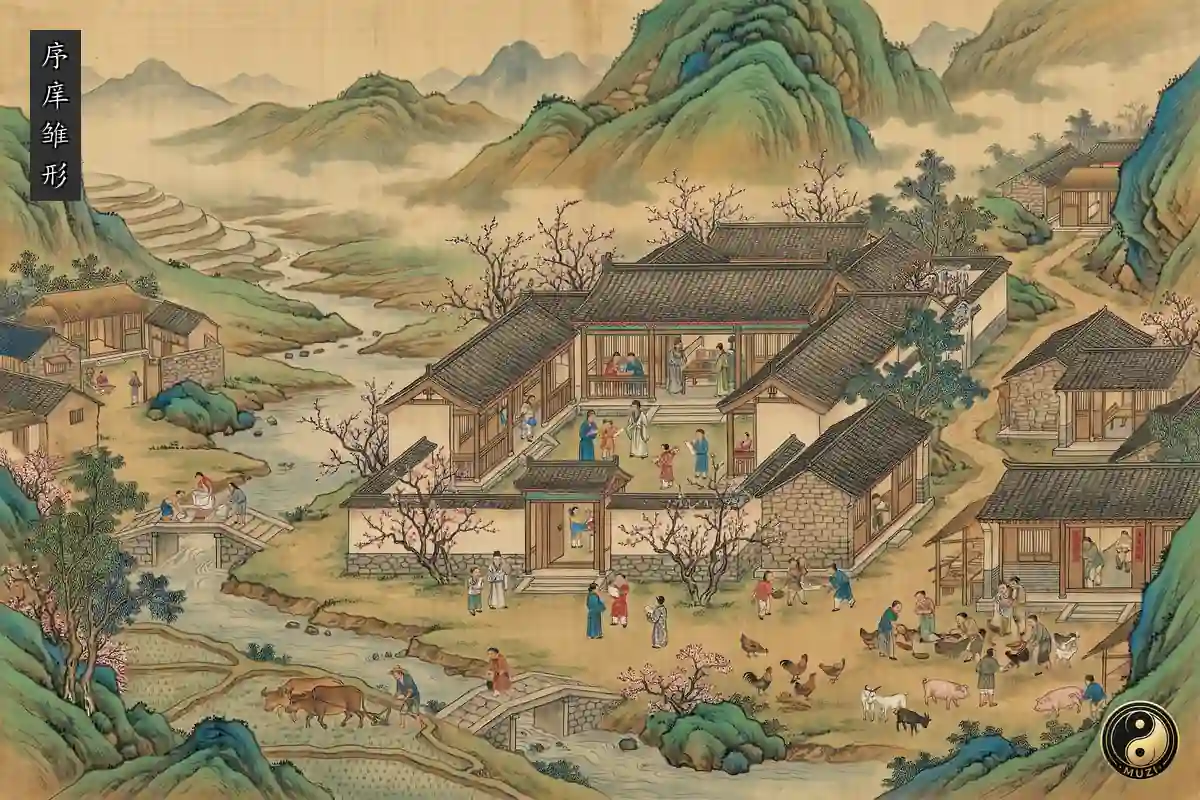
Where China's schools came from, the old books answer first with a string of names, not with a building. Mencius, in Teng Wen Gong I, says: "Set up xiang, xu, xiao and schools to teach them. Xiang means nurturing, xiao means teaching, xu means archery. The Xia called it xiao, the Yin called it xu, the Zhou called it xiang; learning was shared by all three dynasties, and all aimed to make human relations clear." Yet the Wang Zhi chapter of the Book of Rites gives another set: "The lord of Xia nourished the state elders in the Eastern Xu and the common elders in the Western Xu; the men of Yin nourished the state elders in the Right School and the common elders in the Left School; the men of Zhou nourished the state elders in the Eastern Jiao"; and the chapter Mingtang Wei says again: "The Xu is the Xu of the lord of Xia. The Gu Zong is the school of Yin. The Pan Gong is the school of Zhou." What a school of the same dynasty was called differs in the three places, and no ruling is made here; what the three share is that the school is joined to the care of the old, to archery and to rites and music, as the Wang Zhi says: "the elders all attend at the xiang, and on the first day they practise archery and honor merit."
The Shang case has to be read from oracle bones together with later records. An article by Li Linzhi published on the Chinese Social Sciences Net says that the Yu Shun and Xia claims about xiang and xu "cannot be confirmed by archaeology, so we leave them in doubt," while a school in Shang is "confirmed": the texts name teachers such as shibao, taishi and shaoshi, the oracle bones repeatedly show the characters for "teach," "learn" and "teacher," "teach" includes "practising the carving of characters," and "learn" means the content and activity of teaching and also a fixed place. He mentions the Right School and the Gu Zong of Shang, and cites scholars who argue that Shang "great school" and "small school" do not mean what they mean today: the small school was run by regional lords or states, the great school was set up by the central government; and the Gu Zong, first the ancestral temple of the court musicians, became the place where aristocratic sons received instruction in rites and music.
By the Western Zhou the schools had levels. The Xue Ji chapter of the Book of Rites says: "In ancient teaching, a household had its shu, a dang had its xiang, a shu district had its xu, and the state had its xue. Every year new pupils entered, and every other year they were examined. In the first year, whether they could break the text and set their aims; in the third, whether they were devoted to their work and happy among companions ... in the ninth, whether they understood categories and were firm and unwavering: this was called great accomplishment." Following the Rites of Zhou, Li Linzhi divides the Western Zhou schools into state schools, district schools and outlying schools; the state schools were for sons of the nobility and the district schools were managed by the Minister of Education; the Rites of Zhou, in the entry on the Master of Instruction, also says "the idle sons of the state's nobles studied there." He offers the Jing gui inscription as evidence, that King Mu twice went to the great school and taught Jing archery. These records come from the Rites of Zhou and the Book of Rites, and Li Linzhi says that for the date of the composition of the two books "opinions are many and divided," so the levels above are only an outline arranged by later hands.
Why this outline matters depends on what it produced. First, officials and teachers were not separate. Li Linzhi sums up that at the time learning "lay in the offices of government," teachers were mostly court officials, and "official was teacher, teacher was official." Second, schools led to office. The Wang Zhi describes how the township discusses its able men and raises them to the Minister of Education as "selected men," then up into the school, and that "only when the judgment is settled are they given office; once in office, given rank; once the rank is fixed, given salary"; Li Linzhi says that only a very few outstanding commoners passed through successive selections to enter the great school. Third, running schools became the ruler's own business. The Xue Ji says: "The kings of old, in founding states and ruling their people, put teaching and learning first." When Mencius spoke to King Hui of Liang of benevolent government, he too asked to "take care over the teaching of the xiang and xu, and extend it with the meaning of filial and fraternal duty"; Li Linzhi reads this as treating both xiang and xu as schools that carried out teaching of filial and fraternal duty, which can be set beside the mutual respect between old and young described in Filial Piety.
Xiang and xu join several other canons. Mencius says "xu means archery," and archery is one of the six arts described in Six Arts Curriculum; the Zhou took the Biyong as its great school, and Li Linzhi cites the Book of Songs, Ling Tai, "he beats the bells and drums, and is glad in the Biyong," so the bells and drums described in Ritual Music and Dance found a place in the school; "practising the carving of characters" links to Chinese Characters. Only when Confucius opened a private school, Li Linzhi says, did the official schools' sole hold give way, which Teaching for All goes on to describe; he also cautions that the private schools of that time still followed the official ones closely in purpose and content.
When later schools trace where they came from, they come back to xiang and xu: who should run them, whom they should teach, what they should teach, and how they connect with office all took first shape here.
The names quarrel with each other, but the things are largely alike: care of the old, archery, music, and teaching the young. In the Shang oracle bones there are already the characters for "teach" and "learn"; the Western Zhou divided state schools from district schools; the teacher was himself an official, entering school was a road to office, and running schools was the ruler's own business, for the Xue Ji says that in founding a state and ruling its people "teaching and learning come first." What xiang and xu were called may be argued; how the school stands to office, to filial and fraternal duty, and to rites and music was first set down here.
Schooling Roots is the class in the chapter on Education on the origins of schools. It covers the late Shang oracle-bone inscriptions that already contain the character for learning, with dedicated places where noble youths practised archery and ritual appearing and later called xu; and the Western Zhou principle that learning resided in government offices, when a system of state and local schools took shape and education was reserved for the nobility.
 Literature
 Book of Rites
 People
 Wang Zeng
 Confucius (Kongzi)
 Treasures