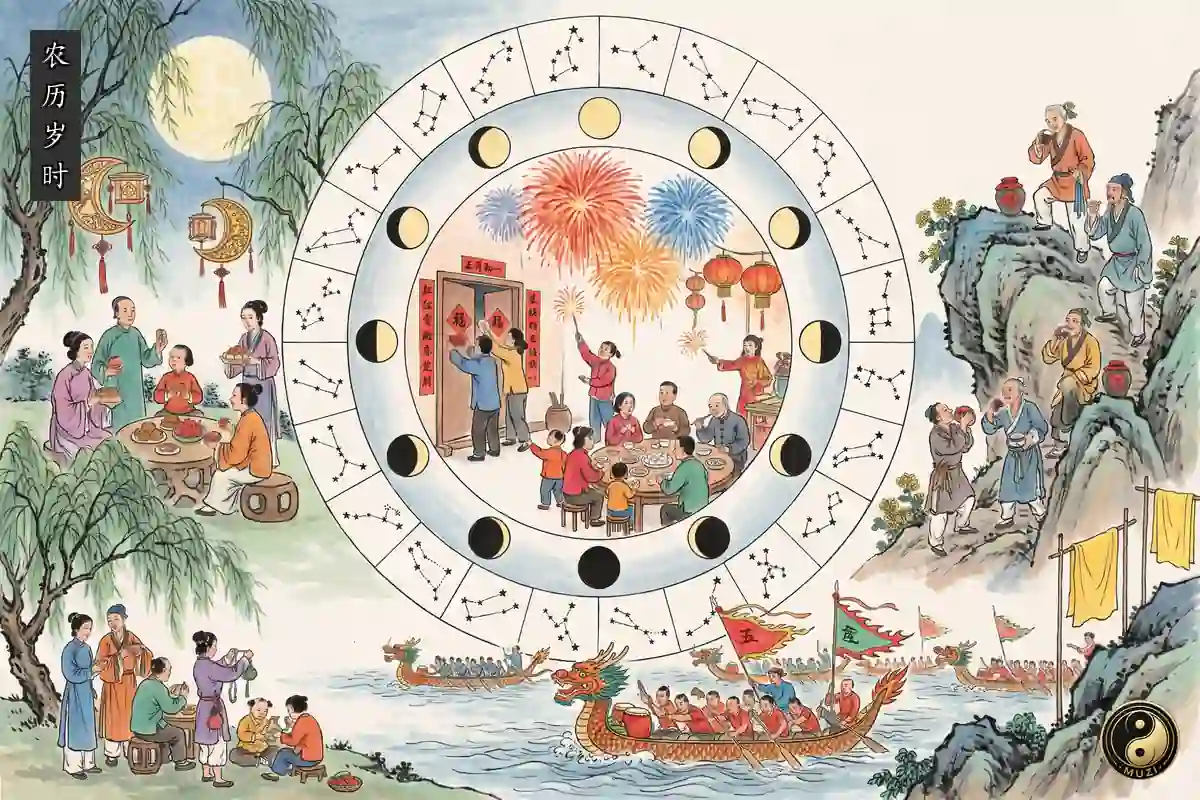
On a moonlit riverbank, a family gathers round a feast in a lantern-hung courtyard as fireworks burst overhead, dragon boats race on the water below, and people climb a cliff carrying wine.
A lunisolar calendar that reconciles solar and lunar cycles through leap months, interwoven with seasonal rituals to shape the reckoning and the festival life of the Chinese calendar.
104 BCE · EvolutionEmperor Wu of Han made the seventh year of Yuanfeng the first year of Taichu (104 BCE) and had the Han Taichu calendar made.1645 · ImpactThe early Qing issued the Shixian almanac for the second year of Shunzhi (1645), setting the solar terms by the fixed qi.
Lunisolar Calendar is not merely a table that gives dates; it is an order that weaves together the phases of the moon, the yearly course of the sun and the festive life of people. It reconciles the cycles of sun and moon through intercalation, and it divides the year into stretches that can be remembered in common through festivals, natural signs, sacrifices and family visits. "Nongli", the farmers' calendar, refers to the lunisolar calendar and the culture of the seasons that continue to this day. It also lets travellers, farmers, officials and families in different places share one cycle of the year, making time a measure by which social ties can be confirmed again and again.
The frame of the calendar is that months follow the phases of the moon and years follow the sun; twelve lunar months fall short of the solar year, and an intercalary month makes up the difference. The Monthly Ordinances in the Book of Rites arranged government orders, farm work and rites month by month from the first month of spring to the last month of winter. The seasons were therefore not only a record of the sky, but a language of time followed in common by the dynasty, the village and the household, translating changes in the sky into the rhythm of the fields and the rites at the family door.
This order has clear turning points in history. According to the Treatise on Pitch-pipes and the Calendar in the Book of Han, officials argued that "the calendar should be reformed", and Emperor Wu ordered "the seventh year to be made the first year", the first year of Taichu (104 BCE), and had the Han Taichu calendar made, so that the empire's reckoning of years and its calendar gained a new beginning. In the Eastern Han, Cui Shi's Monthly Ordinances for the Four Classes of People arranged farm work, sacrifices and family dealings month by month; Zong Lin of the Southern Liang, in his Record of the Seasons of Jing-Chu, recorded customs for New Year's Day, the fifteenth of the first month, the Cold Food Festival, the boat races of the fifth day of the fifth month, the chrysanthemum wine of the ninth day of the ninth month and the La day; and Meng Yuanlao of the Northern Song, in the sixth chapter of his Dreams of Splendour of the Eastern Capital, recorded the festivals of Bianjing under entries such as "The New Year's Court Assembly", "The Beginning of Spring" and "The Lantern Festival". In the early Qing the court issued the Shixian almanac for the second year of Shunzhi (1645); its solar terms, in the words of the Draft History of Qing, are "what the Chinese method calls the fixed qi". In 2009 the Dragon Boat Festival was inscribed on UNESCO's Representative List of the Intangible Cultural Heritage of Humanity.
Its effect on history lies first in putting the government of the state and the arrangements of people's livelihoods into one calendar. The Monthly Ordinances describe, month by month, the season of heaven, farm work, prohibitions and sacrifices, which shows that a calendar could fix the timing of government orders and farming; the Han reform of the calendar and the making of the Taichu calendar brought the empire's reckoning of years to a single beginning. When the early Qing Shixian almanac adopted the fixed qi, the solar terms were set directly by the sun's true position, and the almanac served officials as well as sowing and harvest in the fields. The calendar was therefore both a document through which power proclaimed order and a practical guide by which ordinary people arranged work, storage, travel and gatherings.
Its influence on culture shows itself in what is repeated in daily life. The Record of the Seasons of Jing-Chu places the Cold Food Festival one hundred and five days after the winter solstice and describes wearing dogwood and drinking chrysanthemum wine on the ninth day of the ninth month; the Dreams of Splendour of the Eastern Capital gives the Lantern Festival an entry of its own; and UNESCO's description of the Dragon Boat Festival mentions dragon-boat races and festive meals of rice dumplings and eggs with realgar wine. These dates thus became rites in which every household could take part. Old books recorded these practices as local customs; the inscription of the Dragon Boat Festival shows that traditional festivals are at once local memory, national narrative and a subject of present-day cultural identity. Festivals also keep tastes, colours and gifts in memory, so that an abstract calendar becomes a culture that can be seen, heard and shared.
Lunisolar Calendar and five other canons have shaped one another. With Yin-Yang & Five Elements: the Monthly Ordinances match the seasons, directions and colours with the Five Phases, and so the seasons gained an explanation in the order of the cosmos. With Shadow Measurement: measuring the sun's yearly course and the winter and summer solstices gives an astronomical scale for the solar terms and for intercalation. With Solar Terms: the solar terms cut the continuous change of the solar year into points that farm work can follow, making up for what the moon's phases alone cannot give. With Ritual Music and Dance: the start of the year, sacrifices, court assemblies and family rites turn the dates of the calendar into collective action. With Liquors & Soft Drinks: chrysanthemum wine, realgar wine and festive food let time be remembered in the body and at the banquet. The five show in turn its cosmic explanation, its basis in measurement, its seasonal divisions, its public rites and its life in the senses, and they show that Lunisolar Calendar is no isolated system of dates.
Lunisolar Calendar links the moon's phases, the sun, government orders, farm work and festive custom into one order of time that can be followed in common: the Monthly Ordinances arranged government orders and farm work month by month, Emperor Wu of Han began the Taichu era and had the Han Taichu calendar made, and the Shixian almanac issued in the early Qing adopted the fixed qi. From the Monthly Ordinances for the Four Classes of People to the Record of the Seasons of Jing-Chu and the Dreams of Splendour of the Eastern Capital, festivals turned the state calendar into the memory of families and cities, and the inscription of the Dragon Boat Festival on the UNESCO list in 2009 carries the old seasons on into present-day identity.
Lunisolar Calendar is the class in the chapter on Cosmos on the lunisolar calendar and the festivals of the year. On the calendar side is a lunisolar calendar that reconciles the cycles of sun and moon by intercalation; on the festival side are the festivals of the year, such as the Spring Festival, the Lantern Festival, the Dragon Boat Festival, the Mid-Autumn Festival, the Double Ninth and New Year's Eve. The class is divided by festival.
Spring Festival marks the beginning of the lunar new year through reunion, ancestral rites, staying up on New Year's Eve, spring couplets, fireworks, and dumplings.
Dragon Boat Festival
Dragon Boat Festival falls on the fifth day of the fifth lunar month, represented by dragon boat racing, fragrant sachets, and zongzi.
Mid-Autumn Festival
Mid-Autumn Festival falls on the fifteenth day of the eighth lunar month, centered on moon viewing, lanterns, mooncakes, and reunion.
Double Ninth Festival
Double Ninth Festival falls on the ninth day of the ninth lunar month, marked by climbing high, chrysanthemums, chrysanthemum wine, longevity wishes, and respect for elders.
A single composition weaves together four lunar festivals: Spring Festival with couplets and fireworks, Dragon Boat racing with sachets, Mid-Autumn mooncakes and lanterns, and Double Ninth mountain climbing with chrysanthemum wine. A sophisticated computational algorithm interweaving solar-lunar cycles with cultural warmth.
Lunisolar Calendar is like a long rope tied with knots: the waxing and waning of the moon is one stretch of the rope, an intercalary month is a length spliced on, the festivals are the knots tied in it, and when the year has run its course the end of the rope comes back to the first month.
Oracle bones from Yinxu record twelve months with an interposed "thirteenth month"; Emperor Wu of Han issued the Taichu calendar with the first month as the head of the year; and in the early Qing the Shixian calendar was issued, using the true-solar-term method, and became the direct basis of today's lunar calendar.
Imagine New Year's Eve, with a family sitting round the table for the reunion dinner. After the meal the grown-ups take the children to paste up the spring couplets, and firecrackers sound outside. The child is sleepy, and a grown-up says: we keep the vigil, we do not sleep. The family keeps watch, and no one is willing to give in and go to bed.
New Year's Eve is the last day of the lunar year, mostly the thirtieth of the twelfth month, or the twenty-ninth in a short month. Its main customs are the reunion dinner, the night vigil, pasting spring couplets and New Year pictures, firecrackers and honouring ancestors; the Dreams of Splendor of the Eastern Capital of the Northern Song records households sitting round the stove until dawn without sleeping, called "keeping the year". (This is an illustrative story, not a historical account.)




 Spring FestivalThe first day of the lunar year, when the old year is seen out and the new one welcomed
 Lantern FestivalThe full moon of the first month: a night of lanterns that closes the New Year season
 Dragon Raises Its Head FestivalOn the second of the second month the dragon raises its head: spring rain is coming, and farmers pray for a good year
 She Day (Earth God Festival)In spring the village prays to the earth god for grain, and in autumn gives thanks for the harvest
 Double Third FestivalAn ancient spring festival of purification by the water, outings and feasts
 Cold Food FestivalNo fires and only cold food, 105 days after the winter solstice, in memory of Jie Zitui
 Dragon Boat FestivalBoat races and zongzi on the fifth of the fifth month, the summer festival that remembers Qu Yuan
 Qixi FestivalThe seventh night of the seventh month, when the Herd Boy meets the Weaver Girl and women beg for skill
 Zhongyuan FestivalThe fifteenth of the seventh month: offerings for ancestors and the dead, Zhongyuan to Daoists and Ullambana to Buddhists
 Mid-Autumn FestivalThe full moon of the eighth month: an autumn festival of moon viewing and reunion
 Double Ninth FestivalClimbing heights and admiring chrysanthemums on the ninth of the ninth month, now also the Day for the Elderly
 Cold Clothes FestivalOn the first of the tenth month, paper winter clothes are burned for the ancestors
 Laba FestivalCongee cooked and shared on the eighth of the twelfth month, the first taste of the New Year
 Little New YearThe kitchen god is sent off on the 23rd or 24th of the twelfth month, opening the New Year season
 New Year's EveThe last night of the lunar year: reunion, the year-end vigil, and farewell to the old year
 Canon
 Literature
 Record of a Dream of Splendour in the Eastern Capital
 People
 Meng Yuanlao
 Emperor Wu of Han (Liu Che)
 Zong Lin
 History
 Lanting Canon & Literati Aesthetic
 Qu Yuan's Sacrifice
 Luoxia Hong and the Taichu Calendar
 1911 Xinhai Revolution
 Emperor Wu Holds Ullambana Feast
 Atlas
 Autumn Moon over the Calm Lake
 Flavor