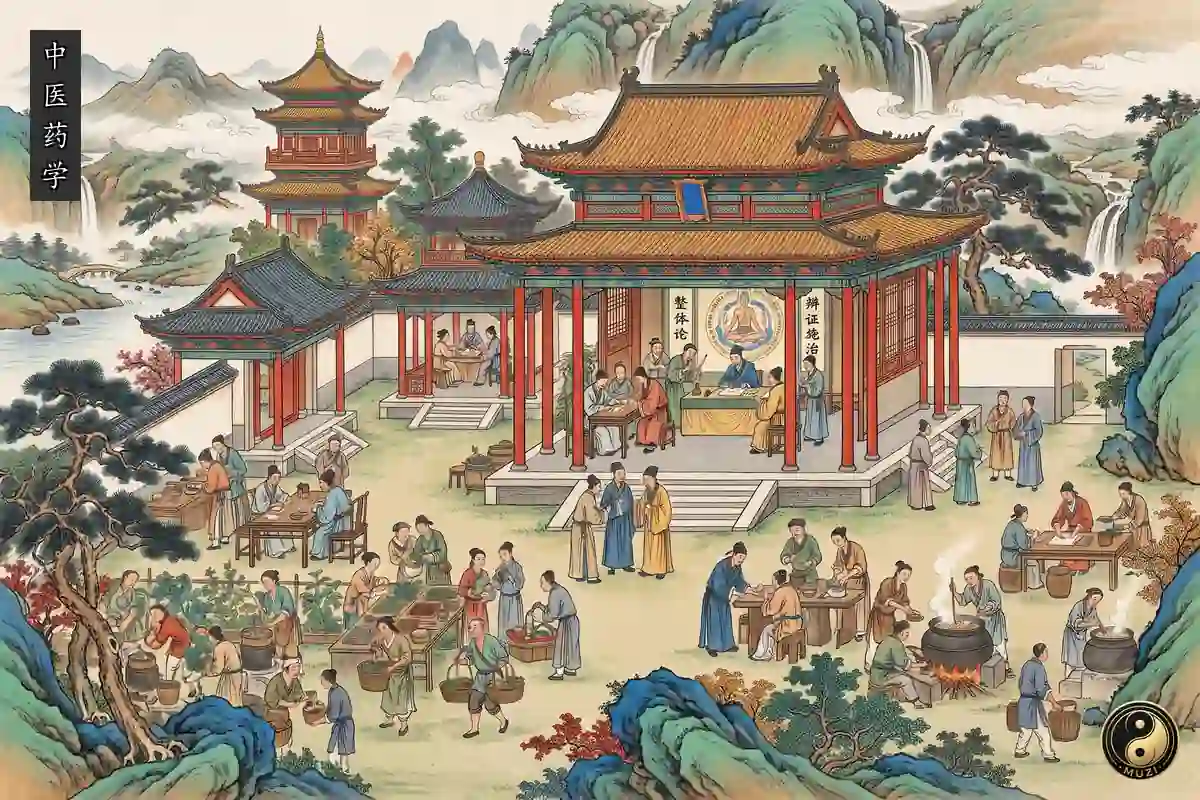
Traditional Chinese medicine is a comprehensive medical system grounded in the philosophical framework of *yinyang wuxing* (yin-yang and Five Phases) theory and in *bianzheng lunzhi* (pattern differentiation and treatment) as its clinical methodology. It is the oldest systematized traditional medicine still in widespread practice today. Its core principle treats the human body as a dynamic system in mutual resonance with the cosmos. Imbalances of yin and yang within the body, disharmony among the generative and restraining cycles of the Five Phases, and blockages in the flow of *qi* and blood are, within the theoretical framework of Chinese medicine, not merely local symptoms of illness but outward signals of a systemic imbalance of the entire bodily state. The *Huangdi Neijing* (Yellow Emperor's Inner Canon), the foundational text of Chinese medical theory, established the basic concepts of holism and dynamic equilibrium: *Yinyang zhe, tiandi zhi dao ye, wanwu zhi gangji, bianhua zhi fumu, shengsha zhi benshi* (Yin and yang are the way of heaven and earth, the governing principle of all things, the parents of change, the root of life and death). The human body is a precise microcosm whose operating principles are, in essence, identical to those of heaven and earth, all governed by a single model of yin-yang and Five Phases.
Zhang Zhongjing's *Shanghan Zabing Lun* (Treatise on Cold Damage and Miscellaneous Diseases, ca. 200 to 210 CE) of the Eastern Han is honored by posterity as the second foundational text in Chinese medical history after the *Huangdi Neijing*. It advanced Chinese medicine from abstract theory into the actionable clinical system of *bianzheng lunzhi* (pattern differentiation and treatment). Zhang Zhongjing confronted the large-scale epidemics caused by the wars and famines of the late Eastern Han. Within fewer than ten years, two thirds of his family had perished, seven tenths of them from cold-damage febrile disease. The anguish of these personal bereavements drove him to devote his entire life to writing this classic. His pioneering *liujing bianzheng* (Six Channel Pattern Differentiation), which classifies externally contracted febrile diseases by affected channel layer, *taiyang*, *yangming*, *shaoyang*, *taiyin*, *shaoyin*, and *jueyin*, remains to this day the foundational clinical method of Chinese medicine.
The four diagnostic methods of Chinese medicine, *wang* (inspection), *wen* (listening and smelling), *wen* (inquiry), and *qie* (palpation), constitute the oldest and most economical full-body examination norm in human medical history. Inspection diagnoses internal disease location and nature by observing the patient's complexion, tongue coating, posture and mental state. Listening-and-smelling diagnosis supplements the assessment through the patient's breathing sounds, cough and body odor. Inquiry diagnosis systematically questions the patient on more than ten baseline signs, including chills and fever, sweating, appetite, urination and defecation, sleep and pain, to construct a complete clinical picture. Pulse palpation uses three fingers pressed against the radial artery at the wrist to perceive more than twenty basic pulse qualities such as floating, sinking, slow, rapid, deficient, excess, wiry and slippery, thereby assessing the functional state of internal organs, *qi*, and blood. These four diagnostic procedures are completed within ten minutes using zero instruments and zero invasive measures, yet in the hands of a well-trained practitioner of Chinese medicine, their diagnostic accuracy and consistency far surpass any self-diagnosis performed by a layperson relying on intuition alone.
The pharmacological system within Chinese medicine, known as *zhongyao* (Chinese materia medica), uses natural plants, animals and minerals as raw materials, which undergo processing (*paozhi*: steaming, stir-frying, roasting, calcining and other methods) before being applied in compound prescriptions. Each individual medicinal substance has its own nature and flavor (cold, hot, warm, cool or neutral, across the five tastes) and channel tropism (the primary organ-channel on which it acts). However, the formula, a carefully designed combination of multiple medicinals, is the most essential feature of Chinese pharmacotherapy. *Jun chen zuo shi* (sovereign, minister, assistant, courier): the sovereign medicinal directly attacks the disease, the minister reinforces and synergizes, the assistant restrains toxicity and side effects, and the courier guides the formula's combined force to the disease site. This four-role compounding design enables a single Chinese herbal formula to simultaneously target multiple symptoms and pathological mechanisms of a single disease through multiple active pathways. This multi-component, multi-target therapeutic strategy remains a frontier research area in modern pharmacology; using single-target, single-compound molecular pharmacological models to understand and validate the compound efficacy of Chinese herbal formulas remains a scientifically unresolved challenge to this day.
The internal logic of traditional Chinese medicine is to treat the human body as a dynamic, self-regulating ecosystem in which disease is not an invasion by an external enemy but a disruption of internal equilibrium, and the goal of treatment is not to annihilate a pathogen but to restore the body's own capacity for self-regulation and balance. With yin-yang and Five Phases as the philosophical axioms, the four diagnostic methods as data-collection instruments, pattern differentiation and treatment as the decision-making logic, and compound prescriptions as the therapeutic toolkit, these four layers together constitute a refined, self-consistent system entirely independent of Western biomedicine. This is precisely why traditional Chinese medicine has been able to provide effective medical care to hundreds of millions of people continuously for two millennia, and why it is regaining research and clinical attention globally in the contemporary era under the rubric of complementary and alternative medicine.