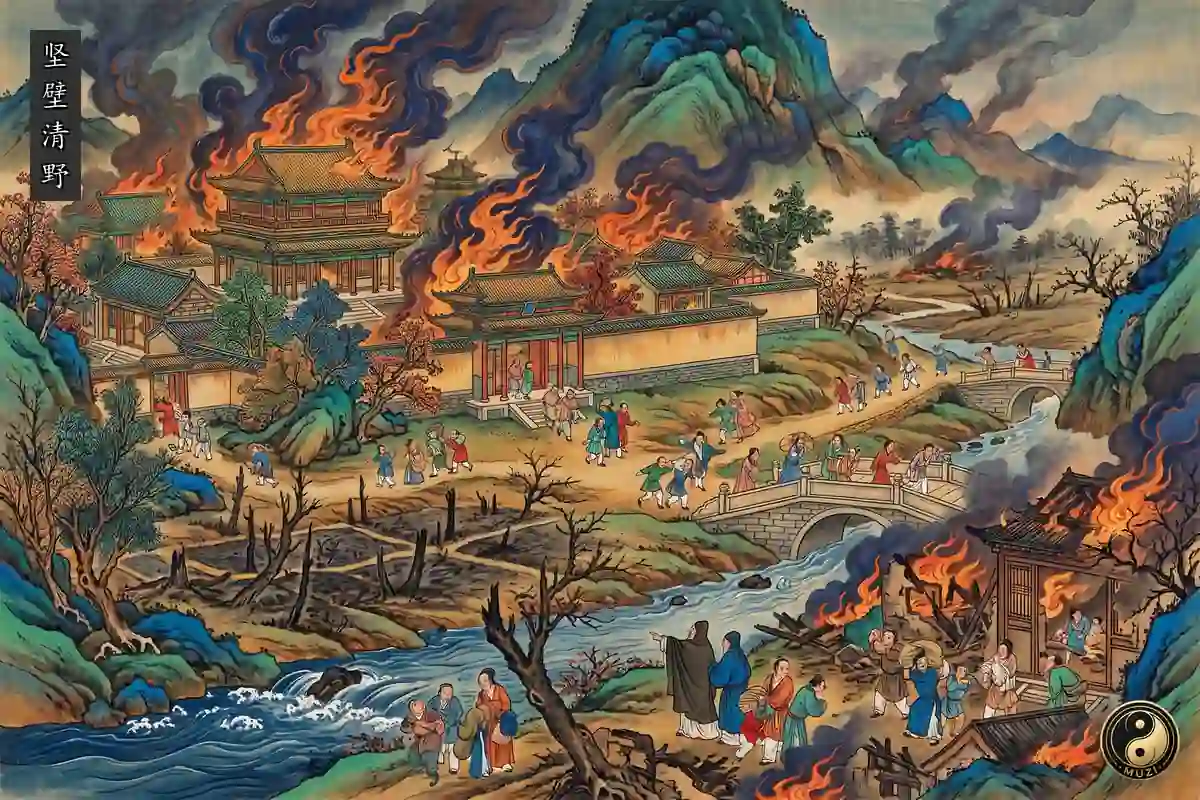
A line spoken by Xun Yu was meant to talk a man out of attacking a city. In the second year of Xingping (195), after Tao Qian died, Cao Cao wanted to seize Xuzhou on the strength of it, and Xun Yu said to him: "Now the whole east has already brought in the wheat. They will surely fortify the walls and clear the fields to await you, General. If you attack and cannot take it, and raid and gain nothing, then within ten days your hundred thousand will be worn out before they have fought." The quotation follows the Biography of Xun Yu in the Records of the Three Kingdoms, which writes "already brought in" with the character yi used for "already."
The line speaks for the defender: the wheat is in, the city is held firm, and the attacker "attacks and cannot take it, raids and gains nothing." Xun Yu's reasons did not stop at this one sentence. He reminded Cao Cao that Yanzhou was not yet secure: "If you leave Lu Bu and go east, leaving many troops will leave too few for the campaign, and leaving few will send the people into the walled towns, so no firewood can be gathered." His plan was first to "lead the troops to harvest the ripe wheat and stock up food and grain," and break Lu Bu in one blow. Cao Cao listened and gave up the plan. Here "fortify the walls and clear the fields" is a judgment used to size up an opponent, urging the one who attacks to count his own supplies first.
The practice is older than the phrase. The Records of the Grand Historian, in the Hereditary House of the Marquis of Jiang, tells that when the seven states of Wu and Chu rebelled, Zhou Yafu asked to "cut their grain road," went to Changyi and "dug in behind deep walls"; when Liang pleaded again and again for help and Emperor Jing ordered him to relieve Liang, he "did not obey the decree and held the walls without sallying," and sent light cavalry to cut the grain road of Wu and Chu, so that the Wu troops "ran short of grain and went hungry; they often tried to provoke a battle, but he would not come out," and in the end they "drew off"; Zhou Yafu then sent out picked troops in pursuit and "smashed them." The note to "Make a noise in the east" in Thirty-Six Stratagems tells of the same event, citing the Book of Han.
In Art of War, the Sunzi takes this view of attacking cities: "The best is to attack the enemy's plans, next to attack his alliances, next to attack his army, and the worst is to attack walled cities. The method of attacking cities is a last resort." It also urges "feeding on the enemy": "the wise general strives to feed on the enemy; one zhong of the enemy's grain equals twenty of our own." Read together with Xun Yu and Zhou Yafu, "fortify the walls and clear the fields" is aimed at exactly these two things, "feeding on the enemy" and "attacking cities": the city is not to be stormed and the grain is not to be taken. This is a reading that sets several passages side by side; the book does not say it in so many words.
In the Qing it became a set of methods. The Draft History of Qing, in the Biography of Le Bao, records that in the first month of the third year of Jiaqing Le Bao reached Liangshan in Sichuan and was later made Governor-General of Sichuan; finding "the rebels' tracks uncertain, forcing others to follow them wherever they went," "drew up a plan of fortified walls and cleared fields, ordering the people to build stockades on the cliffs, store grain, and drill local militia for their own defense." The comment after the biography says that when Delengtai went from Chu into Shaanxi with Mingliang and saw the people suffering from plunder, he had proposed a plan of fortified walls and cleared fields, but "the court discussion judged building forts too heavy a labor and did not approve it; when Le Bao reached Sichuan he first carried it out in full, extended it across the three provinces, and the rebels were broken because of it." In another place, the Biography of Fang Ji says that Fang Ji built more than two hundred stockades at Liangshan, "making each man defend his own," and that refugees from other counties who came to rely on them numbered over three hundred thousand; "the method of fortified walls and cleared fields began, it seems, at Liangshan." The two passages differ on the starting point and are given together here. Luo Quan of Guizhou Normal University says in the abstract of an article that in the White Lotus campaign of the Jiaqing reign the Qing court took, from the top down, a series of fortified-wall-and-cleared-field measures that moved the people's stockades from spontaneous village action to state control; Chen Jun of Renmin University of China points out that scholars usually trace the beginning of local militia to the White Lotus uprising of the Jiaqing reign, but local militia already existed in the early Qing.
In the battle of Ningyuan at the end of the Ming it met firearms. The History of Ming, in the Biography of Yuan Chonghuan, records that in the first month of the sixth year of Tianqi (1626), when the Later Jin army (which the History of Ming calls "the Great Qing") reached Ningyuan, Yuan Chonghuan "burned all the houses outside the city, took his defense gear into the city, and cleared the fields to await them"; the next day, when the army attacked, he ordered the Fujian soldier Luo Li to "fire the great Western guns and wound the troops outside the walls," and on a second attack they were beaten back and "the siege was lifted." The guns discussed in Firearms Evolution here became the means of holding the city after the fields were cleared. These uses are recorded in the Records of the Grand Historian, the Records of the Three Kingdoms, the History of Ming and the Draft History of Qing, and of them the case that comes first in time is in the book treated in Records of the Grand Historian.
Sally out and fight to the end, or open the gates and surrender: these were the defender's two choices. Scorched Earth gave a third: gather the city, the grain and the people first, and let the attacker do the sums. The histories also record its cost: Xun Yu's "the people will all flee into the walled towns," the court's "too heavy a labor to build forts," and the houses burned outside Ningyuan.
Xun Yu used it to talk Cao Cao out of attacking Xuzhou; Zhou Yafu used it to cut off the grain of Wu and Chu; Le Bao had the people stockade the hills; Yuan Chonghuan burned the houses outside Ningyuan and had the Western guns fired. Dynasties changed, and what did not change was the way the account is worked out: the city is not to be taken, the grain is not to be carried off, and the price one pays oneself, such as Xun Yu's "the people will all flee into the walled towns," is set out in the open in the histories and not hidden.
Scorched Earth is the class in the chapter on Strategies on the war of attrition that trades space for time. Against a stronger enemy, the defender strengthens his walls, clears supplies and people from the open country, delays the enemy and wins time for defence. The phrase comes from Xun Yu at the end of the Eastern Han.
 Literature
 Records of the Grand Historian
 Book of Han
 People
 Zhou Yafu
 Cao Cao