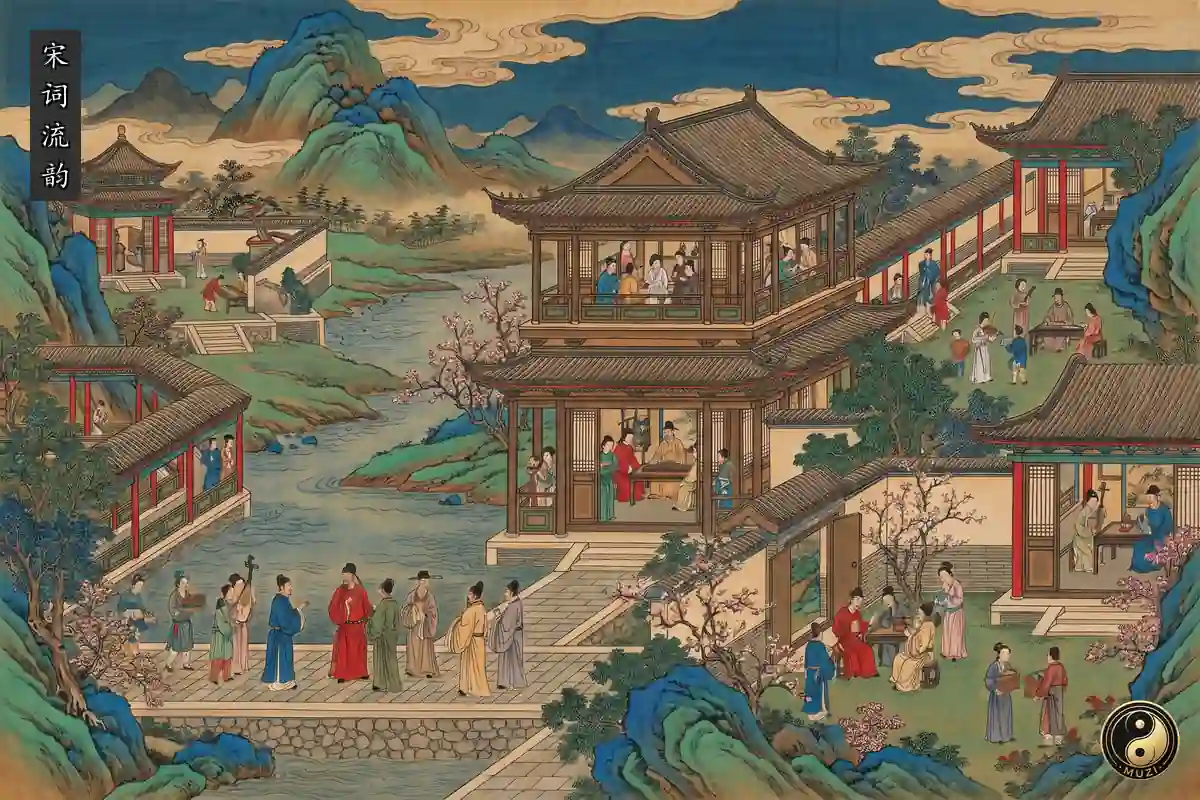
The ci lyric is a form of lines of unequal length set to a tune: the tune comes first and the words are fitted to its pattern, which is why the lines are long or short. In Brush Talks from Dream Brook (Mengxi bitan), Shen Kuo notes: “besides the poem there is also the 'harmonizing sound', which is what is called the tune,” and adds: “the Tang people then filled words into the tune and no longer used the harmonizing sound.” Wang Zhuo's Random Notes from Biji (Biji manzhi) traces the line further back: “the old songs became the old yuefu, and the old yuefu became today's tunes; at root they are one,” and he says that “from the Sui on, what we now call 'tunes' gradually arose, and grew somewhat common in the Tang.”
By the late Tang and the Five Dynasties, the ci had its known masters and its anthologies. The Old Book of Tang says that Wen Tingyun “could follow the sound of strings and pipes and write words of a languid, sensuous kind”; in his preface to Among the Flowers, Ouyang Jiong writes: “In the reign of Emperor Ming there were four ci on the tune Qingpingle that Li Bai wrote on imperial command, and in recent times Wen Feiqing has the Jinquan ji.” Zhao Chongzuo of Later Shu, a junior minister of the Court of the Imperial Regalia, “gathered the guests widely and often invited fine discussion,” and so “collected five hundred recent tune-lyrics by poets, in ten scrolls”; the preface was written in the fourth month, in summer, of the third year of the Guangzheng reign, that is 940 CE, and Ouyang Jiong hoped that “the beauties of the southland would stop singing the Song of the Lotus Boat.” The Qing editors of the Complete Library of the Four Treasuries said of the anthology: “tracing the source to its head, it is this collection that must be called the oldest,” and also that “the ci and songs of the famous late-Tang writers survive only thanks to it.”
In the Song the ci branched into several paths. Liu Yong's lyrics were sung far and wide: Ye Mengde records the words of an official returned from the Western Xia, who said “wherever there is a well to drink from, Liu's lyrics can be sung”; and the General Catalogue of the Complete Library of the Four Treasuries quotes Ye Mengde again, saying that “whenever the Music Bureau's musicians got a new melody, they would ask Yong for words, and only then would it be released.” Su Shi writes of himself: “My recent little ci lack the flavour of Liu the Seventh, yet they are a school of their own,” and in the same letter says he had written one piece and “had the stalwarts of Dongzhou stamp their feet and clap their hands as they sang it, with flutes and drums keeping the beat, and it was quite a sight.” His Niannujiao: Remembering the Past at Red Cliff (1082) opens with “The great river flows east, its waves washing away all the heroes of a thousand ages.” In his preface to Xiang Ziyin's Jiubian ci, Hu Yin says of Su Shi that he “swept away the manner of silks and perfumed powder” and “shed the winding, clinging cadences.”
Xin Qiji's path includes the Pozhenzi titled “Written in Bold Words to Send to Chen Tongfu”; in his preface to the Collected Works of Xin Jiaxuan, Liu Kezhuang says that Liu Yong was “only lingering over scenery and singing the praises of peace,” whereas Xin's lyrics are “cutting across the six quarters” and “sweeping clear the ten thousand ages.” The General Catalogue writes of the Jiaxuan ci: “among the masters of the tune-lyric he was a changed mode that rose like a separate army, standing as a school of its own beyond the cutting of red and carving of green.” Zhou Bangyan, in the General Catalogue's words, “presented the Rhapsody on the Bian Capital in the Yuanfeng years and was summoned to be Chief Musician (taiyue zheng),” and the History of Song, Biographies of Men of Letters, says he “loved music, could compose tunes himself, and made lyrics of uneven lines with a clear and rich rhyme” (as quoted in the General Catalogue).
The ci mattered historically first through its audiences and its venues. Dreams of Splendor of the Eastern Capital (Dongjing menghua lu) lists the entertainers of the capital's tile-markets from the Chong and Guan years on: for “small songs” Li Shishi, Xu Poxi, Feng Yinu, Sun Sansi and others, and among the “pupils of the piaochang” Zhang Qiqi, Wang Jingnu and others. Notable Sights of the Capital (Ducheng jisheng; completed, according to the Catalogue's note, in the second year of Duanping) explains: “Piaochang means singing short tunes and small ci on top of a drum, riding the empty sound and playing freely with the modes,” and adds that this singing “was originally only for the streets, but now the great houses often have it too.” Piaochang thus moved from the streets into private houses, and those who heard the ci were no longer found only in the streets. A further result lay in rhyme: in its entry on Zhong Heng's Ciyun (Rhyme Book for Lyrics), the General Catalogue says that in the Song “there were only writings that made tunes, and never any compiling of rhymes,” because what was discussed then was musical pitch, and the lyrics “were sung by high and low alike and needed only to sound harmonious”; after that, “Zhou Deqing wrote the Zhongyuan yinyun, spread the entering tone among the others, and fixed it as law.”
How the ci should be written was always disputed. Li Qingzhao's Essay on Lyrics (Cilun), as recorded in Hu Zai's Tiaoxi yuyin conghua, criticizes the little lyrics of Yan Yuanxian, Ouyang Yongshu and Su Zizhan, saying that they “have learning that reaches heaven and man, and write little lyrics, but it is like scooping a gourdful of water from the great sea, and all of them are shi poems with uneven lines, and often not in tune”; her reason is that “shi and prose divide into level and oblique tones, while lyrics divide into five notes, five sounds, six pitches, and clear and turbid, light and heavy,” and her conclusion is that “so we know the ci is a separate family, and few understand it.” Of Liu Yong she says he “changed the old sounds and made new ones, issued the Yuezhang ji, and won great fame; though in tune, his words were vulgar.” Hu Zai disagrees: “this judgment is not fair; I do not rely on it.” One side asked the ci to keep faith with music, the other accepted it as a school of its own, and the two views lived side by side in one age. In the preface to his History of Song and Yuan Drama, published in 1913, Wang Guowei wrote: “the ci of the Song, the qu of the Yuan: all are what is called the literature of an age,” and Song lyrics were thereby placed in the sequence of the literature of an age.
With Tang Poetry Meter: Shen Kuo's “the Tang people filled words into the tune” marks the very point where the rules of poetry met the tune; Li Qingzhao sets “shi and prose divide into level and oblique tones” against “lyrics divide into five notes,” showing that the rules of the ci had to answer to both pitch and melody at once. With Theaters: xiaochang and piaochang singing became trades in the tile-markets, so the ci gained professional singers and a street audience. With Yuan Qu Verse: Xu Wei writes in Nanci xulu (Account of Southern Plays): “the Song ci could not be set to strings and pipes, and the southerners too came to favour this,” and also that “early in the Yuan, northern zaju flowed into the south and for a time people leaned toward it like grass in the wind; the Song ci then died out”; Wang Guowei, for his part, sets “the ci of the Song” beside “the qu of the Yuan.” With Ritual Music and Dance: Zhou Bangyan served as Chief Musician; the History of Song, Treatise on Music, says that the Dasheng court music made under Huizong was “issued to the whole land and spread through the Music Bureau,” while Ye Mengde says that the Bureau's musicians asked Liu Yong for words whenever they got a new melody; the Music Bureau appears in both records.
The place of the ci can be seen along a single line: Wang Zhuo says it came down from the old yuefu, Shen Kuo records the Tang people filling words into tunes, and by the time Ouyang Jiong wrote his preface to Among the Flowers there were already five hundred to choose from; an official back from the Western Xia said that “wherever there is a well to drink from, Liu's lyrics can be sung,” Su Shi wanted the “stalwarts of Dongzhou” to stamp their feet and sing, and Xin Qiji sent his “bold words” to a friend. Li Qingzhao held to “a separate family,” Hu Yin praised the ci for washing away the manner of silks, and Wang Guowei at last placed “the ci of the Song” in the literature of an age.
Song Lyric Rhythm is the class in the chapter on Letters on the ci, a verse form that joins lines of varying length to banquet melodies. It took shape in the late Tang, and in the Song it had the bold manner of Su Shi and Xin Qiji and the delicate manner of Liu Yong and Zhou Bangyan, while its audience moved from literati gatherings to townspeople.
 Literature
 Charm of Niannu · Memories of the Red Cliffs
 Brush Talks from Dream Brook
 Complete Library of the Four Treasuries
 Old Book of Tang
 People
 Liu Yong
 Shen Kuo
 Su Shi (Su Dongpo)
 Zhou Bangyan
 Xin Qiji
 Li Qingzhao
 Wen Tingyun
 Ouyang Jiong
 Xu Wei