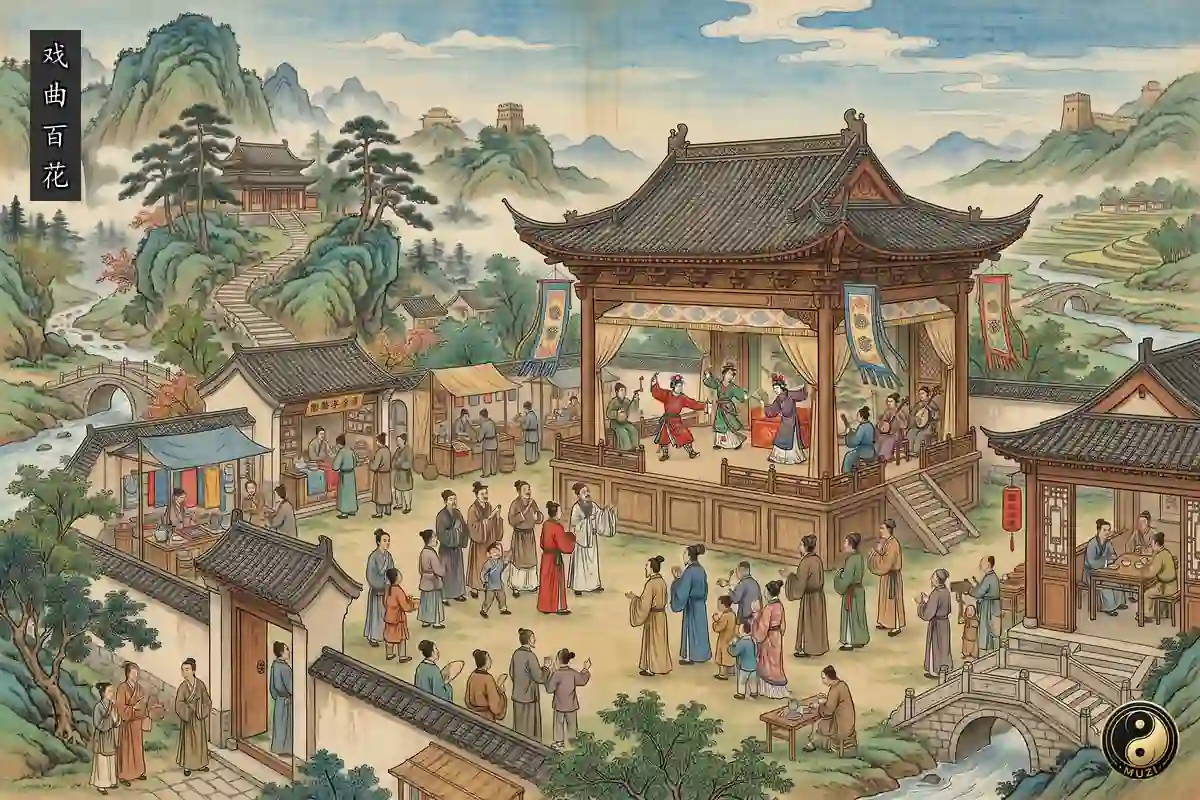
Regional Operas
Systematically gathering diverse regional operas like Kunqu, Peking, and Yue, achieving the pinnacle of symbolic, stylized, and expressionist theater.
To understand Regional Operas, we first need to see the historical pressure behind it. It was not a decorative cultural label, but a response to problems of order, trust, production, education, politics or shared life. Those problems pushed people to seek more durable ways of living together. This gives the chapter element meaning beyond a single historical moment.
Regional Operas is first of all a concrete civilizational mechanism. Systematically gathering diverse regional operas like Kunqu, Peking and Yue, achieving the pinnacle of symbolic, stylized and expressionist theater. It brings a value, technique or institution out of abstraction and into social organization and lived practice. Through it, the reader can see how an age turns experience into rules and how those rules continue to shape later life.
Regional Operas works through repeatable structure. Through learning, imitation, institutionalization and daily use, people turn local experience into a more stable civilizational capacity. This process allows it to cross time and continue shaping later ideas and practices. It makes the chapter not only historical information, but a clue to how civilization accumulates capability. It also helps later readers see why the same element can reappear in different social settings.
Regional Operas also shapes different groups of people. Scholars, artisans, families, officials, merchants, soldiers or local communities may all participate in its formation and transmission. The complete theatrical spectrum fusing symbolic, stylized and expressionist methodologies. This is why it can form meaningful links with other chapters. It has its own functional boundary, yet it sends conceptual, institutional or technical echoes outward.
Regional Operas is a key node in Chinese civilization. Systematically gathering diverse regional operas like Kunqu, Peking and Yue, achieving the pinnacle of symbolic, stylized and expressionist theater. Its importance lies not only in naming an idea, but in showing how people, families, social order, and civilizational values connect. It gives the reader a first doorway into the logic of this chapter. Through it, abstract values enter concrete life.
Xi-qu Bai-hua (Regional Operas: the system-integration of Kun-qu and Jing-ju and Chuan-ju and Yue-ju and 300 and drama schools, the cheng-shi-hua and xu-ni-hua and xie-yi aesthetic Eastern-drama peak) is, in the map of the Chinese classical regional-opera-system tradition, the first-generation source-rule of the reality-physical-standardizing-compression and high-dimensional-virtual-connection-representing tradition that. under the historical pressure of four-sheng-qiang rudiment and Kun-qu reform and Kun-qu script and Kun-qu performance-treatise and Qing chuan-qi double-peak and Jing-ju formation and cheng-shi-hua and xu-ni-hua and xie-yi aesthetic from late-Yuan to late-Qing (14th to 19th century CE). defined as the Wei Liang-fu reformed Kun-qu as Kun-qu canonical founding and Tang Xian-zu Lin-chuan Four-Dreams as Kun-qu peak and Hong Sheng Chang-sheng-dian and Kong Shang-ren Tao-hua-shan as Qing chuan-qi double-peak and Qian-long 1790 Four-Hui-Troupes entering-Beijing as Jing-ju canonical founding and Cheng Chang-geng and Yu San-sheng and Zhang Er-kui as the three-laosheng and Tan Xin-pei as Jing-ju grand-systematization and 300 and regional schools as the bai-hua the most-fundamental civilizational answer that, in the Chinese classical regional-opera-system. the Xi-qu Bai-hua is the reality-physical-standardizing-compression and high-dimensional-virtual-connection-representing that hard-rules drama and stage as the cheng-shi-hua rule and xu-ni-hua rule and xie-yi aesthetic mechanism. To trace a single coherent lineage down to its source, you have to start from the late-Yuan early-Ming four-sheng-qiang rudiment (per Gu Qi-yuan Ke-zuo Zhui-yu Wan-li era. Hai-yan-qiang and Yu-yao-qiang and Yi-yang-qiang and Kun-shan-qiang four-sheng-qiang parallel) to the early-Ming Zhu Quan Tai-he-zheng-yin-pu (1398) 12-ke za-ju classification to the Ming-Jia-jing Wei Liang-fu (1489-1566) reformed Kun-qu (shui-mo-diao and 8 qu-pai systems) THE canonical Kun-qu founding to the Ming-Jia-jing Liang Chen-yu (1519-1591) Huan-sha-ji THE Kun-qu-script first to the Ming-Wan-li Tang Xian-zu (1550-1616) Lin-chuan Four-Dreams THE Kun-qu peak to the late-Ming Pan Zhi-heng Gen-shi and Luan-xiao Xiao-pin Kun-qu performance-treatise to the late-Ming Shen Chong-sui Du-qu Xu-zhi Kun-qu pitch-treatise to the early-Qing Hong Sheng (1645-1704) Chang-sheng-dian and Kong. Shang-ren (1648-1718) Tao-hua-shan Qing chuan-qi double-peak to the early-Qing Suzhou Kun-qu troupe and Qing Kang-xi court Kun-qu to the Qing Qian-long 1790 Four-Hui-Troupes entering-Beijing THE Jing-ju canonical founding to the Qing 4-emperor Jing-ju maturation to the Qing Cheng Chang-geng and Yu San-sheng and Zhang Er-kui THE three-laosheng to the Qing Tan Xin-pei THE Jing-ju grand-systematization to the Qing cheng-shi-hua and xu-ni-hua systems to the Qing-mid-late 300 and regional schools. to trace the Xi-qu Bai-hua as the reality-physical-standardizing-compression and high-dimensional-virtual-connection-representing back to its complete author-and-book roots. The earliest textual anchor is the late-Yuan early-Ming four-sheng-qiang: with the late-Yuan early-Ming (per Gu Qi-yuan Ke-zuo Zhui-yu) four-sheng-qiang parallel as the marker of the four-sheng-qiang rudiment , so that four-sheng-qiang in the late-Yuan early-Ming first acquires the fundamental position of the four-sheng-qiang rudiment. The early-Ming za-ju classification: the early-Ming Zhu Quan (1378-1448) , with Tai-he-zheng-yin-pu (1398) 12-ke za-ju classification as the marker , so that Zhu Quan and Tai-he-zheng-yin-pu in the early-Ming first acquires the fundamental position of the early-Ming za-ju classification. The Ming-Jia-jing Wei Liang-fu Kun-qu reform THE canonical Kun-qu founding: the Ming-Jia-jing Wei Liang-fu (1489-1566) , with reformed Kun-qu (shui-mo-diao and 8 qu-pai systems) as the marker , so that Wei Liang-fu in the Ming-Jia-jing first acquires the fundamental position of THE canonical Kun-qu founding. The Ming-Jia-jing Liang Chen-yu Huan-sha-ji THE Kun-qu-script first: the Ming-Jia-jing Liang Chen-yu (1519-1591) , with Huan-sha-ji (the first Kun-qu script and 28 chu) as the marker , so that Liang Chen-yu and Huan-sha-ji in the Ming-Jia-jing first acquires the fundamental position of THE Kun-qu-script first. The Ming-Wan-li Tang Xian-zu Lin-chuan Four-Dreams THE Kun-qu peak: the Ming-Wan-li Tang Xian-zu (1550-1616) , with Lin-chuan Four-Dreams (Lin-chuan-pai founding) as the marker , so that Tang Xian-zu and Lin-chuan Four-Dreams in the Ming-Wan-li first acquires the fundamental position of THE Kun-qu peak. The late-Ming Pan Zhi-heng Kun-qu performance-treatise: the late-Ming Pan Zhi-heng , with Gen-shi and Luan-xiao Xiao-pin as the marker , so that Pan Zhi-heng in the late-Ming first acquires the fundamental position of the Kun-qu performance-treatise. The late-Ming Shen Chong-sui Kun-qu pitch-treatise: the late-Ming Shen Chong-sui , with Du-qu Xu-zhi (c. 1630s) as the marker , so that Shen Chong-sui and Du-qu Xu-zhi in the late-Ming first acquires the fundamental position of the Kun-qu pitch-treatise. The early-Qing Hong Sheng Chang-sheng-dian Qing chuan-qi double-peak-1: the early-Qing Hong Sheng (1645-1704) , with Chang-sheng-dian (1688, 50-zhe Chang-hen-ge) as the marker , so that Hong Sheng and Chang-sheng-dian in the early-Qing first acquires the fundamental position of the Qing chuan-qi double-peak-1. The early-Qing Kong Shang-ren Tao-hua-shan Qing chuan-qi double-peak-2: the early-Qing Kong Shang-ren (1648-1718) , with Tao-hua-shan (1699, 44-chu Hou-Li story) as the marker , so that Kong Shang-ren and Tao-hua-shan in the early-Qing first acquires the fundamental position of the Qing chuan-qi double-peak-2. The early-Qing Suzhou Kun-qu troupe folk Kun-qu: the early-Qing Suzhou Kun-qu troupe (folk Kun-qu performance) , so that early-Qing Suzhou Kun-qu troupe in the early-Qing first acquires the fundamental position of the folk Kun-qu. The Qing Kang-xi court Kun-qu: the Qing Kang-xi reign (1662-1722) court Kun-qu , so that Qing Kang-xi court Kun-qu in the Qing-Kang-xi first acquires the fundamental position of the court Kun-qu. The Qing Qian-long 1790 Four-Hui-Troupes entering-Beijing THE Jing-ju canonical founding: the Qing Qian-long (r. 1735-1796) , with the Qian-long fifty-fifth year (1790) Four-Hui-Troupes (San-qing and Si-xi and Chun-tai and He-chun) entering-Beijing and Jia-qing and Dao-guang period Hui-Han-merger forming Jing-ju as the marker , so that Qian-long and Four-Hui-Troupes in the Qing-Qian-long first acquires the fundamental position of THE Jing-ju canonical founding. The Qing Dao-guang and Xian-feng and Tong-zhi and Guang-xu Jing-ju maturation: the Qing 4-emperor (1821-1908) Jing-ju maturation (4-emperor Jing-ju replacing Kun-qu as mainstream) as the marker , so that Qing 4-emperor Jing-ju maturation in the mid-late-Qing first acquires the fundamental position of the Jing-ju maturation. The Qing Cheng Chang-geng and Yu San-sheng and Zhang Er-kui THE three-laosheng: the Qing Cheng Chang-geng (1811-1880, Jing-ju ancestor) and Yu San-sheng (1802-1866, Han-diao laosheng) and Zhang Er-kui (1814-1864, Jing-qiang laosheng) , so that Cheng Chang-geng and Yu San-sheng and Zhang Er-kui in the mid-Qing first acquires the fundamental position of THE three-laosheng. The Qing Tan Xin-pei THE Jing-ju grand-systematization: the Qing Tan Xin-pei (1847-1917, Jing-ju grand-systematization and Jing-ju Tan-pai founding) , so that Tan Xin-pei in the Qing-Guang-xu first acquires the fundamental position of THE Jing-ju grand-systematization. The Qing cheng-shi-hua system: the mid-late-Qing (c. 19c) cheng-shi-hua system (the cheng-shi-hua rule-base) as the marker , so that Qing cheng-shi-hua system in the mid-late-Qing first acquires the fundamental position of the cheng-shi-hua rule-base. The Qing xu-ni-hua system: the mid-late-Qing xu-ni-hua system (the xu-ni-hua rule-base) as the marker , so that Qing xu-ni-hua system in the mid-late-Qing first acquires the fundamental position of the xu-ni-hua rule-base. The Qing-mid-late 300 and regional schools: the Qing-mid-late , with Qin-qiang (Shan-xi c. 18c) and Chuan-ju (Si-chuan c. 18c) and Xiang-ju (Hu-nan c. 18c) and Gui-ju (Guang-xi c. 18c) and Yue-ju (Guang-dong c. 19c) and Yue-opera (Zhe-jiang c. 19c) and Hu-ju (Shang-hai c. 19c) and Ping-ju (He-bei c. 19c) and Huang-mei-xi (An-hui c. 19c) and Hua-gu-xi (Hu-nan c. 19c) 300 and regional schools forming and cheng-shi-hua and xu-ni-hua and xie-yi aesthetic common bai-hua qi-fang as the marker , so that Qing-mid-late 300 and regional schools in the mid-late-Qing first acquires the fundamental position of the bai-hua qi-fang. ,、《》、《》《》,、、,:、、,(、、、)(、、)。,,。
In a garden of a hundred operas, troupes of Kunqu, Qinqiang, Bangzi, and Huangmei each occupy a corner in full costume, presenting the dazzling variety of Chinese regional theatre. The complete theatrical spectrum fusing symbolic, stylized, and expressionist methodologies.
A northern official was posted south. On his first day, local gentry hosted a banquet with an opera performance. He loved opera back north.
The actors opened their mouths and sang. The official understood not a single word.
He whispered to his host, What language is that?
The local dialect.
But I cannot understand a word.
Never mind the words. Watch the painted-face character. The moment he enters, you know he is a traitor, yes?
The official watched. His walk is different from the good characters.
Exactly. Good characters have their walk, their costume, their makeup. Bad characters have their own set. Our opera is eighty percent understandable without subtitles, through face patterns, postures, costumes, and drumbeats. These have no dialect. Opera fans across China read them the same way.
The official watched the entire show and followed the plot perfectly.
Now I see. Opera is not only sung, it is shown. Language may differ, but performance is universal.
Explanation
Chinese opera comprises over three hundred regional styles, each with its own dialect and music, from Kunqu's elegance to Peking opera's grandeur, Sichuan opera's humor to Yue opera's tenderness. Yet they all share a unified performance grammar: stylization and symbolism. A walk around the stage represents a thousand-mile journey. Four soldiers represent an entire army. A horsewhip means a steed. This vocabulary transcends dialect, making opera a shared aesthetic language for all Chinese people.