By a lake, an attendant ladles wine from a great earthen vat into a cup, cloth-covered jars cool in a basin of well water, sour-plum drink and sweet soup are served in bowls, two friends toast, and a small still steams in the corner.
Baijiu, yellow wine, rice and fruit wines, kumis and milk drinks, sour-plum and herbal drinks, sweet soups, and the etiquette and games of drinking: the drinks of China other than tea.
Wine and the plain drinks are two things on the table with different jobs: wine serves sacrifice, courtesy and exchange; the plain drinks quench thirst and serve daily life. What follows is how these two were bound by ritual, taken in hand by the state, and written about again and again in poems and medical books.
Start with the Shang and Zhou. An article by Han Ding says that Fu Hao's tomb held 210 bronze ritual vessels, about 74 percent of them wine vessels, with 53 gu and 40 jue alone. Zhang Yuancheng, director of the Shanxi Museum, writes that “the Shang loved wine, the Zhou valued food”; the Zhou court drew the lesson of the Shang collapse and forbade drunkenness, and after the middle Western Zhou the range of wine vessels shrank sharply. This end joins Ritual Bronzes: wine vessels were a large class of ritual vessels. The “Announcement on Wine” in the Book of Documents records the Zhou warning: “do not make wine a habit; among the many states, drink only at sacrifice, and let virtue keep you from drunkenness.”
The Zhou did not stop at saying no; they put wine into institutions. In the Rites of Zhou, Offices of Heaven, the wine steward must “distinguish the names of the five fermented wines,” “distinguish the kinds of the three wines,” and “distinguish the kinds of the four drinks: first clear, second medicinal, third the thin sour drink, fourth the thin millet drink”; the drinks steward “supplies the king's six drinks: water, the thin sour drink, sweet wine, the cool drink, the medicinal drink, the thin millet drink.” Wine and the plain drinks each had their own officials. The Record of Rites, in the chapter on music, states the reasoning bluntly: “Fattening pigs and brewing wine was not meant to cause misfortune, yet lawsuits grew more numerous, for wine overflowed into harm. So the former kings made the rites of wine: in a single offering, host and guest bow a hundred times, and one may drink all day without becoming drunk.” The rites of wine were there to guard against the harm of wine, and this is how the observances described in Rituals were put into practice at the wine table.
In the Han, wine became a matter for the state. The Annals of Emperor Wu in the Book of Han records, for the third year of Tianhan, that wine sales were first made a state monopoly; the Treatise on Food and Money in the same book gives the words of Lu Kuang, the Xihe official: “Wine is Heaven's fine reward, by which emperors nourish the world, offer sacrifice and pray for blessing, and support the weak and care for the sick. In the meeting of a hundred rites, nothing goes forward without wine.” He proposed that “the state brew wine,” and Wang Mang's edict also called wine “the chief of a hundred medicines, the finest of gatherings,” and placed it, with salt, iron and others, among six things taken into official hands. This is the language of ritual and also the language of accounts; it runs on the same road as Salt & Transit Monopolies. The Song “monopoly on wine” appears in the Treatise on Food and Money in the History of Song: “In every prefectural city offices were set up to brew wine; in counties, towns, townships and villages the people might be allowed to brew at an annual levy fixed by the state,” and “the three capitals made leaven officially and let the people buy it with payment.”
Wine also went into the marketplace and into poems. The Dongjing Menghua Lu says “in the capital there were seventy-two main wine houses, besides others too many to count,” and at the Yuxian main house “silver-flask wine was seventy-two coins a jue, lamb wine eighty-one”; the Mengliang Lu, of the tea houses of Lin'an, says in summer they “added iced plum-blossom wine, or Suopi drink and similar remedies against heat,” so wine and summer drinks were in the same shop. Zhu Gong's Beishan Jiujing also quotes “sacrifice with this wine” from the Announcement on Wine, and sighs that “later ages took wine for the plain drink, and to avoid drunkenness became a shame.” Li Bai in “Bring in the Wine” writes “since ancient times sages are forgotten; only the drinkers leave their names,” so wine entered poetry, and the poems described in Tang Poetry Meter include lines like this one.
A banquet needs someone to keep the wine. The Book of Songs, in “The Guests at the First Mat,” says “a monitor is appointed, with a scribe to assist”; in the Records of the Grand Historian, in the house of the Prince Dao Hui of Qi, Empress Lü has Liu Zhang act as wine officer, and he asks to “serve the wine by military law,” and later cuts down with his sword a member of the Lü clan who ran away from the wine. Mare's-milk wine has a trace too: the Book of Han, in the table of officials, records that in the first year of Taichu Emperor Wu renamed the court horses “dong horses,” and Ying Shao's note says the dong-horse office “was in charge of milking mares, working the milk by churning, until it turned sour and drinkable.” Brewing cannot do without leaven, and the Qimin Yaoshu has a chapter on “making divine leaven cakes and wine,” the same fermenting craft as Fermentation Condiments. The author of the Qimin Yaoshu was Jia Sixie of the Northern Wei.
The origin of distilled spirit is still disputed. The Bencao Gangmu says “burnt wine is not an ancient method; it began with the Yuan,” and gives “alaji wine” as another name; the Yinshan Zhengyao says alaji is made by “steaming good wine and taking the dew”; the Lidu burnt-wine workshop site in Jiangxi is listed by the State Council as “Yuan to Qing.” The words “burnt wine is not an ancient method” are Li Shizhen's own, from the “collected explanations” under the entry on burnt wine in the Grains Four section of the Bencao Gangmu. But a team at Zhengzhou University ran experiments with a replica of the distiller from the tomb of the Marquis of Haihun, and the director of the research center, Han Guohe, said this corrects the traditional view that distilled spirit began in the Yuan; Wu Meng of Shandong University and others tested residue in a bronze owl-shaped you from a late Shang tomb at Daxinzhuang, Jinan, judged it to be distilled spirit, and traced the date back three thousand years; she said that although distillers of the Han had been unearthed, whether they were used to make spirit had for a time “not been settled,” and that a Shandong University laboratory had earlier identified the liquor from the Han tomb group at Sanshilipu, Yantai, as distilled spirit, which in her view showed that Han distillation was already used to make it. The views stand side by side, and no verdict is given here.
Without this class, Chinese ritual would lack an instrument of measure, the state a product to levy and manage, and poems and banquets a reason to speak.
How should wine be drunk, who should manage it, and why should it be managed at all? The Zhou set down “drink only at sacrifice” in the Announcement on Wine and gave the wine steward and the drinks steward each an office, and the Record of Music says the rites of wine were made to keep wine from turning into harm; the Han first made wine sales a state monopoly, Lu Kuang said that “in the meeting of a hundred rites, nothing goes forward without wine,” and Song prefectural cities set up offices to brew; the Yuxian main house of Kaifeng sold silver-flask wine at seventy-two coins a jue, and Li Bai wrote “only the drinkers leave their names.” The source of distilled spirit is still argued over, but the answers to these questions are kept, layer on layer, in books of ritual, edicts, market prices and verse.
Spirits, Wines and Folk Drinks is the class for drinks in the chapter on the Cuisine. It covers the aroma styles of baijiu, huangjiu, rice and fruit wines, kumis and dairy drinks, beer and highland barley brews, and also soft drinks such as sour-plum drink, sweet soups, herbal teas and drinking customs, the drinks other than tea and the customs around them. Wine serves ritual, feasting and social exchange, while soft drinks serve thirst and daily life, and this class sets the two side by side. Tea has a class of its own.
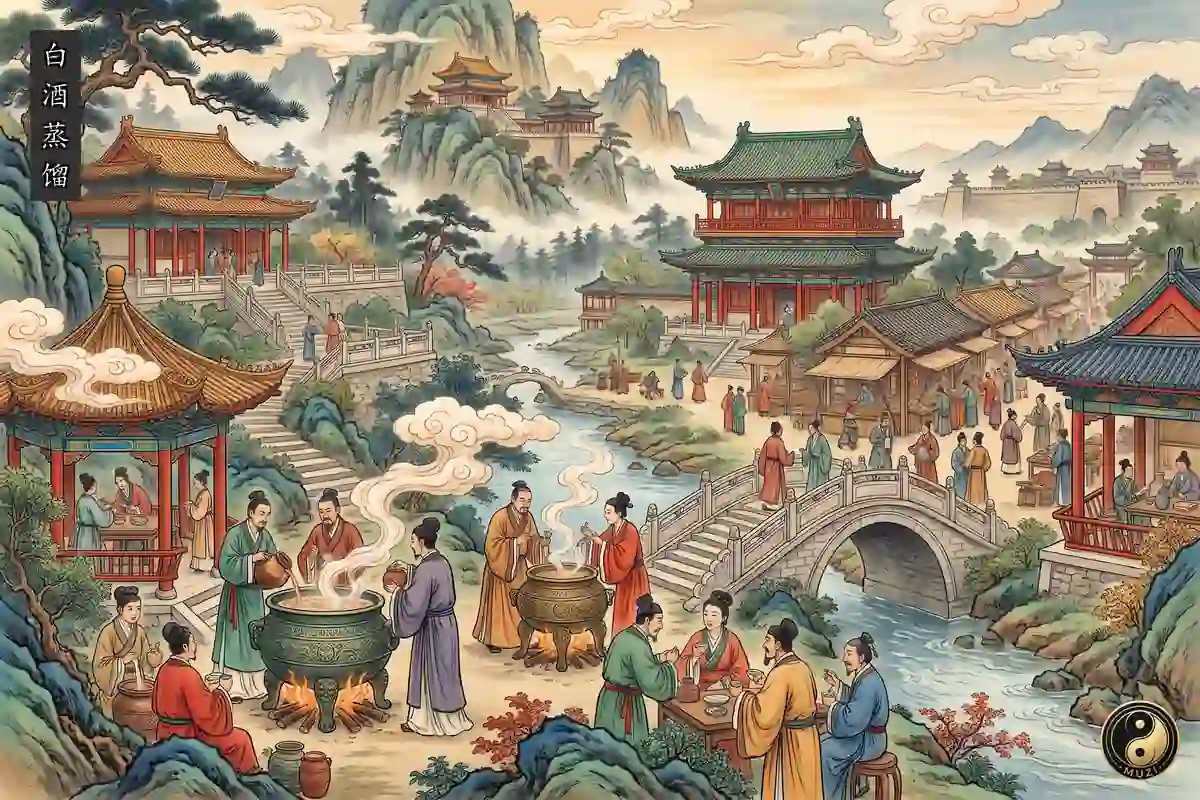
The large steaming bronze vessel at lower left is the central apparatus for liquor distillation.
Collecting Distillate
Figures beside the smaller central vessel show the collection of distilled liquor.
Fire Heating
The fire below the lower-left vessel heats the mash and drives vapor upward.
Liquor Tasting Table
The lower dining group drinking from cups shows distilled liquor entering banquet custom.
In a distillery, fermented grain mash is heated in a wok-like still, the vapour rising to be condensed by a cold-water pan above, and clear baijiu drips from the spout as the master tastes each cut. The chemical leap from low-degree brewing to high-proof solid-state distillation.
Spirits, wines and folk drinks are like a jug with two spouts: one pours wine, the other soft drinks; what comes out differs and suits different occasions, yet both come from one jug, and whoever holds it looks at the occasion before tipping it.
Shang wine vessels and oracle-bone wine offerings, and the wine master and drinks master set side by side in the Zhou texts, show that the jug had two spouts early and has been used ever since.
Two old friends met after many years. One brought wine, the other brought sour-plum drink he had made himself.
They drank wine first and talked for a long time, from their own homes to their own children. As it grew hot they switched to the sour-plum drink, and the ice in the cups slowly melted.
Someone nearby asked them, "Which is really better?"
They said, smiling, "It depends on the time and who you are with." When they left, the one who had brought wine left what remained on the table, and the one who had brought sour-plum drink poured what was left into his own jug, saying, "Next time, then."
A year later the two met again. This time the one with the wine had also brought a jug of sour-plum drink, and the one with the sour-plum drink had also brought a small bottle of wine. Each looked at what the other had brought and they both laughed.
Many years later one of them grew old and could no longer drink wine, and drank only sour-plum drink. The other still came with wine, poured a cup and set it opposite, drank his own, and the two still talked for a long time.
Passers-by saw a wine cup and a drinking bowl side by side on the table, and the two old men talking across it, each drinking his own, neither urging the other to change.
Wine and soft drinks each have their occasions, one for gathering and ceremony, the other for thirst and daily life. This class sets them together to show that they are neither the same thing nor opposites, and the same person uses both at different times. (This is an illustrative story, not a historical account.)



 Beer and Highland Barley BrewsUndistilled grain brews other than huangjiu and rice wine, chiefly beer and highland barley brew.
 Blended and Infused LiquorsLiquors made by steeping or blending plants, flowers or fruit into a base of baijiu, huangjiu or another alcoholic drink.
 Sauce-Aroma BaijiuBaijiu of the sauce aroma, known for starter made at a high temperature.
 Strong-Aroma BaijiuBaijiu of the strong aroma, fermented in mud pits and marked by the fragrance of the pit.
 Light-Aroma BaijiuBaijiu of the light aroma, made with separate steaming and distilling and a daqu starter.
 Other Baijiu Aroma StylesBaijiu aroma types other than the sauce, strong and light aromas.
 HuangjiuHuangjiu, fermented from glutinous rice, millet or wheat and then pressed.
 Rice and Fruit WinesRice wines of the sweet fermented-rice kind, and wines brewed from fruit.
 Kumis and Dairy DrinksFermented mare's milk, and the other drinks made from milk.
 Sour Plum and Other Soft DrinksSour plum drink and the other non-alcoholic drinks made from plants and grain.
 Sweet SoupsSweet soups served as dessert, such as mung bean soup.
 Drinking CustomsDrinking etiquette, the manners of urging a drink and drinking games.
 Canon
 Literature
 Compendium of Materia Medica
 Bring in the Wine
 Essential Techniques for the Common People
 People
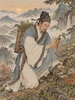 Li Shizhen
 Fu Hao
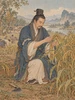 Jia Sixie
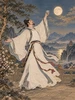 Li Bai
 Ying Shao
 Flavor