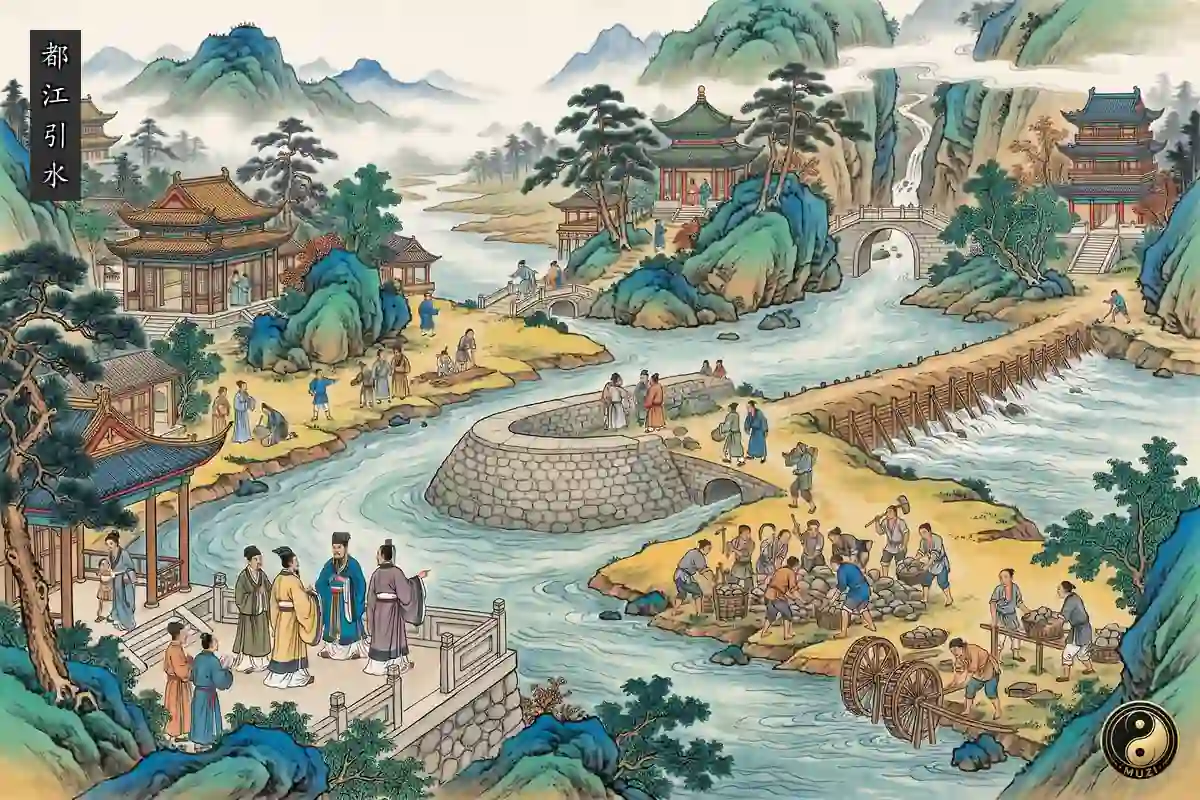


For the date and make-up of Dujiangyan, the UNESCO World Heritage page says the irrigation works were begun around 256 BCE, modified and enlarged under the Tang, Song, Yuan and Ming, and uses the lie of the land and the behaviour of the water to draw off irrigation water, shed silt, control floods and regulate flow without dams; at the head of the works are three key parts, the Yuzui bypass dike (the Fish Mouth), the Feishayan floodgate (the Flying Sand Weir) and the Baopingkou diversion passage (the Bottle-Neck Channel), and today it irrigates 668,700 hectares of farmland. Another place on the same page says it was begun in the 2nd century BCE, which does not agree with the opening statement; this text follows the opening statement, around 256 BCE, and leaves the two accounts side by side.
Dujiangyan came after Qin took Shu. The "Biography of Zhang Yi" in the Records of the Grand Historian (Shiji) says Sima Cuo urged King Hui of Qin to attack Shu, giving as his reason that "to take its land is enough to enlarge the state, and to take its wealth is enough to enrich the people and equip the army"; the result was that "once Shu belonged to Qin, Qin grew stronger, richer and more thickly peopled, and looked down on the other lords". That passage says nothing of water works. They appear in the Treatise on Rivers and Canals (Hequ shu): "The Governor of Shu, Bing, cut through Lidui, removed the harm of the Mo River, and opened two rivers through Chengdu. These channels could all carry boats, and what was left over was used for irrigation, so that the people enjoyed the benefit." The Shiji says only "Bing, Governor of Shu"; the Chronicles of the Land South of Mount Hua (Huayang guozhi), "Shu Annals", is the one that states "King Xiaowen of Qin made Li Bing the Governor of Shu", says he "knew the heavens and the earth", that he "dammed the river and made the embankment", and "divided the branch streams so that they ran in pairs past the commandery", letting boats pass. The editor's note on that page places Li Bing's governorship between 256 and 250 BCE; the main text names only King Xiaowen of Qin, with no year; the UNESCO page has around 256 BCE. The three are set side by side here, unmerged.
The Huayang guozhi then records what these works achieved: "He also irrigated three commanderies and opened rice fields. So Shu became a fertile plain of a thousand li, called the Land Sea. In drought he drew water in to soak the fields; in rain he shut the water gates." An editor's note says that "flood and drought were answered by human hand" and "no year of famine, so that the world called it the Land of Heaven" are taken from Qiao Zhou's Records of Shu (Shu ji), while the main text introduces them with "as the record says". It was not only fields: "on the Min mountains grew many catalpa, cypress and great bamboo, which tumbled down with the current and brought timber with no effort, saving labour and giving plenty", and he also "knew the veins of the salt water and dug the salt wells of Guangdu, and the pools and ponds". Timber came down on the water, and salt wells and ponds stand in one passage; here water becomes transport, resources and livelihood together.
The book also writes legend alongside engineering. Li Bing "made three stone men" and "made a pact with the river god: when the water falls it must not pass the foot, and in flood it must not cover the shoulder"; the Mo River at Qingyi, "its currents swift, wrecking boats, was a trouble through the ages", so "Bing sent out conscripts to level the cliff and open the true channel of the water", and then comes one more line, "Some say that when Bing was cutting the cliff the water god was angry, and Bing took a knife into the water and fought the god". The first is conscripts cutting a cliff; the second begins "some say"; the book keeps the two apart.
After the water works come schools. The Huayang guozhi records that "at the end of Emperor Wen's reign, Wen Weng of Lujiang became Governor of Shu"; Wen Weng "cut the mouth of the Jian River and irrigated 1,700 qing of fields in Pi and Fan", "set up a school and chose sons of officials to study", and sent Zhang Shu and seventeen others "east to the Erudites, to receive the Seven Classics and come back to teach them"; "Emperor Jing approved, and ordered all commanderies and kingdoms in the empire to set up schools; Weng began this teaching, and Shu was the first". The two things sit side by side in the book: a governor opened a channel to irrigate fields and also founded a school, and the court then spread the founding of schools to all commanderies and kingdoms.
Historians have set two of Qin's waterworks side by side: the Treatise writes of the Zheng Guo canal that "so Guanzhong became a fertile plain, with no year of famine, and Qin grew rich and strong and finally swallowed the lords"; for Shu it has only the few lines on the Governor of Shu, Bing quoted above. No text joins "Qin grew stronger" directly to Dujiangyan. To say that Dujiangyan underpinned Qin's strength is to join the "richer and more thickly peopled" of the Zhang Yi biography to the "fertile plain of a thousand li" of the Huayang guozhi: an inference, this essay's reading, not any page's own words. What can be confirmed are two points on the UNESCO page: the works are still in use, and the page calls them a major landmark in the history of water management and technology.
Set beside other canons, Dujiangyan matches up in four places. The Treatise on Rivers and Canals records the Governor of Shu, Bing together with Xuanfang, so Yellow River Harnessing is the other end of the same chapter: the Yellow River has to be confined against harm, the Min drawn off for benefit. The Guangdu salt wells are written in the same passage as the irrigation, and with Salt & Transit Monopolies they are one kind of resource, salt revenue. The Treatise is part of the Records of the Grand Historian, which is the work that canon is about. And when Wen Weng sent men to "receive the Seven Classics", it was an early stretch of the line that Confucian Classics treats, the handing on of the Confucian texts.
The Shiji recorded only three words, "Bing, Governor of Shu"; the Huayang guozhi added Li Bing's name and "a fertile plain of a thousand li"; one governor opened a channel to irrigate the fields and also founded a school, and the court then ordered the commanderies and kingdoms to do the same; and today the UNESCO page still says that Dujiangyan irrigates more than 660,000 hectares of farmland. The water has gone on flowing, and those who write about it have gone on writing, and this is how the canon has stood.
Dujiangyan Water Project is the class in the chapter on Infrastructure on the Dujiangyan waterworks, created by Li Bing and his son. Three works, the Fish Mouth, the Flying Sand Weir and the Bottle-Neck Channel, led the water off without a dam and cleared the silt automatically, and made the Chengdu plain a land of plenty secure against drought and flood.
 Literature
 Records of the Grand Historian
 Records of the Lands South of Mount Hua
 People
 King Xiaowen of Qin
 Atlas
 Dujiangyan Irrigation System