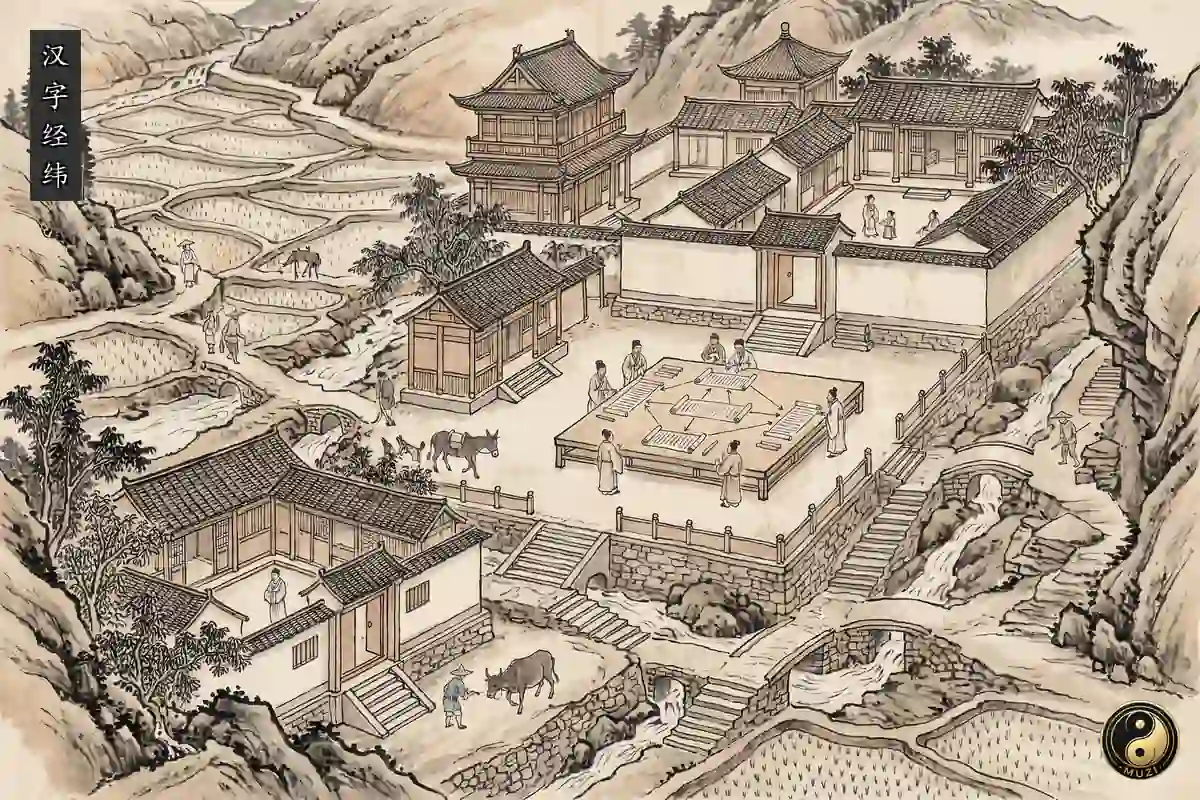
Chinese Characters is first of all a tradition of writing that fixes sound, meaning and shared memory in forms that can be passed on. The oracle-bone inscriptions of Yinxu date to the Late Shang (about 1250–1045 BCE), and the script appears fully developed; the oracle bones mostly record questions put about sacrifices, harvests, weather and military campaigns. From the beginning, therefore, writing was bound up with royal divination, record-keeping and ritual order. It is not a set of shapes cut off from use, but a cultural form that lets people, events and institutions leave traces that can be checked again.
Its core is the bond between form, sound and meaning. The oracle-bone materials show that the shapes of characters could carry divination and record-keeping; Confucius said, "In words, it is enough that they get the meaning across," asking language to reach what it means to express. In the postface to the Shuowen jiezi, Xu Shen of the Eastern Han traced the origins of writing, explained the making and use of characters through the Six Categories, and linked forms, glosses and readings through radicals, so that Chinese writing gained a classic that explains its own structure in turn. The postface says that when Cangjie "first made writing, he followed kinds and imitated shapes, and so they were called wen; afterwards form and sound were added to each other, and so they were called zi", presenting the difference between wen and zi as a development in the making of characters.
This warp and weft has clear points in time. After Qin unified the realm in 221 BCE it carried out "the same script for writing": according to the postface to the Shuowen jiezi, the chancellor Li Si asked to "abolish whatever did not agree with the Qin script", and the small seal script became the single script; the Basic Annals of the First Emperor of Qin in the Records of the Grand Historian records "the same script for writing" together with "one standard for laws, weights and measures, and the same gauge for carts", which shows that writing was treated as a state standard of the same kind as weights and measures. Around 100 CE, Xu Shen of the Eastern Han completed the Shuowen jiezi, analysing the structure of characters through the Six Categories. The Qin standard let edicts, statutes and registers be copied, read and checked in the newly joined commanderies and counties, while Xu Shen's analysis brought changing forms into a classification that could be discussed; both remained within a tradition that later ages collated again and again.
Its effect on history falls on how the state governed and how society remembered. A unified script gave administration across regions a common standard, so that edicts, statutes and local registers could build up into a tradition of documents; the Treatise on Literature in the Book of Han used "the writings of the Six Arts" to organize the collected books, and writing thus also became a way of ordering knowledge. In the Postface of the Grand Historian, Sima Qian organised people and periods into basic annals, hereditary houses and biographies, and said that the eight treatises dealt with "the bounds between heaven and humankind"; writing then not only preserved events but also arranged the order and causes of memory. Xu Shen's Shuowen, the dictionaries of later dynasties and the commentaries of classical learning also let offices, schools, temples and families keep checking old words as they copied them.
Its influence on culture reaches beyond literacy. Confucius's idea of words that "get the meaning across" became an aim of prose; the Treatise on Calligraphy by Sun Guoting of the Tang discusses the force of the brush and the temperament of regular, cursive, clerical and seal scripts, showing that the same set of forms could become calligraphy in the wrist, in composition and in style. The classics entered education through copying, teaching, commentary and the examinations, while stone inscriptions, genealogies, contracts, letters and colophons carried the experience of lineages, trades and individuals into social memory; variant forms, popular forms, borrowed characters and the disputes between standard and popular forms are the very places where later readers reread the characters and revised their interpretations.
It and five other canons support one another. With Slips & Scrolls: bamboo, wood and silk limited the length of a text, and they also preserved early administrative and scholarly writing. With Ritual Music and Dance: the oracle bones recorded sacrifices, and the ritual books wrote forms of address and ceremony into an order that could be performed again. With Confucian Classics: the classics were handed down through their wording, and glosses and commentaries set how later ages would understand them. With Records of the Grand Historian: the Records arranged people of past and present in writing, making writing both memory and judgement. With Painting & Xuan Paper: characters moved from record to the art of brush and ink, and paper widened copying, mounting and circulation.
Chinese Characters became a canon not because the forms never changed, but because writing kept carrying government orders, classics, history and feeling between a shared standard and local hands: the Late Shang oracle-bone script appears fully developed and served royal divination and record-keeping; the Qin "same script for writing" was set beside "one standard for laws, weights and measures" as a standard of the state; Xu Shen's Shuowen jiezi set out the principles by which characters are made through the Six Categories; Sima Qian arranged past and present in basic annals, hereditary houses and biographies; and calligraphy turned characters to be read into beauty to be seen. Without this script, the later study of the classics, the writing of history and the art of calligraphy would all lose their common medium.
Chinese Characters is the class in the chapter on Letters on Chinese writing, how this mature script formed and was put in order. The Yinxu oracle bones are its earliest evidence, after the Qin unification the policy of "same script" standardised writing on the small seal script, and Xu Shen of the Eastern Han completed the Shuowen Jiezi, analysing character structure by the six principles. Chinese characters unite form, sound and meaning and also gave rise to calligraphy.
 Literature
 Records of the Grand Historian
 People
 Confucius (Kongzi)
 Li Si
 Sima Qian
 Xu Shen
 Treasures
 History
 Standardization of Systems