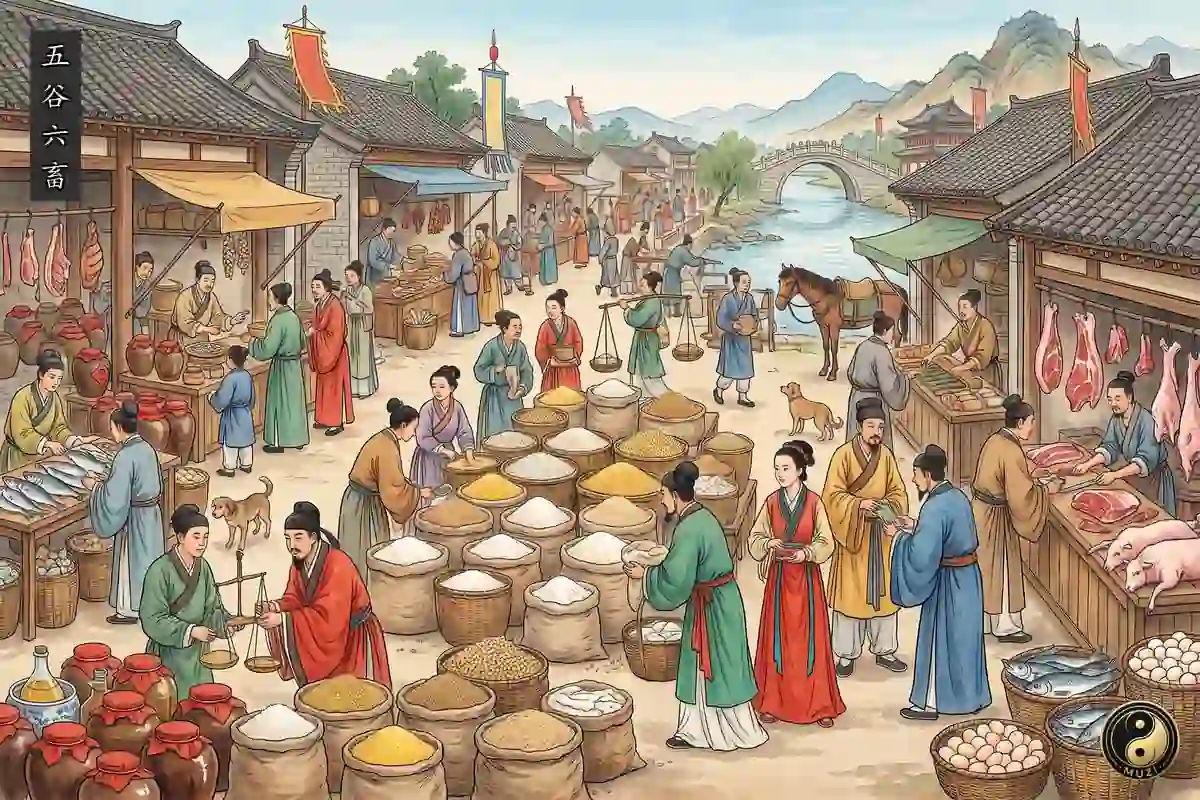
Pigs, cattle, sheep, and poultry have different domestication histories. Research places pig domestication in northern China between 10,000 and 9,000 years ago, locates the domestication of cattle and sheep in western Asia, and records their introduction into China before 4,500 years ago. Chicken origins remain disputed. Their presence in northern China before 3,600 years ago does not settle where they originated. A Northern Wei agricultural treatise includes material on raising cattle, sheep, pigs, and chickens, treating their husbandry as a subject for detailed description. A Yuan food treatise lists butter and curds from cow's milk, curds from sheep's milk, and three grades of mare's milk. These entries show that dairy foods were listed as food; they do not describe preparation or preservation.
Accounts of meat and fish preservation describe soaking, shade drying, and hanging. An agricultural treatise describes five-flavor dried meat made from beef, mutton, or pork, soaked with fermented soybean liquid, salt, scallion whites, pepper, ginger, and tangerine peel, then threaded onto thin cords and dried beneath the north eaves. White dried meat is soaked in clarified salt water with ground pepper, removed after two nights, and shade dried. Goose, chicken, duck, and raw fish also appear among ingredients suitable for curing. Snakehead fish is prepared from the beginning of the eleventh month through the end of the twelfth month, then hung beneath the north eaves to freeze through winter. Months follow the original text and are not converted to the Gregorian calendar. The chapter does not describe smoking. Jinhua ham undergoes low-temperature salting between the Beginning of Winter and the following Beginning of Spring, followed by dehydration at moderate temperatures and fermentation at higher temperatures. It matures after the summer dog days begin and is shaped like a bamboo leaf or pipa through shaving, cutting, trimming, and pressing. Xuanwei ham is described as having emerged no later than the end of the Ming dynasty and having become known in 1727, the fifth year of the Yongzheng reign. An account of Longxi cured pork describes salting for about 40 days before hanging it to dry.
Accounts of aquatic foods cover eating, seasonality, cultivation, and sale. Ancient poetry places fresh fish at a farewell banquet, while a ritual text records the presentation of wei fish in late spring. A historical work mentions fishpond enterprises, and a Northern Wei agricultural treatise includes a chapter on raising fish. Winter night markets in a Song city sold clams and crabs; Hangzhou also had fish, crab, and fresh-fish markets. A Qing food manual compares eels from lakes and streams with those from rivers, mentions eating shad in the third month and the hardening of knife anchovy bones out of season, and describes fresh fish, ark clams, and other clams as foods that may lose tenderness even with brief cooking. These are that manual's observations on individual fish and shellfish. For rice, see Rice; for other grains, Plant Foods; for wheat foods, Flour Foods; and for pastries, Pastries & Snacks. Festival customs belong under Food Customs and the Lunisolar Calendar.




 Dairy FoodsSolid and semi-solid foods made from the milk of cattle, sheep, horses and other animals, such as butter and milk skin.
 Braised and Sauced Cooked MeatsMeat and poultry simmered in a seasoned sauce or brine stock until the flavour is in, ready to eat as they are.
 PorkPigs as food: breeds, cuts, blood and offal.
 Beef and MuttonBeef, mutton, lamb, goat and yak meat, with their breeds and cuts.
 Poultry and EggsChicken, duck, goose and other poultry, with their eggs and egg products.
 Freshwater Fish, Shrimp and ShellfishFish, shrimp, crab and molluscs from rivers, lakes and ponds.
 SeafoodSea fish, shellfish, sea cucumber, seaweed and the dried foods of the sea.
 HamDry-cured ham, mostly from the pig's hind leg, salted, air-dried and fermented.
 Cured Pork and SausagePork cured in the twelfth month and air-dried or smoked, and sausages.
 Dried JerkyAir-dried and heat-dried meats such as beef jerky and rou fu.
 Smoked FoodsMeat, fish and poultry smoked over wood, rice or other materials.
 Salted FishFish preserved by salting, drying or curing.
 Canon
 Flavor