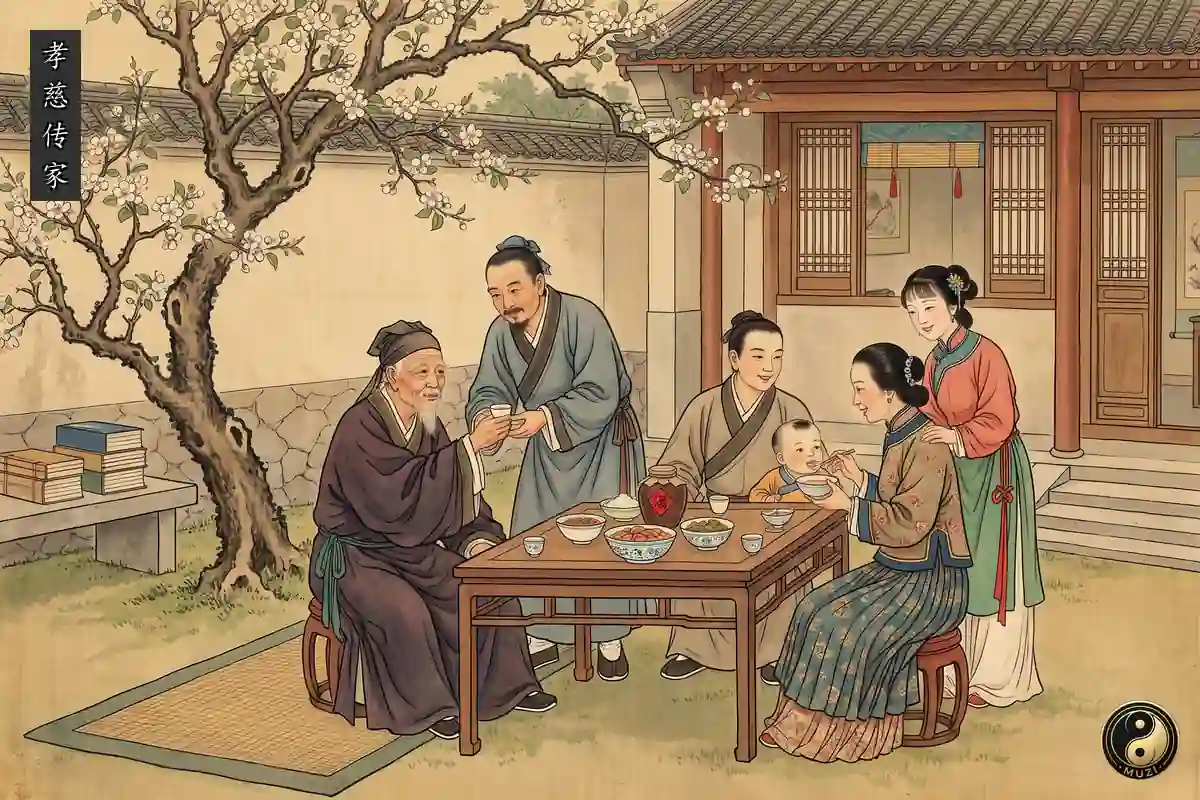
That filial piety began as reverence for ancestors is the account given by Yuejia Wang, a scholar at Qufu Normal University, in a 2023 review. The review says that the character for xiao was first seen in Yin oracle-bone inscriptions and also appears in Shang and Zhou bronze inscriptions; the Western Zhou was the period when the idea of filial piety flourished, and xiao then chiefly meant reverence for and sacrifice to deceased parents and ancestors. Wang also holds that Confucius was the innovator who brought living parents into filial piety. Confucius told Ziyou: "Filial piety today means being able to feed one's parents. But even dogs and horses are fed; without reverence, what is the difference?" To Meng Yizi he said: "While they live, serve them by ritual; when they die, bury them by ritual and sacrifice to them by ritual." (Analects, Weizheng) In the Liren chapter he also speaks of what to do when parents are in the wrong: "In serving one's parents, remonstrate gently; if one sees that they will not follow, remain reverent and do not oppose them, toil and do not complain." And: "While one's parents are alive, do not travel far; if you travel, have a fixed destination." Here filial piety became everyday care for living parents. Alongside xiao stands ci, a parent's kindness: the Liyun chapter of the Book of Rites lists ten "human duties", beginning with "kindness in the father, filial piety in the son, goodness in the elder brother, deference in the younger", so the duties between generations run both ways.
At the end of the Warring States period the Classic of Filial Piety was composed, raising xiao to a systematic ethic. Its opening chapter says: "Filial piety is the root of virtue and the source from which teaching grows." It also says: "Body, hair and skin are received from one's parents, and not daring to harm them is the beginning of filial piety; to establish oneself, walk the Way and make one's name known to later ages, bringing honour to one's parents, is the end of filial piety." "Filial piety begins with serving one's parents, continues in serving one's lord, and ends in establishing oneself." Filial piety thus reached from care within the household to holding office and to a life's standing.
Filial piety entered the system of choosing officials, and it entered the penal code. In the eleventh month, winter, of the first year of Yuanguang (134 BCE), Emperor Wu of Han "first ordered the commanderies and kingdoms each to recommend one filial and incorrupt man" (Book of Han, Annals of Emperor Wu). Six years later, in the first year of Yuanshuo, the officials memorialized: "Not to recommend the filial is not to obey the edict, and should be judged as disrespect; not to examine the incorrupt is to be unfit for office, and should mean dismissal." Recommending filial sons went from encouragement to a duty that local officials had to fulfil. The Biography of Dong Zhongshu in the Book of Han also says that "the recommendation of the talented and of the filial and incorrupt by provinces and commanderies all started with Zhongshu". The Classic of Filial Piety says that "the enlightened kings of old governed the realm by filial piety", and the Han claimed to rule the realm through filial piety. In the Tang, filial piety was written into the penal code. The Tang Code with Commentary lists the "ten abominations", "the seventh is being unfilial"; the note lists accusing or cursing grandparents or parents, setting up a separate household register or dividing property while grandparents or parents are alive, failing to provide for them, marrying, making music or putting off mourning dress during mourning for a parent, and concealing news of a death without mourning; the commentary says that "among the five punishments, the ten abominations are the gravest, damaging the teaching of names and tearing the official cap". This matches the Classic of Filial Piety: "The offences under the five punishments number three thousand, and none is greater than being unfilial."
How filial piety was taught also provoked reflection. In 1926 Lu Xun wrote the memoir essay "The Pictures of the Twenty-Four Filial Exemplars", later collected in Dawn Blossoms Plucked at Dusk. Reading the story of Guo Ju burying his son, he wrote: "But by then I not only no longer dared to think of being a filial son myself, I was afraid that my father would become one." Of Lao Lai amusing his parents he said it "made the unfeeling into a moral rule, slandered the ancients and taught later people badly". What he opposed was not caring for one's parents but turning filial piety into a performance against human feeling.
Filial piety stands where several lines of ethics meet. With Benevolence: in the Xue'er chapter of the Analects Master You says that filial piety and fraternal respect are "surely the root of benevolence", so benevolence spreads outward from filial piety at home. With Loyalty: the Classic of Filial Piety says that "the gentleman serves his parents with filial piety, and so his loyalty can be transferred to his lord", leading filial service to parents straight into loyal service to the ruler. With Rituals: in answering Meng Yizi, Confucius required life, death, burial and sacrifice all to accord with ritual, so that filial piety gained a concrete form through ritual. With Kinship: the Classic of Filial Piety goes on, "he serves his elder brother with deference, and so his obedience can be transferred to his seniors", and the Liyun sets "goodness in the elder brother, deference in the younger" beside "kindness in the father, filial piety in the son", so filial and fraternal duty belong to one household ethic.
Filial piety travelled from the ancestral altar into the court and the penal code: the Western Zhou used it to honour the ancestors, Confucius turned it toward living parents, the Classic of Filial Piety called it "the root of virtue", the Han chose officials as filial and incorrupt and held officials to account for failing to recommend them, and the Tang Code listed being unfilial among the ten abominations. It also ties together benevolence, loyalty, ritual and the bond between brothers. And precisely because it was raised so high, Lu Xun recoiled at the story of Guo Ju burying his son, reminding readers that filial piety ought to accord with human feeling.
Filial Piety is the class in the chapter on Values on the ethic between old and young in the family: mutual respect, and care repaid with gratitude. Western Zhou bronze inscriptions already read "to offer filial service" to the ancestors, the Classic of Filial Piety of the late Warring States called filial piety "the root of virtue", and Emperor Wu of Han had the commanderies recommend the filial and incorrupt, the Han claiming to rule the realm through filial piety.
 Literature
 Tang Code with Commentary
 People
 Confucius (Kongzi)
 Emperor Wu of Han (Liu Che)
 Treasures