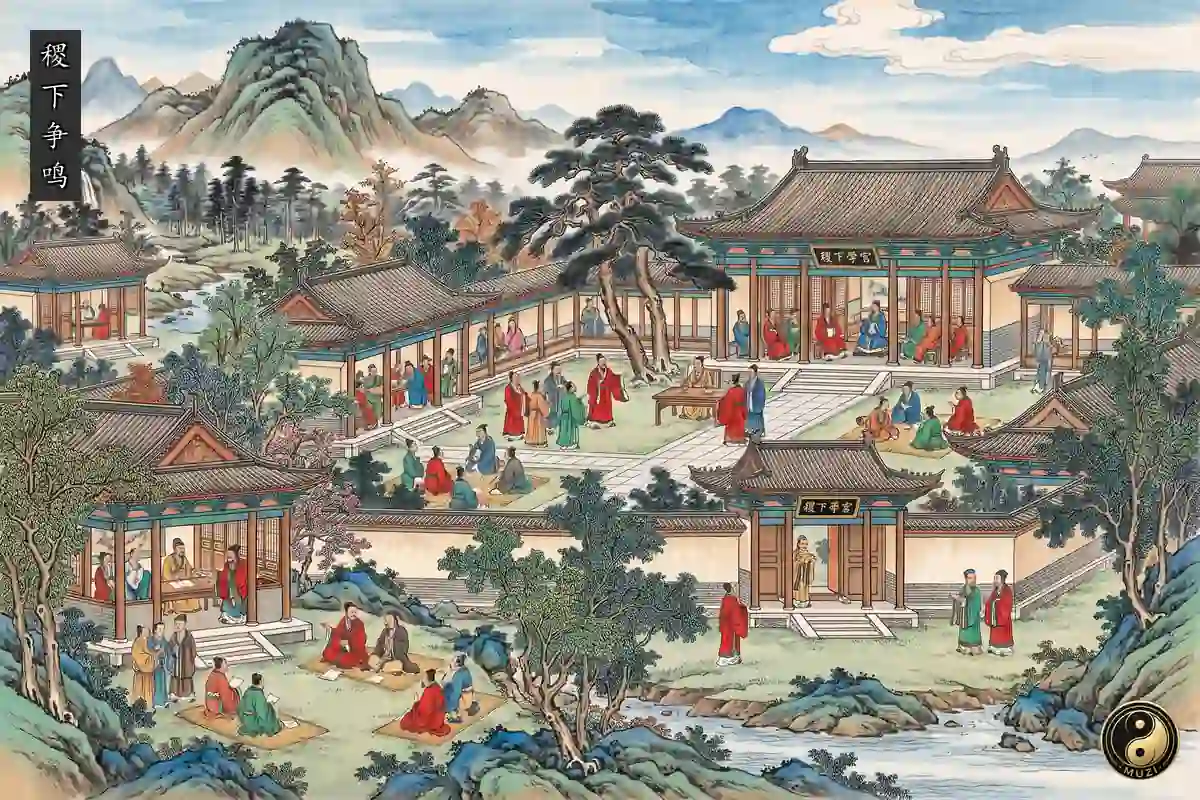
By one account the Jixia Academy took its name from a city gate. The Suoyin commentary to the Records of the Grand Historian says: "Jixia was a gate of the city of Qi," and records another view: "some say Jixia was the name of a hill; it means that the scholars of Qi gathered beneath the Ji Gate." A report on CCTV News relayed by Hunan Daily's new-media arm says that, according to historical records, the Jixia Academy was founded in 374 BC and lasted more than 150 years. Who founded it is not told the same way in every book: Xu Gan of the Han writes in the Zhonglun (Balanced Discourses), "Formerly King Xuan of Qi set up the Hall of Jixia, instituted the title of Grand Master, and drew in worthy men and honored them"; the "Hereditary House of Tian Jingzhong Wan" in the Records of the Grand Historian records under King Xuan that "the scholars of Jixia flourished again, numbering several hundred or even a thousand," and says nothing about a founder.
King Xuan of Qi "was fond of men of letters and itinerant persuaders." Seventy-six of them, among them Zou Yan, Chunyu Kun, Tian Pian, Jiezi, Shen Dao and Huan Yuan, "were all given mansions and made Senior Grand Masters; they held no office but discussed affairs." The "Biographies of Mencius and Xun Qing" adds detail: from Chunyu Kun on down they were "all styled Grand Masters, and for them were opened mansions on the thoroughfares, with lofty gates and great houses, to honor them," the purpose being "to show that Qi could draw the worthy men of the realm." The Censor in the Discourses on Salt and Iron is a critic, and yet he too admits that these men "drew the salary of a Senior Grand Master, held no post, and discussed affairs of state." The authorities supplied mansions and stipends; the scholars held no post and only debated. That was the Jixia arrangement.
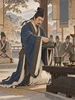
What they debated was not uniform. Zou Yan "cited the world from the splitting of heaven and earth onward, the shifting of the Five Virtues, and how each rule had its fitting time." Shen Dao, Tian Pian, Jiezi and Huan Yuan "all studied the arts of Huang-Lao and the Way and its Power." Chunyu Kun was "widely learned and of strong memory, and followed no single master." Xun Qing came to study in Qi at fifty and later "three times served as Libationer." In Against the Twelve Masters he names and criticizes "Shen Dao and Tian Pian," saying their teaching "honors law yet lacks law," and also criticizes how "Zisi led and Mencius echoed." Tian Pian, whom he criticizes, is among the Jixia masters listed in the Records of the Grand Historian.
Whether Mencius counts as a Jixia master is told differently in the sources. The Records of the Grand Historian says under Mencius only that he "went to serve King Xuan of Qi, but King Xuan could not use him," and he is not on its list of Jixia masters; the Censor in the Discourses on Salt and Iron, however, pairs "Mencius and Chunyu Kun and their like," saying they drew the salary of a Senior Grand Master. Bai Xi, for his part, says the debates between Mencius and Chunyu Kun recorded in the Mencius "all took place at the Jixia Academy."
The effect on history has to be judged by what keeping scholars produced. On the side of talent: Xun Qing later left Qi and became magistrate of Lanling in Chu, and among his students, in the record's words, "Li Si was once a disciple and later became chancellor of Qin." On the side of the state: the Censor says "the Confucians' securing the state and honoring the ruler has never shown any effect"; the Literati answer that when King Min would not heed the remonstrance of the scholars, "Shen Dao and Jiezi fled, Tian Pian went to Xue, and Sun Qing went to Chu." Xu Gan's view is that Qi drew in worthy men yet "Qi grew no stronger, because Huang Xie met disaster when he was not heeded," and he adds of such men, "they are for their words and counsels; if the counsels are not used, what good is their number?" On their account the trouble lay in using, not in keeping.
Jixia is tied to several existing canons. First, Masters' Prose: the Records of the Grand Historian says these men "each wrote books on order and disorder, to seek out the rulers of their age"; the Treatise on Literature in the Book of Han lists, under the Yin-yang school, Zou Zi in forty-nine pian, and Zou Zi's Beginnings and Ends in fifty-six pian; under the Daoists, Tian Zi in twenty-five pian; and under the Confucians, Sun Qing Zi in thirty-three pian; and Xun Qing's Encouraging Learning opens with "learning must never cease." Second, Yin-Yang & Five Elements: Sima Qian judges that Zou Yan's "words were grand and unorthodox," that "in the end they came back to benevolence, righteousness and frugality," and that "when kings and nobles first saw his art they were startled and changed, but afterwards could not carry it out." Third, Teaching for All: Confucius took pupils privately, whereas Jixia was funded by the authorities so that "the guests of the lords of the realm" would see that Qi could draw worthy men; the Censor sets Confucius against this, saying that he "taught on the banks of the Zhu and Si, yet his disciples did not change and his age was not set in order." Fourth, Confucian Classics: the Treatise on Literature lists Mencius in eleven pian and Sun Qing Zi in thirty-three pian under the Confucians; one "went to serve King Xuan of Qi," and the other "three times served as Libationer" at Jixia; both had been to Qi.
How do researchers see it today? Bai Xi of Capital Normal University, in a lecture text published in Guangming Daily, says that before it scholars "knew nothing of one another," and that "the key to this great contrast was the founding of the Jixia Academy of Qi and its long existence." According to a report of February 2022, after nearly five years of excavation by the Shandong Provincial Institute of Cultural Relics and Archaeology, a group of building foundations outside the west gate of the small city of the Qi capital at Linzi was "basically identified as the site of the Jixia Academy," with a total area of nearly 40,000 square meters.
Qi gave the scholars mansions and stipends and asked only for debate: Zou Yan spoke of the shifting of the Five Virtues, Shen Dao and Tian Pian studied Huang-Lao, Chunyu Kun followed no single master, and Xun Qing three times served as Libationer and named and refuted his colleagues in Against the Twelve Masters. The lofty gates and great houses were opened on the thoroughfares so that the lords would see that Qi could draw the worthy; yet the Han writers saw that Qi grew no stronger, and Xu Gan asked, "if the counsels are not used, what good is their number?" Kept but not used, the scholars left books: the Treatise on Literature in the Book of Han lists Zou Zi, Tian Zi and Sun Qing Zi. Bai Xi, for his part, sees the founding and long life of Jixia as "the key" to the contrast between the time before it, when scholars "knew nothing of one another," and the contention of the hundred schools that followed.
Jixia Academy is the class in the chapter on Education on the academy at Jixia. It covers the academy that Tian Wu of Qi founded beside the Ji Gate of Linzi in the Warring States period, where the state paid and scholars freely debated; under King Xuan of Qi it reached its height, with hundreds of scholars "debating without governing"; Xunzi served three times as its libationer, and the academy's legacy lasted until Qi fell.
 Literature
 Mencius
 Records of the Grand Historian
 Discourses on Salt and Iron
 People
 Confucius (Kongzi)
 Zi Si
 Mencius (Mengzi)
 King Xuan of Qi
 Xunzi
 Li Si
 Sima Qian
 History
 Hundred Schools Contention
 Atlas
 Shandong