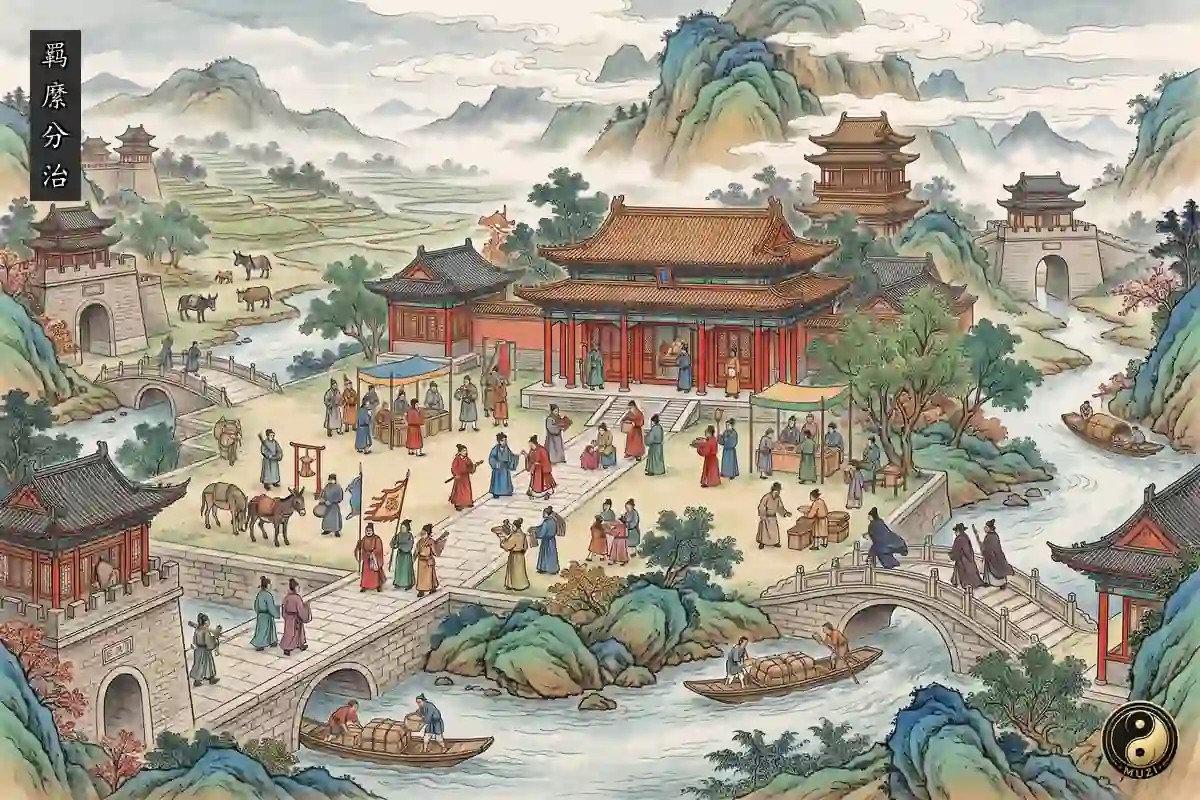
The four characters jimi wu jue, "keep the rein and do not cut it," come from a passage in the Biography of Sima Xiangru in the Records of the Grand Historian. Sima Xiangru had been sent to open a road to the southwestern tribes, and twenty-seven elders and gentry of Shu came to see him; when they had finished their courtesies they said: "We have heard that the Son of Heaven's way with the barbarians is simply to keep them on a loose rein and not cut it off." This was the received view of the time, yet it states the measure plainly: do not let go, and do not pull tight. Later courts turned that measure, step by step, into a practice with official titles, hereditary succession and written rules. What follows takes it in three steps: Han, Tang, Qing.
The Han step is in the Treatise on the Western Regions in the Book of Han. In the second year of Shenjue, the Xiongnu Rizhu king came over with his people; Zheng Ji, the envoy who protected the states west of Shanshan, went to receive him and was enfeoffed as Marquis of An'yuan, and the court "thereupon had Ji protect the northern route as well, and so called the office Protector-General." The Protector-General "oversaw Wusun, Kangju and the other foreign states and reported any stir or change. Where they could be pacified, he pacified them; where they could be attacked, he attacked them," and his seat was at Wulei. The states listed in the treatise still have their own kings and their own counts of households and troops; the state of Ruoqiang, for example, has a king whose title is "Quhulai king." The same treatise records that from Dunhuang west to the Salt Marsh "pavilions were raised here and there," and that "the First Emperor of Qin drove back the Rong and Di, built the long wall and fixed the border of China, yet in the west it did not pass Lintao," while the Han "set out four commanderies and held the two passes." The traffic described in Silk Road and the frontier line described in Great Wall both connect with this Protector-General's charge.
In the early Tang the difficulty fell on people. The Zizhi Tongjian records that after the Eastern Turks fell, some one hundred thousand surrendered to the Tang, and the ministers gave their views. Dou Jing, Military Governor of Xiazhou, proposed to "divide their land and split their tribes, so that their power is weakened and their strength divided and they are easy to rein in"; Wen Yanbo proposed to "keep their tribes whole, follow their customs, fill the empty land with them, and make them a screen for China"; Wei Zheng objected, saying they should be "let go back to their old land and not kept within China." The outcome was that "the emperor in the end adopted Yanbo's plan." Liu Yufeng of Shandong University says in People's Tribune that this took place in the fourth year of Zhenguan (630), when the court set up the Dingxiang and Yunzhong commanderies on the former Turkish land. The Geographical Treatise of the New Book of Tang sums up the method: "Taking each tribe as it was, it set out prefectures and counties. The larger became commanderies, with their chiefs as commandants and prefects, all hereditary. Although tribute and household registers mostly did not go up to the Ministry of Revenue, yet the reach of the court's teaching was all under the border commandants and protectors-general, and was written into the statutes and regulations." It also records "in all eight hundred and fifty-six commanderies and prefectures, called jimi." In the twenty-first year of Zhenguan (647), the Tongjian records an edict making the Huihe tribe the Hanhai Commandery and so on, "each with its chieftain as commandant and prefect"; the tribes then asked to open the "Way of the Heavenly Khan," with sixty-eight relay stations, and to pay "marten pelts yearly as tax"; and Emperor Taizong said to his ministers: "Since ancient times all have honored the Chinese and despised the Yi and Di; I alone love them as one."
The Qing reached the other end of this practice. The Draft History of Qing, in its chapter on native chieftains, records that in the spring of the fourth year of Yongzheng, E'ertai submitted: "To give the people peace one must first bring the non-Han under control, and to bring them under control one must replace hereditary chiefs with appointed officials." He admitted that the Ming division into appointed officials and native chiefs "was originally because of the miasma-ridden new frontier, whose customs were not yet familiar, so it was fitted to the place," but that after several centuries it had come to "govern the barbarians by barbarians, and so govern bandits by bandits"; taking Wumeng as his example, "its grain and money amounted to little more than three hundred taels, yet a hundredfold was taken from below." The chapter says "from the fourth year to the ninth, the barbarians were all brought under appointed officials." Fang Tie records in his article that in the fifth month of the fourth year of Yongzheng (1726) the Changzhai chieftaincy was abolished and Changzhai Subprefecture set up, that the Wumeng and Zhenxiong chieftaincies were abolished in the winter of the same year, that 220 chieftain houses were removed in the Yongzheng reign, and that chieftaincies were kept south of the Lancang River. The change was not calm: the Biography of E'ertai says the chiefs "had held their land for generations, and once it was entered in the registers, their leaders were executed or moved away, none escaping," and then records a fresh rising in Wumeng, with "near and far responding." Chen Weixin (writing in Sixiang Zhanxian, 2018, no. 4) presents this memorial, held in the Palace Museum in Taipei, which contains the passage "where the moment allows a change, change it at once"; but he notes that in the original memorial this passage "was struck through with a red brush," and he reads the memorial as E'ertai urging that the change be carried out at once.
What this practice left behind is more than a few official titles. The first is standing: Liu Yufeng, working from the Tang Liudian and the New Book of Tang, concludes that the Tang "did not rule the jimi prefectures directly from the center," yet the protectorates governed the jimi commanderies and the commanderies governed the jimi prefectures, and "in effect brought all the jimi regions into the Tang administrative map"; the Draft History of Qing, in its chapter on native chieftains, shows chieftains' succession also running through the court: "succession to the Pacification, Pacification-Commissioner, Appeasement and Chief Offices went through the Ministry of War, and to native prefectures and subprefectures through the Ministry of Personnel." The second is cost: the New Book of Tang itself says "afterwards some submitted and some rebelled, and the regulations were not uniform," and the Draft History of Qing says that in the Ming, putting down Bozhou, Shuixi and Luchuan "all used armies of hundreds of thousands and drained the strength of the realm before they were levelled," so Yunnan, Guizhou, Sichuan and Guangxi "always took the chieftains as the measure of order and disorder." The third is culture: Fang Tie writes that the Mu chieftains of Lijiang promoted Confucian learning from the mid-Ming, that the four characters on the archway beside the Mu mansion, "Tianyu liufang," mean "go and study" in Naxi, and that the Wanjuan Tower held books "of Song and Ming editions by the ten-thousand." Settling the frontier peoples also entered the counsels of planners: the Records of the Three Kingdoms, in the Biography of Zhuge Liang, carries the speech described in Longzhong Plan, with the line "make peace with the Rong in the west and soothe the Yi and Yue in the south"; Dou Jing's "power weakened and strength divided" can be set beside the use of division and union to find balance described in Balance of Power, though this is a comparison, and the sources themselves do not say so.
Without this practice, facing frontiers whose customs were "not yet familiar," the court would have lacked the road between sending troops to stay and letting go entirely. That road had to be held up at both ends, by law and by force.
"Do not cut," as the Shu elders said, is only half of jimi; the other half is standing and rules. The Han court set up a Protector-General and the kings of the states stayed in place; the Tang court gave chiefs the titles of commandant and prefect with hereditary succession, and the New Book of Tang counts eight hundred and fifty-six commanderies and prefectures; the Draft History of Qing records that chieftains' succession passed through the Ministries of War and Personnel. In the fourth year of Yongzheng, E'ertai called for an end to centuries of governing "barbarians by barbarians" and a turn to appointed officials. A practice that ran for centuries, and was then ordered changed with such gravity, has its gains and its losses written in these very texts.
Loose-Rein Rule is the class in the chapter on Strategies on how the borderlands were governed. It covers the indirect rule that central dynasties exercised over tribal areas on the frontier: tribal chiefs were invested with titles and allowed to hold hereditary posts as military commissioners and prefects, with their self-rule kept. The Western Han set up the Protectorate of the Western Regions as the first step, the Tang loose-rein prefectures took shape, and after the Yongzheng-era reform of replacing native chiefs with appointed officials the areas were governed directly.
 Literature
 Comprehensive Mirror for Aid in Government
 People
 Qin Shi Huang (Ying Zheng)
 Wei Zheng
 History
 Opening of the Silk Road
 Atlas
 Forbidden City