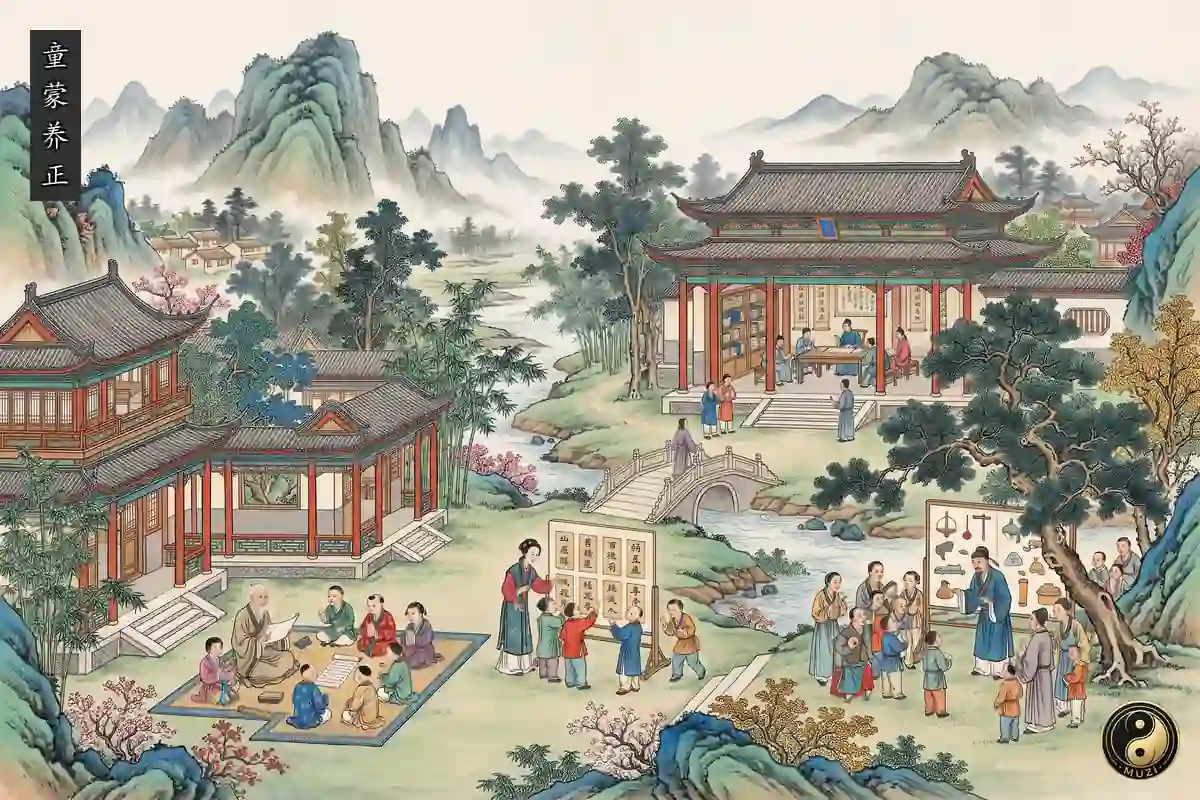
Teaching a child began with learning characters. Xu Yong, professor in the School of Education at Capital Normal University, says that before the Sui and Tang every primer, "without exception, was a reader for learning characters". The Treatise on Bibliography in the Book of Sui lists a long run of such books under elementary learning, among them "the Thousand Character Classic, one scroll, by Zhou Xingsi, Gentleman Attendant of the Liang", and also a commentary by Xiao Ziyun, Libationer of the Liang Directorate of Education. The Biography of Zhou Xingsi in the Book of Liang records that texts for the Liang emperor Gaozu, among them "Rhymed in Sequence the Thousand Characters of Wang Xizhi's Calligraphy", were all assigned to Zhou Xingsi, and that "at each presentation, Gaozu invariably praised it". Xu Yong sums the book up as one thousand non-repeating characters chosen from Wang Xizhi's writing and arranged in 250 lines of four characters each; there are nearly fifty Dunhuang manuscripts of the Thousand Character Classic, many of them children's writing exercises.
The Thousand Character Classic opens "Heaven and earth, dark and yellow; space and time, vast and wild", goes on to history, human relations and capitals, and has lines such as "Filial piety: give it all your strength; loyalty: give it your life", "Brothers are deeply bound, branches of the same breath", and "Excel in study and you rise to office; take a post and share in government". The Hundred Family Surnames opens "Zhao, Qian, Sun, Li; Zhou, Wu, Zheng, Wang"; Xu Yong says it "simply lists surnames, arranged at will," yet also calls it "the most outstanding representative" of the new literacy readers of the Sui, Tang, Five Dynasties and two Song periods. The Three Character Classic opens "At birth, people are by nature good"; Xu Yong calls it a text urging study, which spends much of its length on arithmetic, the classics, history and general knowledge, and adds many stories of diligent learners.
The three books' dates are reported differently, and the several accounts are set side by side here without a verdict. The Three Character Classic has long been handed down as the work of Wang Yinglin; when Zhang Taiyan revised it in 1928, his preface still wrote "handed down as written by Wang Bohou", and said that the parts from the Liao and Jin onward were "continued by people of the Ming and Qing". Another view, Li Jianming's, holds that the author was Ou Shizi of Shunde in Guangdong at the end of the Song; an accompanying note describes this view as "suspected of partiality." Xu Yong says the Three Character Classic was "completed in the early Yuan" but came from a Song survivor. The years in which the Hundred Family Surnames and the Thousand Character Classic were completed are given on none of the pages cited here, so they can only be placed by the dynasties that Xu Yong, the Book of Sui and the Book of Liang report.
The books' first effect on history was to connect literacy to the examinations. Xu Yong says that in the Sui, Tang, Five Dynasties and two Song periods, "to meet the needs of the examinations, instruction in all kinds of knowledge became the focus of early education". The Three Character Classic states the route itself: "One who studies must have a beginning; when the elementary stage ends, come to the Four Books", and "When the Four Books are mastered and the Classic of Filial Piety is known, the Six Classics may then be read". Zhang Taiyan's revised edition glosses the Four Books as the Great Learning, the Doctrine of the Mean, the Analects and the Mencius. A child who began with characters was thus led toward the classics treated in the entry on Confucian Classics, and beyond them to the examinations treated in the entry on Imperial Examinations. In the Ming, Cheng Dengji's Youxue qionglin (Jade Grove for Young Learners) put the vocabulary of that road into rhyme; in Volume 4, under "Examinations", it says: "A scholar entering school is said to 'tour the pool' or 'pluck the cress'; a scholar passing the examination is said to 'doff the coarse robe' or 'win the prize'."
In values, Xu Yong points out that early education in the Yuan, Ming and Qing stressed ethics, above all habits of daily conduct, which "is related to Zhu Xi's advocacy": Zhu Xi divided elementary from higher study by content, teaching "affairs" in the first and "principle" in the second. The Three Character Classic speaks in the register of the home teaching treated in the entry on Filial Piety: "To raise without teaching is the father's fault; to teach without strictness is the teacher's laxity", "Xiang at nine could warm the bed mats", "Rong at four could yield the pears". The Thousand Character Classic's "Filial piety: give it all your strength; loyalty: give it your life" runs the same way. The characters it uses are those treated in the entry on Chinese Characters: one thousand without repetition, used both for recognition and for practising writing.
The books have been judged in two ways. When Zhang Taiyan revised the Three Character Classic he compared it with the Thousand Character Classic and said that although the Three Character Classic "has repeated characters and no ornament, it surpasses it in opening people's knowledge", added that today's textbooks "are far worse than the Three Character Classic", and that the added portion made "a third". Xu Yong reminds readers that the content of such primers "mixes the fine and the poor" and that today we need "a historical eye". Taken together, these books were both prized and expected to be read with discrimination.
What to read after learning characters, these small books had already arranged for the child: first the thousand non-repeating characters of the Thousand Character Classic, then the road the Three Character Classic points out, the Four Books after the elementary stage, and the Six Classics only when the Four Books are mastered and the Classic of Filial Piety is known. "To raise without teaching is the father's fault" and "Rong at four could yield the pears" teach the rules of the home, and the Youxue qionglin puts the examination phrases, touring the pool, doffing the coarse robe, winning the prize, into rhyme. Literacy, ethics and the examinations were joined in these books. Zhang Taiyan said the Three Character Classic "surpasses it in opening people's knowledge", while Xu Yong warns that fine and poor are mixed in it.
Primary Education is the class in the chapter on Education on the primers of old for young children, represented by the Three Character Classic, the Hundred Family Surnames, the Thousand Character Classic and the Youxue qionglin (Jade Grove for Young Learners). In easy-flowing rhyme these books taught children to read characters, together with ethics, history and common knowledge.
 Literature
 The Analects
 Mencius
 Three Character Classic
 Book of Sui
 People
 Zhu Xi
 Zhang Taiyan
 Xiao Yan
 Wang Yinglin
 Zhou Xingsi