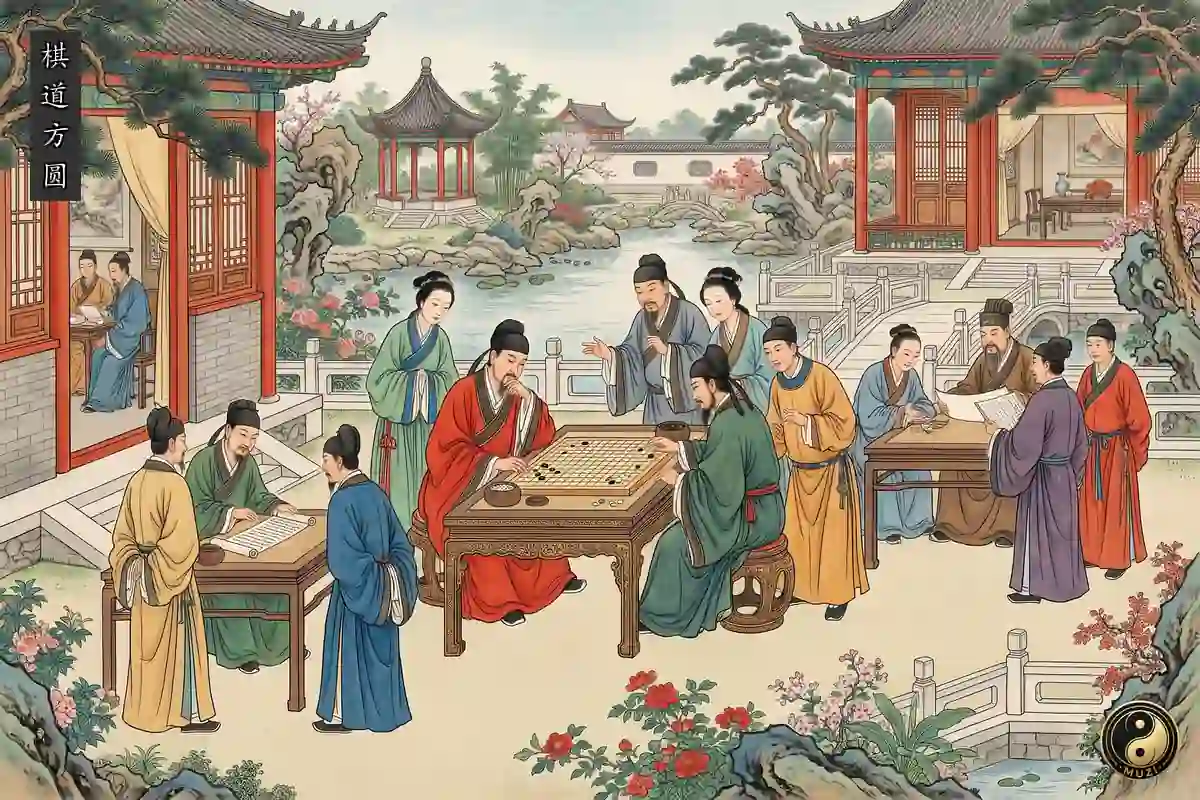
Board Game Strategy (*qi dao fang yuan*) refers to the two strategic thinking instruments of Go (*weiqi*) and Chinese chess (*xiangqi*), corresponding respectively to macro-strategic vision and micro-tactical execution, two fundamentally different cognitive models. Go is a spatial-occupation mechanism: a 19-by-19 grid yields 361 intersections on which every stone is functionally identical, with no hierarchy of rank; players compete for territory through topological encirclement and the creation of eyes, testing holistic judgment, long-range resource allocation, and the resolve to sacrifice lesser positions. Chinese chess operates as a centralized command-and-decapitation norm: a strict hierarchy of pieces (general, advisors, elephants, horses, chariots, cannons, soldiers) divided by the River of Chu and Border of Han, with every tactical action serving the singular objective of eliminating the opposing supreme command node.
The origin of Go predates the Warring States era. In the Analects (*Yanghuo* chapter), Confucius remarked: *bao shi zhong ri, wu suo yong xin, nan yi zai! bu you bo yi zhe hu? wei zhi, you xian hu yi* (To eat one's fill all day and apply the mind to nothing is difficult indeed! Are there not games of strategy? Even playing them would be better than idleness). In Confucius's view, playing board games was at least preferable to complete mental vacancy, confirming that strategic board games were already a familiar pastime by the late Spring and Autumn period. A Western Han 17-line Go board excavated at Dunhuang in Gansu province proves that early boards were not standardized at 19 lines; the 19-line shape was formally established only during the Northern and Southern Dynasties. Go was transmitted to Japan via Tang dynasty envoys, becoming a required accomplishment for the aristocratic and warrior classes during the Nara and Heian periods. The Edo period produced the four great Go houses (Honinbo, Yasui, Inoue and Hayashi), which elevated Go into a fully professionalized competitive discipline.
The origin of Chinese chess is later than that of Go, with its modern form crystallizing during the Tang and Song dynasties. By the Tang era, a game resembling modern chess was already popular among commoners. By the Song dynasty, the basic rules and piece names were essentially identical to those used today. Chess is extraordinarily widespread at the grassroots level in China, from street-side boards to teahouse matches, standing as the most ubiquitous recreational contest in Chinese communities. Its hierarchical piece system, with the general at the top and soldiers at the bottom, each specialist piece possessing its own domain, directly mirrors the bureaucratic ranks and military command structures of traditional Chinese society.
The development of board games across China, Japan and South Korea has produced distinct cultural personalities. Japanese Go pursues the aesthetic of *yugen* (profound mystery): elegant shapes, global equilibrium, and a reluctance to rush into combat. Korean Go is renowned for its ferocious fighting style, where any local imbalance on the board can instantly ignite full-scale warfare. Chinese Go seeks a balance between the two, combining panoramic strategic planning with decisive local combat. The long-term clash and mutual learning among these three styles fueled a revolutionary surge in Go technique during the second half of the twentieth century, with new joseki and opening ideas emerging at a pace far exceeding that of the preceding two millennia.
Since the 1980s, competition among China, Japan and South Korea in Go has constituted the highest arena of East Asian intellectual sport. The Korean player Lee Chang-ho dominated the world stage in the 1990s with sixteen world championship titles; subsequently, Chinese players Chang Hao, Gu Li, and Ke Jie gradually assumed the summit. In 2016, Google's artificial intelligence program AlphaGo defeated the Korean player Lee Sedol four games to one, producing the most sensational event in Go history. It not only transformed the global understanding of artificial intelligence but profoundly overturned humanity's self-understanding of Go, the most complex strategy game to have remained essentially unchanged for millennia.
The decision-making philosophies embodied by Go and chess correspond to two fundamentally different modes of competitive reasoning. Go teaches one to find local advantages within a globally unfavorable position; a single stone in a distant corner of the board may simultaneously threaten multiple regions. Chess teaches one to maximize lethality with limited forces; the coordinated deployment of chariot and cannon forms a long-range fire system. The former is about expansion and trade-offs; the latter is about concentration and annihilation. Each trains a complementary dimension of strategic thinking.
The internal logic of board game strategy is to generate the deepest conceivable strategic space from the simplest conceivable rules: Go's rules fill fewer than ten sentences, and any child can learn chess's rules in ten minutes, yet the number of possible game sequences in each exceeds the number of atoms in the observable universe. This design philosophy of severe simplicity generating severe complexity is what makes them the highest testing platforms for human intelligence. This is precisely why Go and chess have crossed centuries and national boundaries to become enduring symbols of intellectual competition worldwide: with nothing more than wooden and stone pieces as their medium, they map the absolute limits of human decision-making capacity. From Warring States wooden boards to the silicon-based Go of the AI era, the dimensions of the board have expanded to interstellar scales, yet the strategic dialogue between black and white stones has never changed. AlphaGo's victory did not end the civilizational significance of Go; on the contrary, it deepened humanity's awe before the creative thinking spaces among those 361 intersections that remain beyond the reach of raw computational power.